How Credit Card Casino Deposits Actually Work
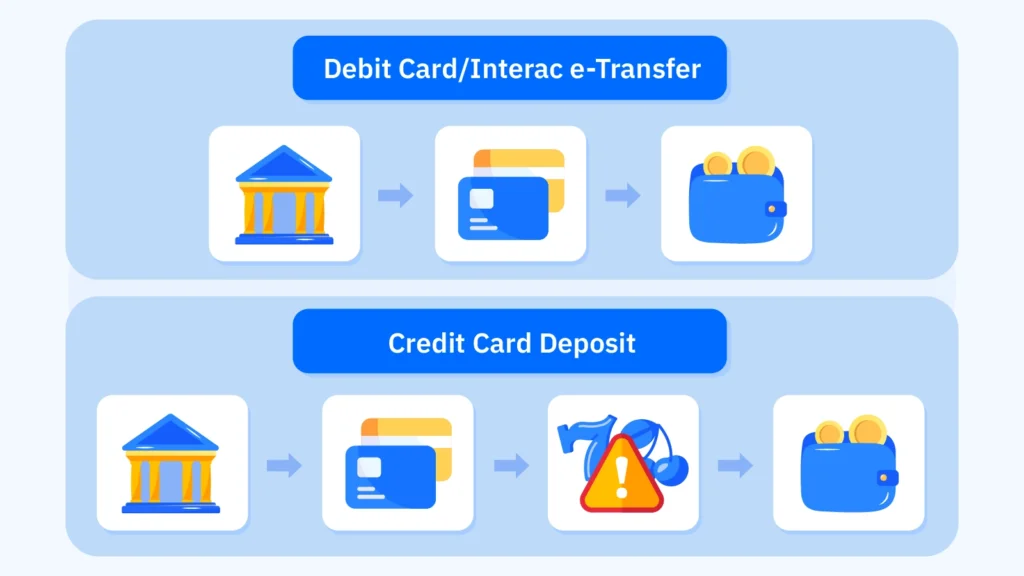
When you make a deposit using a debit card or Interac e-Transfer, the casino operator pulls the money you deposited directly from your bank account. A credit card transaction works differently. Essentially, you’re borrowing money, and the issuer decides how that transaction gets classified. Most regular purchases (groceries, gas) are classified as standard purchases and come with an interest-free grace period, provided you pay off the full monthly balance.
Gambling transactions, on the other hand, don’t get the same treatment. Transactions made at online casinos, sportsbooks, or lottery sites are flagged as gambling, and Canadian issuers respond to that flag by processing the transaction as a cash advance rather than a regular purchase. There are also stricter issuers (Scotiabank and TD) that decline deposits to offshore casinos altogether.
The Cash Advance Classification (Not a Purchase)
A cash advance is treated by your card issuer exactly as if you had walked up to an ATM and withdrawn cash directly against your credit line, even though what you actually did was fund an online casino account. This distinction matters a great deal, because cash advances lose all the consumer protections that come with regular purchases:
- There’s never an interest-free grace period on this type of transaction- interest starts accruing immediately.
- A separate annual percentage rate (APR) applies, and it’s typically higher than the rate used for regular purchases.
- An additional cash advance fee is charged, deducted immediately from your available credit.
- Most cards don’t offer reward points or cash back on gambling cash advances.
This is a well-established practice across the Canadian market, not a rare or isolated exception. Real, published cardholder agreements from major issuers explicitly list gambling, betting, and casino transactions under categories such as “cash-like transactions” or “cash advance.” If you’ve ever wondered why a casino deposit shows up on your statement looking completely different from your other purchases, this classification is exactly why.
Cost Breakdown: A C$100 Deposit’s True Cost
Let’s say you deposit C$100 to a casino using your credit card, and your issuer charges a representative cash advance fee of 3%. In reality, issuers’ minimum fees range from C$5 to C$10. There’s also a 21% annual interest rate (APR) on the cash advance. In reality, issuer rates range from about 21.99% to 29.49%.
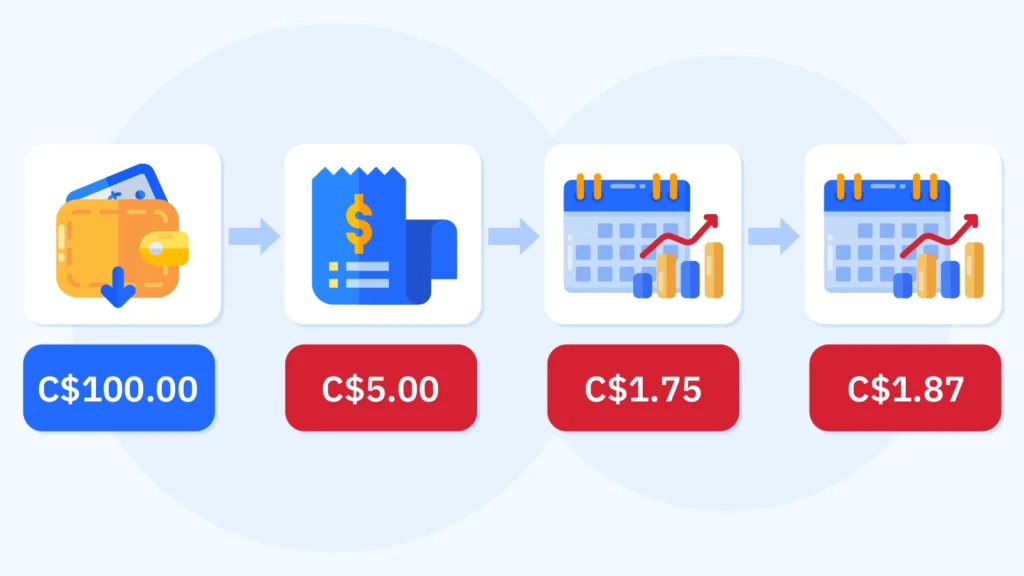
Essentially, that C$100 deposit already becomes a C$105 deposit before you’ve placed a single bet. If you leave the balance unpaid, the amount will keep growing every month. Even if you pay it off in full on the day your statement is generated, you’ll still have paid the C$5 fee plus whatever interest accrued for the number of days the balance remained unpaid.
For a regular purchase, most Canadian card issuers give you a grace period of at least 21 days, interest-free. The condition is that you must have paid off the previous balance in full. Keep in mind that cash advances don’t get this benefit.
Interest on a cash advance starts accruing from the day of the transaction itself, not from the statement date. It keeps accumulating daily until the balance is paid off in full.
In practice, the moment you deposit C$100 at a casino, that deposit is processed as a cash advance. Even if you pay off your card in full within a week, you’ll still owe a few days’ worth of interest, on top of the upfront fee.
This is where it differs from a regular purchase, where you can avoid interest by paying the balance in full. With a cash advance, there’s no way to avoid interest.
Monthly Interest Accrual Calculation (Show the Math)
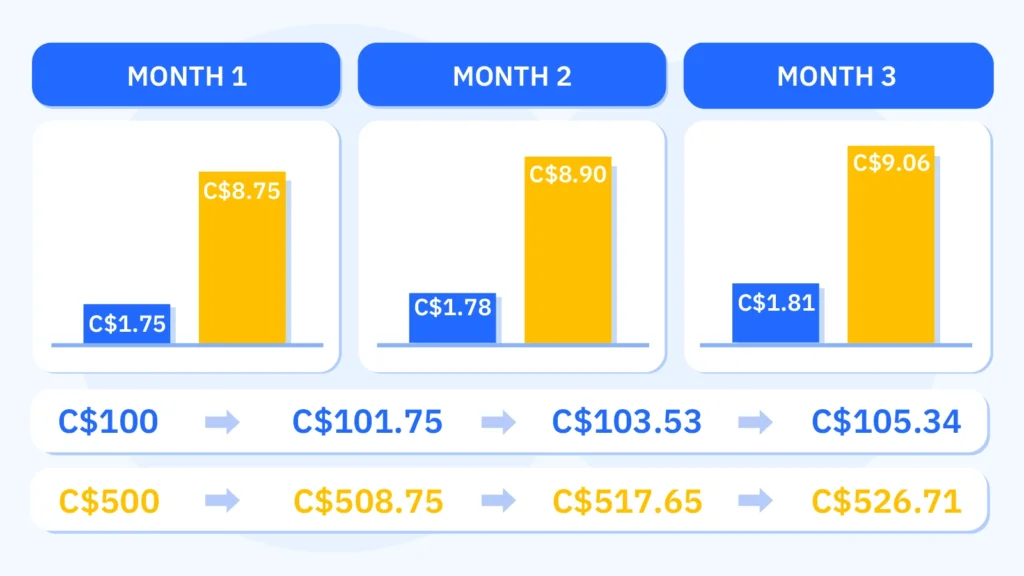
To help you understand even better how interest accrues if you don’t pay off the balance right away, let’s walk through a clear example.
The C$100 Example: Month by Month
Consider a representative annual rate of 21% for cash advances, which we divide by 12 months. 21% divided by 12 comes out to about 1.75% per month. Apply that percentage to your C$100 balance and you get 1.75% of C$100, which is C$1.75 in interest for a single month.
If you leave the amount unpaid for a second month, interest will be calculated again — this time on a slightly larger balance. At first glance, it might not seem like you’ll end up paying that much interest, but if we look a bit further ahead and consider a C$500 cash advance, you’d owe C$8.75 in interest alone, on top of which you’d also have the cash advance fee.
Keep in mind that the annual rate for cash advances on many Canadian cards is higher than 21%, with some reaching as high as 29.49%.
Credit vs Debit Cards: The Fundamental Difference
There’s a simple difference: with a credit card, you’re using borrowed money, straight from the bank, while with a debit card, you’re using your own money that you already have. With a debit card, there’s no credit line involved, so the issuer automatically can’t classify a transaction as a cash advance.
When you use a credit card, the issuer gives you a short-term loan for every transaction you make. As a result, regular purchases come with more favorable terms, since banks want to encourage everyday spending. A transaction classified as a cash advance, on the other hand, comes with the least favorable terms.
Why Debit and Interac Are Safe Alternatives
Interac e-Transfer and debit card deposits are a standard, low-cost payment method Canadian players can use to fund their casino account. Since this payment method uses your own money rather than borrowed funds, these transactions don’t trigger mechanisms such as:
- There’s no cash advance fee, since no credit line is being accessed.
- There’s no increased annual interest rate.
- There’s no immediate interest accrual.
- The money transfers directly from your bank account, making it easier to track your budget.
From what we’ve observed, Interac e-Transfer is the preferred deposit method at most licensed and offshore casinos. We ourselves recommend opting for this payment method and avoiding credit cards for casino payments.
What Your Bank Statement Actually Shows
A cash advance made with a credit card won’t get lost among your other expenses. On most Canadian statements it shows up as a separate line item, and most of the time it’s also labeled as a cash advance or with the casino’s merchant name. Either way, the cash advance fee and interest will also appear as separate lines.
This lets you clearly see how much your casino deposit, paid with a credit card, actually costs you. However, if you want discretion, any family member will be able to see this transaction on the account statement. For discretion, your best option is Interac e-Transfer, which only displays the recipient’s name or a generic transfer reference.
The Bottom Line for Players
A credit card is the fastest way to top up your casino account when your debit balance is low. However, in Canada it’s about the most expensive option.
This type of transaction is classified as a cash advance, which means it eliminates the grace period and adds an upfront fee, while interest starts accruing right from the moment the transaction is processed. This means a simple C$100 deposit will actually end up costing you C$105 or even more.
Why Debit and Interac Come Out Ahead
If you deposit using Interac e-Transfer or other debit cards, you won’t run into these issues, since you’ll be paying directly with money you already have, not borrowing. There’s one important thing we want you to take away from this article: treat credit cards as a last resort, not your first option!
How We Verified This
Every figure in this guide was verified against the current terms and conditions officially published by Canadian credit card issuers. Our review process always follows the standard 47-factor evaluation methodology. Two independent analysts researched the issuers’ cardholder agreements.
Where the source data were only approximations, we’ve stated this explicitly and presented ranges of values, rather than treating a single figure as universally applicable.
A Note on Responsible Gambling
Never deposit money you can’t afford to lose, and never use borrowed money or credit cards to chase your losses. If you feel that gambling is affecting your finances or wellbeing, you can contact your provincial responsible gambling helpline at any time.
This article is for informational purposes only. Interest rates, fees, and terms may vary depending on your card issuer. We recommend confirming current interest rates directly with your card issuer before making a deposit.