This article provides predictive analysis about potential Canadian adoption of UK-style financial risk assessments based on international regulatory trends as of January 2026. This is not legal advice. Predictions are analytical opinions. Actual regulatory implementation may differ significantly from UK model.
UK Financial Risk Checks: Deposit Monitoring in Canada
By Adela Mariuta

Summary
- UK’s Financial Risk Assessments: What They Are
- Why Canada Will Follow UK’s Lead
- What Financial Risk Assessments Mean for Canadian Players
- Canadian Implementation: How It Would Work
- Controversy: Player Freedom vs Protection
- Timeline: When Canada Adopts Financial Risk Checks
- What High-Spending Players Should Do
- Summary: Financial Risk Checks Coming to Canada
- Sources
UK’s Financial Risk Assessments: What They Are
Did you know that the UK Gambling Commission is trying out a new way to spot players who might be spending more than they can afford? This isn’t the same as the usual affordability checks, it works a bit differently, and it’s designed to help players stay in control.
Here’s how it works in real life:
- If your losses reach a certain level, say around £1.000-£2.000 in a month, the casino might take a quick look at credit information to see if there are any warning signs, like missed payments or outstanding debts.
- If something shows up, don’t worry it’s not about punishing you. The casino will usually get in touch to understand your situation and make sure you can keep playing safely. In some cases, they might temporarily limit your access to games until it’s clear that you’re in a good spot financially.
In the UK, it all started with a pilot program between 2024 and 2025. They ran 1.7 million assessments across 860,000 accounts. The good news? 97% of these checks were done automatically, so players didn’t need to provide any extra documents.
Only about 3% required manual checks and additional paperwork. The takeaway is that the system can spot signs of financial difficulty without affecting most players’ experience.
Our Prediction
We expect that a similar system could be introduced in Canada around 2028-2029. It would likely start in Ontario and Alberta before rolling out nationwide.
Why do we think this? Canada often adopts certain UK gambling regulations a few years after they’re implemented there. See how Ontario iGaming compares to offshore sites in our guide.
Why Canada Will Follow UK’s Lead
We, the experts at CasinoAlpha, have reached a simple conclusion: Canada consistently adopts gambling regulations from the UK, but only after observing how they are implemented and what results they produce.
Competitive licensing model
- Introduced in the UK: 2005
- Adopted in Canada: Ontario in 2022, followed by Alberta in 2026
Responsible gambling standards
- Introduced in the UK: 2010s
- Adopted in Canada: Ontario in 2022
Self-exclusion systems
- Introduced in the UK: 2018
- Canada: Ontario exploring centralized solutions in 2025-2026
Systems to monitor financial risk
- UK pilot: 2024-2025
- Expected in Canada: 2028-2029
As you’ve probably noticed, the UK is often the first testing ground for new gambling regulations. This allows Canadian regulators to see how these changes work in practice. Only then can they decide whether similar rules would make sense for Canada as well.
There’s no need to worry about these changes. On our website, you’ll find all the information you need, including which banks block casino deposits.
What Financial Risk Assessments Mean for Canadian Players
If Canada adopts the same system used in the UK, players who lose large amounts could be looked at more closely. In some cases, they might face extra checks or temporary limits to make sure they can keep playing safely at top online casinos.
Do you risk being affected?
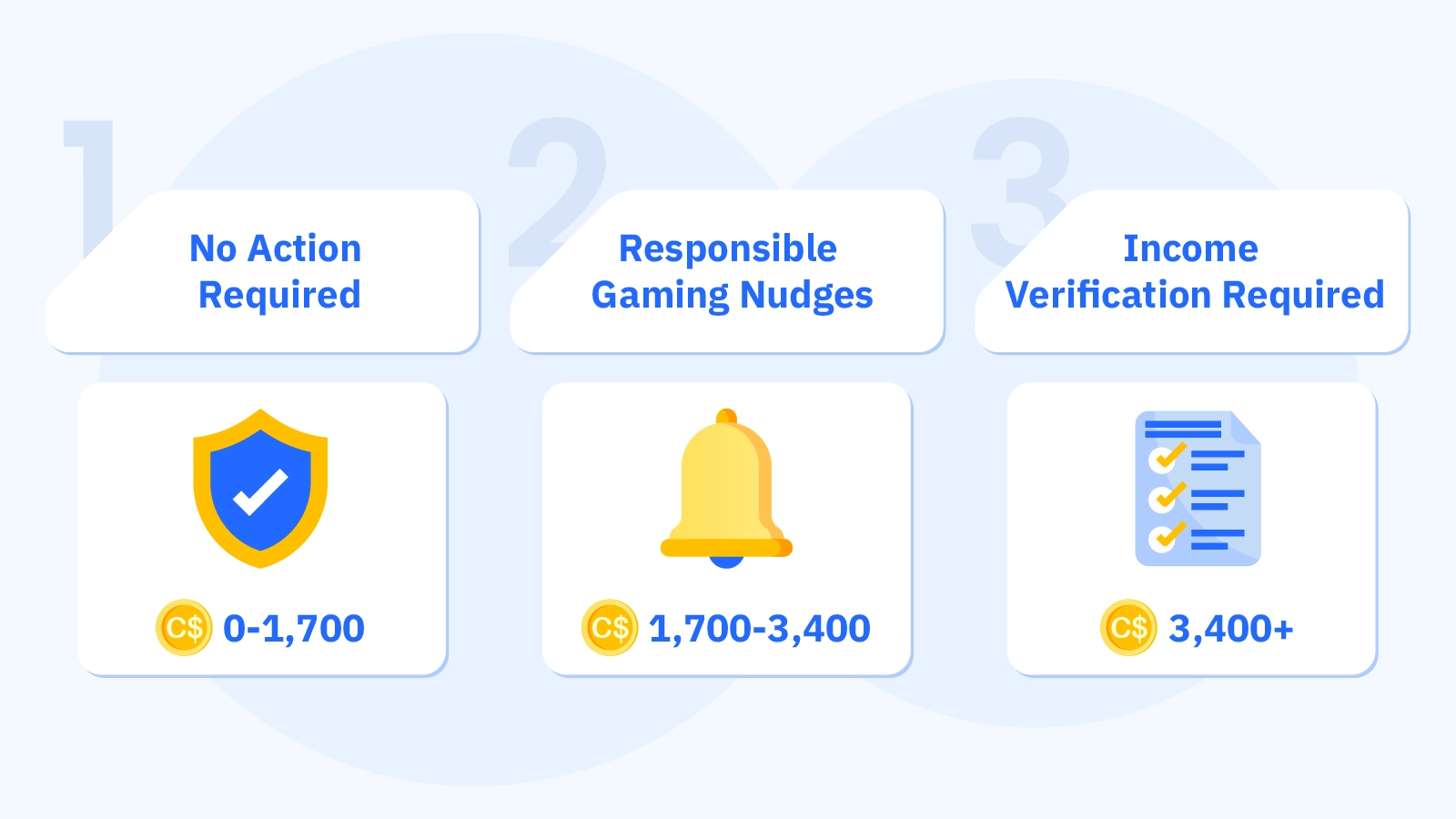
In the UK, checks are proposed to be triggered when a player’s monthly net losses reach between £1,000 and £2,000. In Canada, this threshold would translate to approximately C$1,700-3,400 in monthly net losses.
So what does that look like in Canada?
- In Ontario, that would mean roughly 63,000 players being reviewed.
- In Alberta, the number drops to about 9,000 players.
- The majority of casual players wouldn’t be affected, since their spending stays well below these limits. If you’re a casual player as well, there’s no need to worry.
How the check works
We, the CasinoAlpha CA specialists, analyzed the UK pilot and observed that most players were not affected by the checks at all. About 97% of players continued playing as usual, with no interruptions or issues. Everything happens quietly in the background.
For the other players, it’s a more manual process, typically when the system can’t automatically match credit data. In these cases, a real person will look at the documents and decide whether play can continue.
If you’re a player whose monthly losses reach roughly C$1,700-3,400, here’s what it would look like:
- Green: Nothing happens. You play as usual.
- Yellow: The casino nudges you toward responsible gambling tools, you can ignore them if you want, but they’re there.
- Red: You may be required to provide proof of income. Your access will be restricted until the verification is complete.
For most players, including yourself, if you don’t exceed the limit, the experience will remain virtually unchanged. The system is designed to identify potential financial issues early, not to restrict recreational play. If there are no financial problems, there’s nothing to worry about. This change shouldn’t affect you.
However, if you feel you might be at risk, our CasinoAlpha experts recommend checking out our responsible gaming guides, as they’ll definitely help you.
Canadian Implementation: How It Would Work
Ontario and Alberta are the most likely provinces to test these checks first. We believe this could happen around 2027-2028. If the rollout proves successful, similar rules could gradually be expanded across Canada, with federal standards potentially following by 2029.
The rule is simple! All licensed operators will need to have a method of identifying players who are losing more than they can afford. The exact threshold is not yet confirmed, but there is talk of a limit of C$2,000-3,000 per month.
How This Affects Players | From Our Perspective
For almost everyone, nothing changes. Over 95% of players probably won’t notice anything because it all happens in the background. Only if someone starts missing payments or showing signs of stress would someone actually check manually.
To put things into perspective, here’s how the system would likely apply at different spending levels. In practice, most players fall into the lower tiers where nothing really changes.
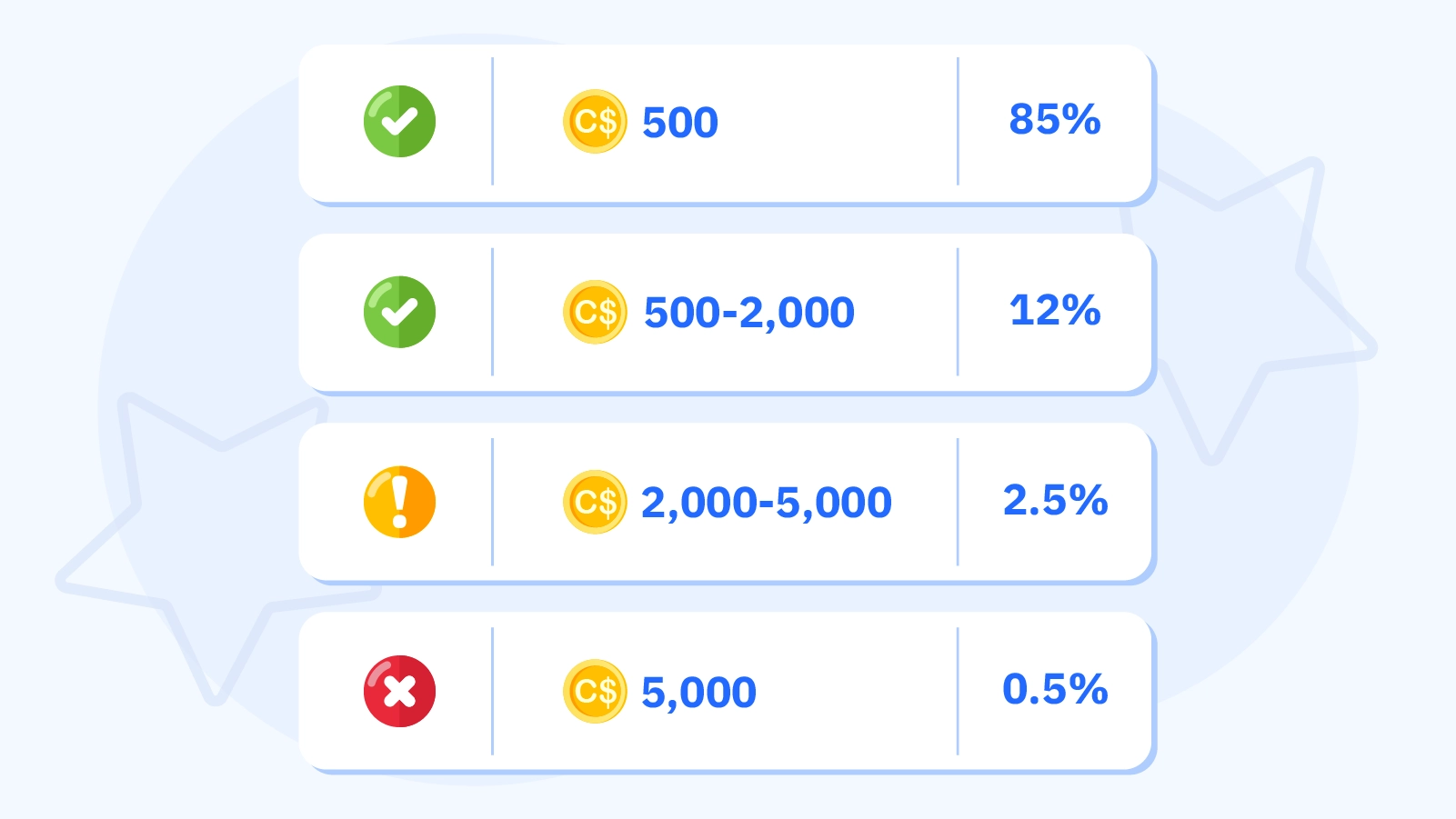
Long story short, most Canadian players won’t notice any change, probably not you either. Only those losing more than C$2,000 per month would be subject to checks, and even then, the process happens discreetly, without any unnecessary complications.
Controversy: Player Freedom vs Protection
Like any major change, financial risk assessments have sparked plenty of debate in the UK gambling community. High-income recreational players argue that these measures are over the top. On the other hand, organizations supporting responsible gambling say these changes are a good thing!
Arguments against (player freedom perspective)
High-income players earning over C$300,000 can afford monthly losses of around C$5,000. They feel that being asked to prove their income is intrusive and treats adults like children.
There are also privacy concerns, as casinos can access credit data without asking for explicit consent each time. CasinoAlpha experts have reviewed PIPEDA and understand that these checks only happen under certain conditions. Still, many players feel they are being monitored too closely.
Some players also worry about the threshold being lowered in the future. Could it drop to C$500 at some point?
Arguments for (harm prevention perspective)
From a harm prevention point of view, there’s a clear pattern in the data. Players who go over these spending thresholds are more likely to fall behind on payments or end up in debt. At CasinoAlpha, we see these as early warning signs rather than judgments about individual players.
In practice, this kind of system is mainly about picking up on risky behaviour sooner, especially in situations where people are gambling with money they don’t really have: for example, credit card funds they can’t realistically pay back.
Take a simple example
Someone might start by using money meant for rent, then switch to credit cards just to keep playing. In cases like that, financial risk checks would likely step in around C$2,000-5,000 in losses, instead of only becoming an issue when things have already escalated to C$50,000-100,000.
The 97% frictionless rate is also important here. It means the vast majority of responsible, high-income players wouldn’t notice any real change. Based on our analysis at CasinoAlpha, only users showing clear signs of financial stress would ever be reviewed in practice.
Timeline: When Canada Adopts Financial Risk Checks
Based on the completion of the UK pilot (2025), the current stage of regulations in Ontario and Alberta, and the usual delay in Canada adopting UK rules, CasinoAlpha has put together an estimated implementation timeline.
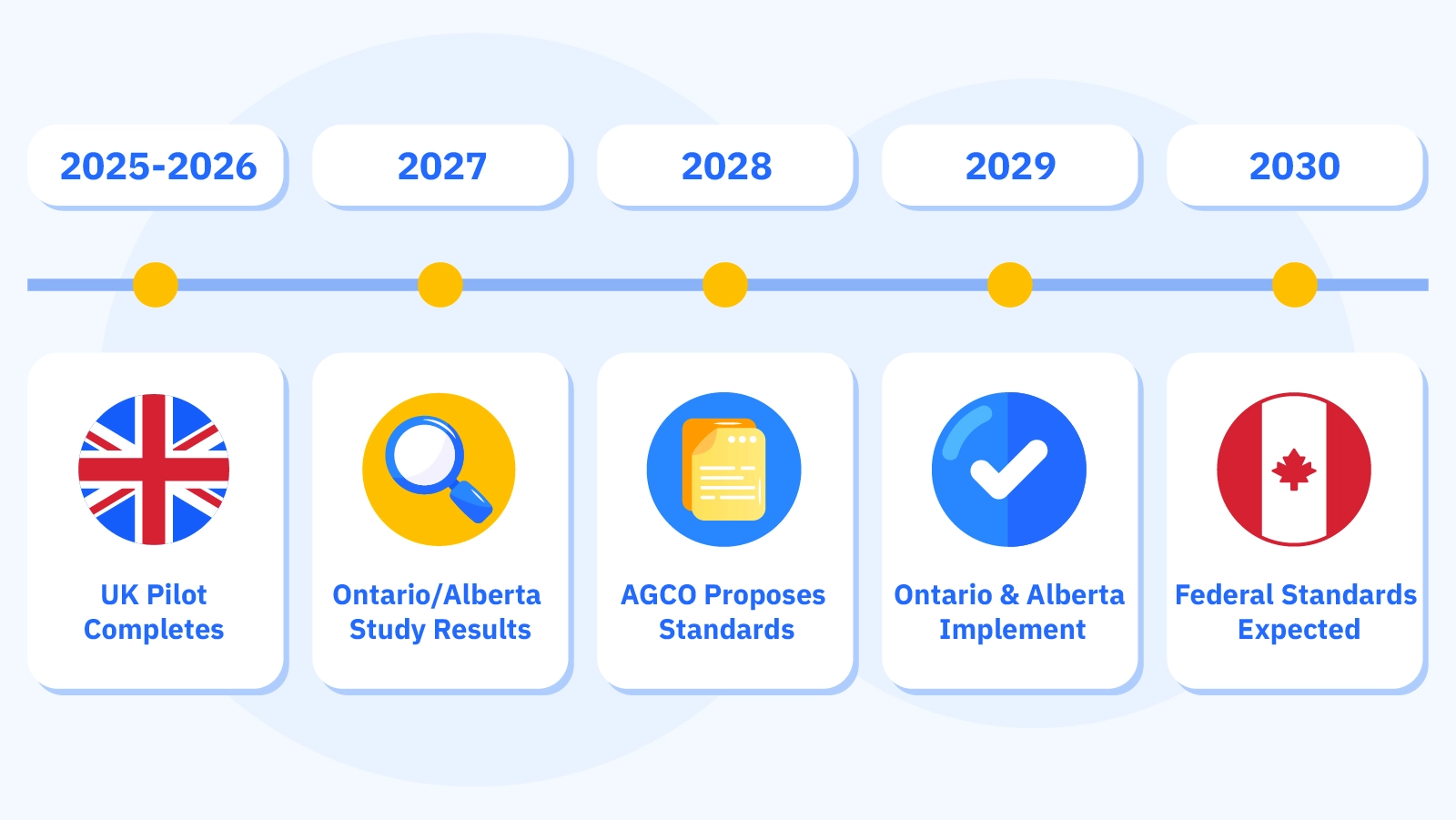
- 2025-2026
The UK wraps up its pilot program and publishes the final results along with implementation guidelines. Meanwhile, Ontario and Alberta keep an eye on the UK outcomes while focusing on launching and stabilizing their own local markets.
- 2027
The UK makes financial risk assessments mandatory through the UKGC and shares the first results showing how well the system works. At the same time, regulators in Ontario and Alberta are studying how it was applied in the UK to see how it could be adapted for Canada.
- 2028
Ontario’s AGCO is proposing to include financial risk assessments in its updated standards. This will be followed by a public consultation period, where operators raise concerns about implementation costs, while players remain divided between added protection and privacy concerns.
2029
Ontario introduces financial risk checks for operators licensed through iGaming Ontario. Alberta follows with its own AGLC requirements. The thresholds are set at C$2,000-3,000 in monthly net losses, with credit checks handled through Equifax and TransUnion Canada.
2030
The federal government adds financial risk assessments to national minimum standards. All provincially regulated markets would be expected to implement them.
The CasinoAlpha team estimates a 60% chance that Canada will adopt financial risk checks by 2029. A lot of this depends on how successful the UK pilot turns out to be. If it fails, Canada will likely step away from it as well.
Other factors include political will and pressure from the public health sector. In the end, it still remains to be seen how things will play out. See more about Alberta’s regulated market if you want to know how it can affect your casino play.
What High-Spending Players Should Do
Do you regularly lose over C$2,000 at online casinos? If so, these changes will affect you! Here’s how you can prepare, straight from the experts at CasinoAlpha.
Keep your credit in good shape
If you have a clean credit history, there’s nothing to worry about. Financial risk checks look for missed payments or arrears. In most cases, you won’t even notice these changes because they won’t directly affect you.
Play responsibly, based on your budget
If you earn C$150,000 a year and lose C$3,000 in a month, that’s a manageable amount, about 2% of your gross income. Our advice is to keep your pay stubs handy just in case you need to show them.
If your income is C$60,000 a year and you’re losing C$5,000 monthly, financial risk checks are actually a good safety net for you; they help make sure you don’t get in over your head.
Be ready for checks
If you spend large amounts at online casinos, at some point you may be asked to provide proof of income (pay slips or bank statements). This is expected to become common for monthly losses above C$5,000. We recommend keeping your documents handy to avoid any issues with your play.
Set your own limits
If you want to avoid financial checks, it’s a good idea to keep your deposit limits below C$1,500 per month. Responsible gambling tools make this easy to do in advance.
Play at multiple casinos
If one casino runs checks and restricts your access, having accounts at other licensed casinos can help. You can compare those sites from our A-Z casino list, which are already tested by us. Keep in mind, though, that eventually all of them may adopt the same rules if AGCO/AGLC requires it.
Summary: Financial Risk Checks Coming to Canada
Here’s a quick summary of how financial risk checks could make their way to Canada, based on what we’re already seeing in the UK.
UK pilot: 2024-2025 (Analyzed by CasinoAlpha)
In the UK test, financial risk assessments were applied to 860,000 accounts. In most cases (around 97%), everything was handled automatically and players didn’t feel any difference at all. Only 3% went through manual checks, according to data analyzed by CasinoAlpha CA.
What’s interesting here is that these checks don’t happen randomly. They’re usually triggered when there are already signs of financial risk. The data also shows that these players are 2–5 times more likely to have real debt problems.
What could happen in Canada?
From what we see at CasinoAlpha, the most likely scenario is adoption between 2028 and 2029, starting with Ontario and Alberta. If things continue in the same direction, federal standards could also follow by 2030. The thresholds being discussed right now are around C$2,000-3,000 in monthly net losses.
And this is the important part: we’re talking about a small group of players, around 3%, those losing more than C$2,000 a month. The remaining 97% likely won’t notice any change. And even among those who are checked, almost all (97%) go through the process without any disruption. In practice, for most people, nothing really changes.
What’s next and when?
The UK put these measures in place in 2025. Ontario will check out the results around 2027 to see what could work for Canada. Then, between 2028 and 2029, Ontario and Alberta might officially start using the financial risk checks. And down the line, we could even see a federal framework by 2030.
How to get ready for this change
- Keep your credit in check, most of the time, the checks are automatic and you won’t even notice them.
- Play within your means, if you spend larger amounts, it’s a good idea to have proof of income ready in case it’s requested.
- Set your own limits so you don’t hit the thresholds that trigger checks. Check out our guides on the site for tips.
- And keep an eye on AGCO and AGLC announcements from time to time so you stay up to date with the new rules.
From CasinoAlpha’s analysis of UK data, things look fairly clear. Financial risk checks are likely to make their way to Canada between 2028 and 2029. Players who lose larger amounts would fall into credit check territory and, in some cases, may be asked for additional income details.
Sources
- UK Gambling Commission, Financial Risk Assessments Pilot – Update on Stage Two, May 21, 2025 https://www.gamblingcommission.gov.uk/blog/post/financial-risk-assessments-pilot-update-on-stage-two
- UK Gambling Commission, Financial Risk Assessments Pilot Update on Progress, February 10, 2025 https://www.gamblingcommission.gov.uk/blog/post/financial-risk-assessments-pilot-update-on-progress
Meet Our Experts

Author
Adela Mariuta
Author & Editor
Adela Mariuta is a Senior Gambling Specialist at CasinoAlpha since 2019. Her work focuses on what casinos usually hide: ethical gambling practices, self-exclusion tools, and responsible gaming features. She has written 400+ casino reviews, bonus codes, guides, and blogs that prioritize player safety.

Recommended Articles

License Verification in 3 Minutes: Legitimacy Check
We know, no one has told you this, but it’s not just the welcome bonus that matters! It’s much more important to verify the authenticity of the license. It only takes 3 minutes, 3 minutes that wil help you a lot more down the rod. We’re here to guide you in fact, we’ve even incorporated this step into our own evaluation process, which is based on 47 factors. Let’s go through the following points together!
By Isabell Dreghiciu

Casino Account Closures: Your Rights When Banned
You log into your player account, and instead of the lobby, you get this message: your account has been closed. No explanation, just a line about breaking the terms, worse still if you had money in there, since your balance stays locked.
By Isabell Dreghiciu

Why Most Players Should SKIP Welcome Bonuses
For our recent article, we decided to conduct a six-month research study, analysing the activity of 50 Canadian players in iGaming Ontario and offshore casinos. 73% of those who received welcome bonuses lost more money than those who started playing without bonuses. The point here is that sometimes bonuses are nothing but hooks, which means marketing tools. In our latest article, we will reveal to you the proper way to determine whether the welcome bonuses are created for marketing purposes only or are paid out. We will reveal the psychology behind marketing tools and help you choose a welcome bonus depending on your preference and hints about withdrawal.
By Adela Mariuta

Why 100% Match Bonuses Beat 300%
The 300% deposit bonus offered on an online casino platform can be quite misleading. This is because the percentage of Canadian players who try to get something out of it by meeting its wagering terms comes to only 82%. It is important to mention here that it is all about terms and conditions and not luck since there are 50x-60x wagering terms associated with the offer, a C$500 maximum amount limit, and terms for deposit and bonus wagering. Compare this with the 100% deposit bonus that involves 25x-40x wagering terms. In case you have read the article, you know that 62% of players meet the terms and get a profit.
By Adela Mariuta

Problem Gambling Early Warning Signs: Self-Assessment
Gambling can be a form of entertainment, but for some people, the line between fun and a genuine problem becomes hard to see. In this guide, we explain what gambling addiction means from a clinical standpoint, the criteria specialists use to identify it, and how you can recognize the signs early on. Our goal is to help you better understand this topic, whether it concerns you directly or someone close to you.
By Isabell Dreghiciu
Most Read
1.