This article from CasinoAlpha CA provides predictive analysis about Quebec’s online gambling regulatory future based on political climate, industry pressure, and international precedents as of January 2026. This is not legal advice. Predictions are analytical opinions, not guarantees. Timeline estimates may change based on elections, economic conditions, and political priorities.
Quebec Gambling Regulation: Will Espacejeux Monopoly End?
By Isabell Dreghiciu

Summary
- Quebec’s Espacejeux Monopoly: Under Pressure to Open
- Why Quebec’s Monopoly Is Failing Players and Government
- What’s Blocking Quebec from Regulating?
- The Quebec Online Gaming Coalition Push
- Predicted Timeline: When Quebec Will Regulate
- What Would Change for Quebec Players
- The Quebec Online Gaming Coalition Pressure Campaign
- Political Landscape: The 2026 Election Wild Card
- What’s Different About Quebec (Why It’s Harder Than Alberta)
- Counter-Arguments: Why Quebec Might NOT Regulate
- How Quebec Regulation Would Likely Work
- What Quebec Players Should Do Now
- Summary: Quebec’s Regulation Outlook
- Sources
Quebec’s Espacejeux Monopoly: Under Pressure to Open
In Québec there is only one licensed casino, Espacejeux. The province refuses to authorize any others, and players find alternatives. How? They play at offshore casinos instead. The CasinoAlpha team has spent months analyzing this topic to give you a clear picture. Don’t forget to share your thoughts at the end!
A few numbers we pulled together
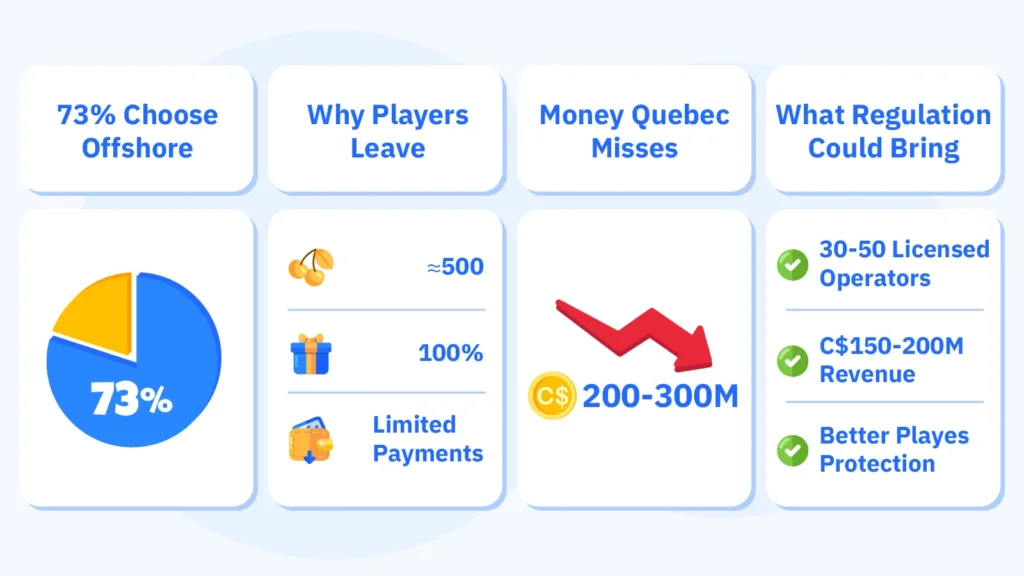
Our team of specialists found a 2023 Mainstreet Research survey. It found that 73% of players in Québec prefer offshore operators over Espacejeux. This preference has a real cost for the province. More than half of the province’s online gambling revenue ends up on sites like Bet365 and PokerStars, from which Québec sees not a single cent in taxes.
Private operators in Quebec are represented by the Quebec Online Gaming Coalition (QOGC), which is actively lobbying the provincial government to follow Ontario and Alberta’s competitive licensing model. The pressure to change is real! Quebec is running a budget deficit, and the Ontario example is hard to ignore: by year two of competitive licensing, the province had already pulled in around C$261M in revenue.
We’ve been following what happened in Ontario and our conclusion is pretty clear. We looked at all the data together and we believe Québec will take the same step by 2028-2029. But we shouldn’t forget that Loto-Québec doesn’t give up easily, and this province has shown many times that it prefers to move at its own pace. So we put 65% odds on this scenario, no more. Check our website periodically to see if we were right!
Why Quebec’s Monopoly Is Failing Players and Government
Espacejeux launched in 2010: Canada’s first provincial online casino, a full 12 years ahead of Ontario. Quite the head start, but it hasn’t counted for much: but 15 years in, it’s not working the way Quebec hoped.
Most Quebec Players Already Play Elsewhere
We came across a 2023 Mainstreet Research survey showing that Quebec players aren’t happy with Espacejeux.When given the choice between Espacejeux and offshore operators, three quarters pick offshore every time. Why players don’t choose Espacejeux?
- Outdated platform: the interface looks and feels behind the times
- Limited game selection: 500 titles versus 2,000+ at offshore casinos
- Weaker bonuses: 100% match versus 200-400% elsewhere. On our website you’ll find the best bonuses available.
- Fewer payment options: no crypto, limited e-wallet support
None of this is surprising to us. We review online casinos for a living, and Espacejeux wouldn’t make our top 50. We recommend checking out our website, you’ll find all the legal casinos there!
The Money Quebec Never Sees
Quebec has a budget problem and needs money. Ontario brought in C$261 million in its second year of regulated gaming. Alberta, with half Quebec’s population, is expecting C$80-120 million in year one.
Right now, Quebec’s online gambling market generates around C$1 billion a year. Espacejeux captures roughly C$300-400 million of that, the rest goes straight to offshore operators. At Ontario’s tax rate, that’s a lot of money Quebec never collects. We’ve gone through all of this data so you can get a clear picture of what Quebec is actually dealing with.
We’ve run these numbers ourselves at CasinoAlpha, and they hold up, Quebec is leaving serious money on the table every year
Ontario Already Did This. Here’s What Happened
For Quebec, this doesn’t have to be complicated. Ontario went through this change in 2022. We’ve looked at the numbers from the past two years and now you can see them too:
What Ontario delivered:
- 46 operators licensed in year one, 49 by year two
- C$2.2 billion in gross gaming revenue in year two
- C$261 million back to the province in year two
- C$2.7 billion contribution to GDP
- OLG kept running alongside private operators, no disruption
We think the same will apply to Alberta in 2026. PlayAlberta.ca isn’t going anywhere just because private operators are entering the market.
What does that mean?
Espacejeux wouldn’t disappear either. The difference is that Loto-Québec would finally start collecting significantly more tax revenue. See how Ontario gambling differs from offshore casinos in our article.
What’s Blocking Quebec from Regulating?
Quebec’s political and institutional obstacles are the main reasons. We have analyzed every aspect, including the economic arguments. Read through the following paragraphs to find out the whole truth.
Why Loto-Québec has no interest in changing anything
In case you hadn’t figured it out, Loto-Québec is a Crown corporation with a lot more political influence than you might think. It has deep government connections and a clear interest in keeping things exactly as they are. The official argument is that the monopoly protects players, delivers stable revenue, and keeps the industry under provincial control.
But that’s not quite how things play out in practice and at CasinoAlpha, we’ve looked at the numbers closely enough to say so. Players aren’t sticking to Espacejeux. 60-70% are already gambling offshore. The monopoly isn’t stopping them.
Cultural and Political Factors
Over the years at CasinoAlpha, we’ve noticed that Quebec has a political culture of its own. The province has always been skeptical of private operators. Quebec likes to do things its own way and tends to push back against anything that looks like the Ontario model.
For the CAQ government, gambling isn’t a priority. There are no real discussions about potential changes. Healthcare and education come first.
That said, the provincial election in October 2026 is right around the corner. That could be the push this topic needs. You’ll find all the information you need on this topic on our website!
The Quebec Online Gaming Coalition Push
If you think nothing is happening on the Quebec gambling front, think again. QOGC isn’t sitting idle! Over the past year, the pressure they have been putting on the provincial government has been growing. Find out in the following lines how the situation is being addressed!
What’s their core argument?
Keeping a monopoly when 73% of players are already going offshore doesn’t make economic sense. And honestly, we agree. What they’re proposing is a licensing framework similar to Ontario’s, one that could bring a lot of extra money into the provincial budget.
There’s also a responsible gambling angle that’s hard to dismiss. Offshore casinos aren’t connected to Quebec’s support systems or self-exclusion registries. If these operators were licensed, they’d have to meet provincial standards, which would actually give players more protection than they have now. We always recommend choosing only safe and licensed casinos! On our website, you have access to a complete list!
What’s CasinoAlpha’s take?
At CasinoAlpha, we’ve also noticed a growing number of public awareness campaigns aimed at showing Quebec voters exactly how much money the province is leaving on the table every year. What do you think? Are these campaigns actually making a difference?
Predicted Timeline: When Quebec Will Regulate
We’ve been closely watching how things unfolded in Ontario and Alberta: 18 months from legislation to launch in Ontario, 12 months in Alberta. Based on that and Quebec’s political calendar, here are the scenarios we, the CasinoAlpha team, see:
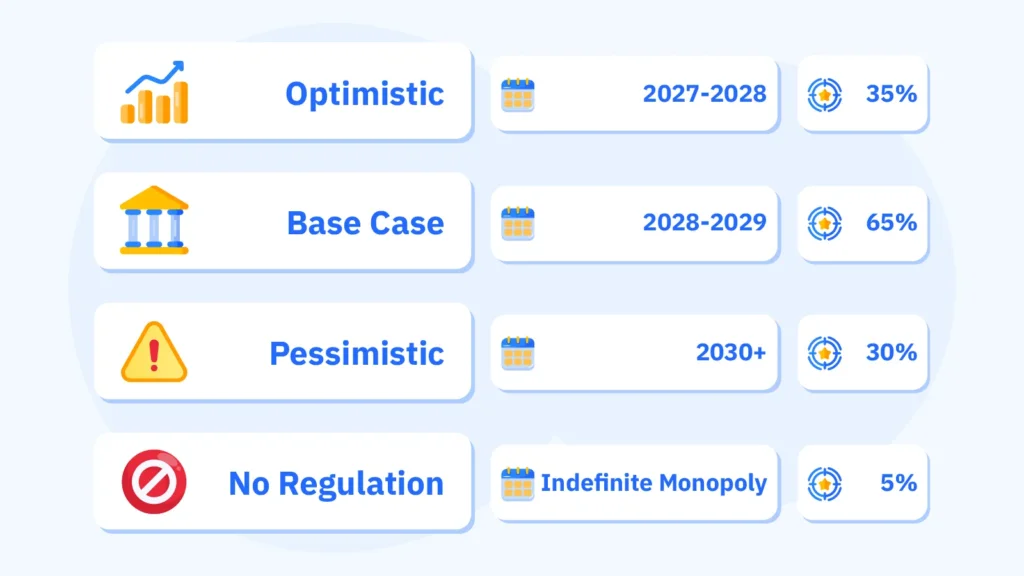
At CasinoAlpha, we expect Quebec to regulate the market by 2028-2029. We don’t think it’ll happen overnight, more of a gradual shift. The budget deficit will keep building pressure, Alberta will show the model works, and whatever government comes out of the October 2026 election will find it harder and harder to justify the money left on the table every year.
Here’s How We Think 2028-2029 Actually Plays Out
- 2026: Election year. For the first time in years, gambling regulation could actually make it onto the political agenda. Right after the election, the new government will evaluate its priorities, including where new revenue could come from.
- 2027: The study phase: A study on competitive licensing will be conducted. Given that it already exists in Alberta, there will be clear feedback to draw from.
- 2028: Things start moving: Legislation is introduced, the bill is passed, and the regulatory framework takes shape. RACJ begins putting licensing standards together.
- 2029: The market opens: Operator license applications start coming in. The first licenses are granted, the first operators enter the market, and you get to choose which casino to register at. Remember, you can find them all on our website, along with the bonuses they offer!
We believe there are a few things that could speed up the process. One of them is the budget deficit. Other reasons include Alberta surprising with its Year 1 numbers or the Liberals winning the election. We can’t ignore the things that could slow the process down either. For example, if CAQ wins again and nothing changes, or if Loto-Québec lobbies aggressively enough to stall any momentum.
What Would Change for Quebec Players
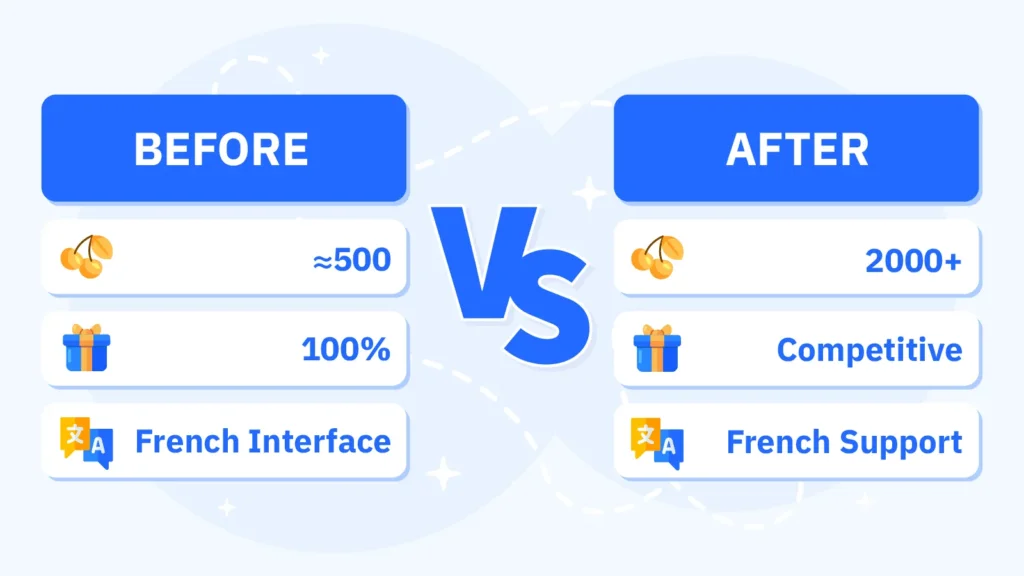
The monopoly model wouldn’t disappear overnight, but it would change fundamentally. Espacejeux would stay in the market just no longer as the only option.
Current situation
Right now, Quebec players have two options: Espacejeux or offshore operators. Espacejeux gives you around 500 games, a standard 100% welcome bonus, and a French-language interface. It’s safe and regulated.
Offshore casinos are a different story. More games (2,000+), mobile apps, VIP programs, and crypto payments. Tempting, right? That’s exactly why most players end up there.
After regulation (estimated 2028-2029)
If Quebec follows Ontario’s path, players will suddenly have 30-50 licensed operators to choose from, instead of just one. After 2022, the difference for Ontario players was significant, more competitive bonuses, a much bigger game selection: NetEnt, Microgaming, Pragmatic Play, Evolution Gaming. Everything available in French too, since that will be a mandatory requirement for any operator licensed in Quebec.
On the protection side, things improve as well. RACJ will oversee all licensed operators, disputes get resolved locally, and self-exclusion will work universally. Our team at CasinoAlpha has tested several self-exclusion systems in Ontario, and when they work properly, they make a real difference for vulnerable players. If you’re not sure how to use them, our website has plenty of guides that can help. We encourage you to check them out!
For Quebec as a province, the difference is even clearer. We are talking about over 150-200 million dollars annually compared to the current 50-80 million. Another benefit is the jobs, over 5,000 new positions. Our team arrived at these figures based on real data from Ontario.
One thing stays the same, and we mention it because you’re probably already wondering about it. Offshore casinos will remain accessible, so there’s no need to worry.
The Quebec Online Gaming Coalition Pressure Campaign
Private operators aren’t sitting on their hands. QOGC is actively lobbying all major political parties and working to shift public perception around the monopoly.
Their argument comes down to three things: the money the province is losing, the weaker player protection that comes with offshore gambling versus a regulated market, and the concrete examples from Ontario and Alberta.
What does QOGC actually say?
The Coalition’s argument is simple: you can’t enforce a monopoly on the internet. Quebec players are already on hundreds of offshore sites, Espacejeux or not. They’re not asking whether players in Quebec gamble online, they clearly do, and in large numbers. The real issue is whether the province wants a cut of that money or keeps watching it disappear offshore.
There’s also a conflict of interest that responsible gambling experts, including those we work with at CasinoAlpha flag regularly: Loto-Québec runs the games and sets the rules at the same time. Ontario split those two roles years ago AGCO regulates, iGaming Ontario operates. Quebec never did.
The percentage of players who prefer private operators should not be ignored. We are talking about real players who have already made a choice. What do you choose? Offshore casinos or Espacejeux?
Political Landscape: The 2026 Election Wild Card
We are sure of one thing! The October 2026 election is the key moment. Whoever wins will largely dictate what happens with regulation, either things start moving, or the monopoly stays intact for another term.
Current Government: CAQ (Coalition Avenir Québec)
From all the data we have analyzed, we can see that Premier François Legault’s government shows no interest in ending the Loto-Québec monopoly. The CAQ is a nationalist-oriented party.
That said, we cannot forget that Québec is running a budget deficit. Our conclusion is that the CAQ will defend the monopoly for as long as it can. Everything depends on whether Alberta can demonstrate that private licensing brings in significant revenue.
Opposition Parties: Varied Stances
The Liberal Party is likely to support market reform. The Liberals have always been open to the private sector. We believe competitive licensing could be a central point of their electoral campaign, and the argument would be straightforward. More operators would mean more money for the province and more jobs.
In the case of the Parti Québécois, things are more complicated. This party supports state control over the economy. However, when provincial finances demand it, the Parti Québécois can be pragmatic.
Québec Solidaire is certainly against casino licensing. For this party, public health comes first, and casinos represent a social problem. Gambling addiction is the main argument against it. It’s worth noting that if you ever feel gambling is becoming an issue, our responsible gambling guides are there for you.
What do you think? Don’t forget to leave us a comment with your opinion!
What’s Different About Quebec (Why It’s Harder Than Alberta)
In Alberta, things were much simpler, there was no existing provincial casino, and the political parties were aligned.
Quebec, on the other hand, has always had a tendency to find its own solutions. Even when they can see that Ontario’s model works well, they prefer to build something of their own, driven by a desire to protect their culture. Loto-Québec has a long history, having been on the market since 1969. For them, allowing private companies to enter the market means abandoning a national institution.
On top of all this, there is one more challenge. Any operator granted a licence must operate fully in French. Major companies like Bet365 and PokerStars already offer French versions, but it remains a mandatory requirement that does not exist in other provinces.
Loto-Québec employs thousands of people, funds community programs, and operates as a cultural institution, more than just a simple casino. Read our blog on Alberta’s regulated casino market to find all the insights.
Counter-Arguments: Why Quebec Might NOT Regulate
Even the best analysis comes with no guarantees. When the Casino Alpha team estimates a 65% probability, we also acknowledge that 35% of scenarios look different. Before we present our conclusion, here are the arguments that could prove us wrong:
- Loto-Québec’s political influence plays an important role. If the government is convinced that the monopoly better protects Quebec’s interests, there will be no change.
- Quebec shows resistance to the Ontario model, and if the budget situation improves on its own, economic arguments no longer hold weight.
- On top of that, if the federal government regulates online gambling at a national level, provincial licensing becomes irrelevant.
- Add to all of this the public opposition. If advocacy groups frame competitive licensing as prioritizing revenue over public health, the calculations shift. We always support responsible gambling.
How Quebec Regulation Would Likely Work
We believe that if Quebec creates its own system, inspired by the Ontario and Alberta models, things will look like this:
- RACJ would be the primary regulatory body, handling licensing and compliance.
- French would be a mandatory requirement for all operators. We are not just talking about a translated website, every casino must have customer support and responsible gambling guides in French.
- Based on our analysis, we also believe taxes will be higher than in Ontario. Quebec has traditionally applied higher taxes across the board.
- Espacejeux will continue to operate as Loto-Québec’s official site, even after regulation, competing directly with private operators. We can see the same model in Alberta, where PlayAlberta is still active.
What Quebec Players Should Do Now
If you are among the players waiting for potential regulation, here is what you can do!
If you want change to happen faster, contact your Member of National Assembly (MNA) and express your support. Back QOGC publicly on social media, participate in government consultations, and make your voice heard at the 2026 elections.
In the meantime, you can continue playing at offshore casinos. They are legal and safe options. Our advice is to choose casinos with reputable licenses, such as MGA, Gibraltar, or UKGC. See other regulations and whether online gambling is legal in Canada from our guide.
If you prefer to play on a regulated platform right now, Espacejeux remains the only option. While it offers fewer games and smaller bonuses, it is a safe choice!
Summary: Quebec’s Regulation Outlook
From our perspective, the situation in Quebec is fairly clear. Loto-Québec continues to hold the monopoly through Espacejeux. At the same time, players prefer offshore casinos, which means Quebec is losing a lot of money.
The pressure for change keeps growing, especially after Ontario proved that its model works, bringing over 261 million dollars to the budget. Quebec is facing a budget deficit that is becoming increasingly hard to ignore.
We, the CasinoAlpha team, estimate that regulation will come in 2028-2029. The October elections will be the decisive moment. If we were to bet on it, we are 65% confident that things will unfold this way!
What will change?
If regulation comes, you as a player will have access to over 30 new casinos, more bonuses, and better games. Espacejeux will continue to operate alongside private casinos.
Until then, our advice is to play on MGA or UKGC licensed offshore platforms. You can find them on our website, along with full reviews! Check out the complete list and make the best choice!
Sources
- SCCG Management, Quebec’s Gaming Monopoly Under Fire: A Call for Change, January 16, 2025, https://sccgmanagement.com/sccg-articles/2025/1/16/quebecs-gaming-monopoly-under-fire-a-call-for-change/
- CultMTL, Quebec Looks to Ontario & Alberta As iGaming Role Models, July 2025, https://cultmtl.com/2025/07/quebec-looks-to-ontario-alberta-as-igaming-role-models/
- Casino.org, Private Operator Coalition Looks to Cut Back Quebec Monopoly, 2025, https://www.casino.org/news/private-operators-look-to-cut-back-quebec-monopoly/
- iGaming Ontario, Annual Report 2023-2024, https://igamingontario.ca/en/annual-report-2023-2024
Meet Our Experts

Author
Isabell Dreghiciu
Author
Isabell Dreghiciu, an Author at CasinoAlpha since 2021, personally tests every bonus with real C$ deposits and withdrawals to uncover hidden terms, explains provincial gambling laws and tax implications on Canadian winnings using plain language, and continuously updates content to reflect regulatory changes.

Recommended Articles

License Verification in 3 Minutes: Legitimacy Check
We know, no one has told you this, but it’s not just the welcome bonus that matters! It’s much more important to verify the authenticity of the license. It only takes 3 minutes, 3 minutes that wil help you a lot more down the rod. We’re here to guide you in fact, we’ve even incorporated this step into our own evaluation process, which is based on 47 factors. Let’s go through the following points together!
By Isabell Dreghiciu

Casino Operating Costs Explained: Why Some Afford Better Bonuses
Have you ever wondered why two online casinos might offer completely different bonuses? Keep in mind that behind every offer there are a number of casino operating costs, and all of these can affect the promotional budget. Let’s figure out together how to choose not only the best casino, but also the best bonus!
By Isabell Dreghiciu

New Casino vs Established: Risk Analysis
A brand-new casino with a huge bonus, or an older one with a solid reputation? The choice is never as simple as it looks. Each option comes with its own advantages and risks, and the real difference doesn’t necessarily come down to the casino’s age, but to what’s actually standing behind it.
By Isabell Dreghiciu

Problem Gambling Early Warning Signs: Self-Assessment
Gambling can be a form of entertainment, but for some people, the line between fun and a genuine problem becomes hard to see. In this guide, we explain what gambling addiction means from a clinical standpoint, the criteria specialists use to identify it, and how you can recognize the signs early on. Our goal is to help you better understand this topic, whether it concerns you directly or someone close to you.
By Isabell Dreghiciu

The 96% RTP Myth Explained
Your first impression upon seeing a slot paying out 96% RTP is that it will give you back C$96 for each C$100 you wagered. It’s not that simple. By monitoring 10,000 spins on Starburst, we observed an average RTP rate of 96.2% but also noted that in any individual 100-spin play, the results could be as low as 54% or even as high as 142%. The weekend play you do does not care about RTP, because variance, bonuses, and hit rate determine whether or not you win or lose.
By Adela Mariuta
Most Read
1.