Scenario Setup: 2 Players, C$5K Budget Each, 6 Months
Both players set aside the same entertainment budget, C$5,000, for both slots and online table games over 6 months. The money was deposited via Interac e-Transfer and played on sites with similar games and RTPs. Neither player set out to spend the full C$5,000 budget over the 6 months; it’s a ceiling, not a target. What actually made the difference was the amount each player ended up depositing.
What set the two players apart?
Player A took every welcome bonus, reload bonus, and free-spin offer available. Player B, on the other hand, turned down every bonus offer, deposited cash only, and played it straight, with no wagering requirements, bonus terms, or other rules to worry about.
The CasinoAlpha CA team tracked how much money the players deposited, how much they wagered, how much they managed to withdraw, and ultimately, what their net loss came out to.
Every other factor, like game selection, playing style, or session length, was kept as similar as possible between the two players. That way, the bonus decision would be the only thing driving the difference in the comparison.
You’ll find out what the results of the test were in the lines below! If you’re not sure what type of bonus you’re dealing with, our complete guide to casino bonuses breaks down every category before you claim one.
Player A’s Path: With Bonuses (Month-by-Month)
Player A deposited C$500 a month and claimed a bonus almost every time. Most often, they got match bonuses, smaller ones, around C$100, with a 35x wagering requirement. Keep this in mind, we’ll come back to it!
A C$500 deposit plus a C$100 bonus doesn’t automatically mean C$600 to play with, worry-free. You have to wager that C$100 35 times before you can withdraw any money. Add in the small free-spin offers Player A also received, and the actual wagering volume ended up consistently higher than the deposit amount, even though they never deposited more than C$500 in any given month.
Withdrawals were rare and small in the early months, since the funds were still locked up by the wagering requirements. Eventually, month 4 brought a bit of bad luck too. Player A lost the entire balance they’d built up. This pattern shows up constantly in the gambling world, especially when bonuses are involved. A lot of players never manage to actually clear the wagering requirements.
Six months in, Player A had deposited C$3,000 in cash, but the wagering requirements attached to those bonuses had pushed total betting volume to C$18,000 – six times the cash actually put on the table.
Player B’s Path: Without Bonuses (Month-by-Month)
Player B deposited less overall, and the amount kept dropping as the months went on. Early on, deposits were steady; later, they were smaller top-ups. As we mentioned before, this player didn’t take any bonuses, so there were no wagering requirements to chase. Every dollar wagered went toward the games they chose, at the stakes they chose too.
We could also see this in the withdrawal pattern, since no amount was locked under bonus terms. Player B could withdraw winnings the moment they showed up, without having to keep playing to unlock the money. Session length ended up shorter compared to Player A’s sessions.
By months 5 and 6, Player B had already scaled deposits down to C$350 a month and already had a few withdrawals to their name.
Six months in, Player B had deposited C$2,500 total, wagered C$10,000 total, and withdrawn C$1,380 – less cash risked, less volume wagered, and more cash successfully banked than Player A.
Month 6 Total Results Comparison
If we line up all the data side by side, we can see clear differences between playing with a bonus and playing without one:
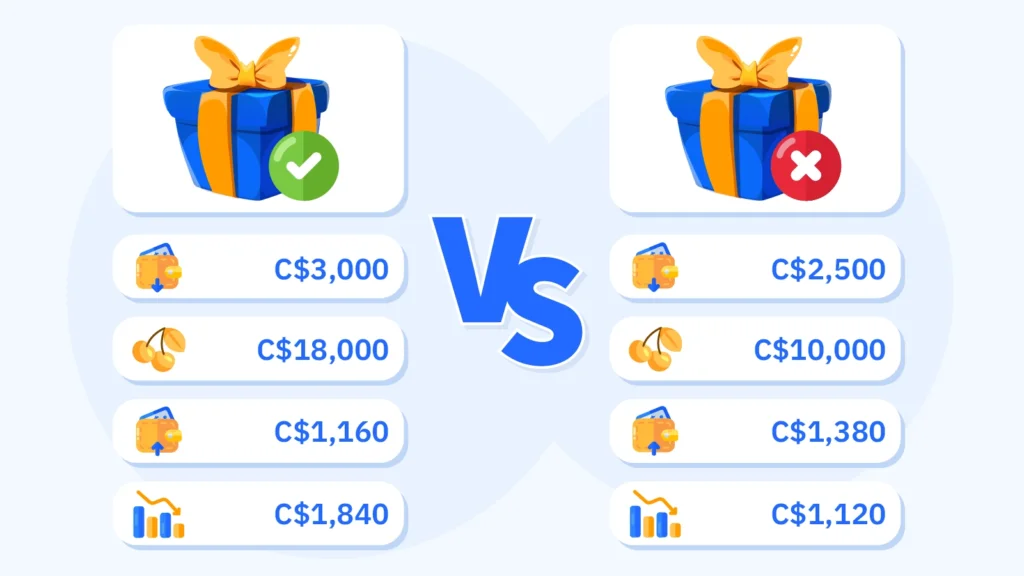
As you can see, Player A deposited C$500 more than Player B over the six months they played. In the end, though, they ended up C$720 further in the hole. That C$720 gap is actually the real cost of chasing bonuses. What do you think? Let us know in the comments!
Why Bonuses Cost More: The Overplay Effect

The mechanism behind this gap is simple, once you understand it. The expected loss in any gambling game increases along with the total wagering volume, not with how much money you deposited. Every spin has a house edge, and that edge takes its cut from every dollar you wager. This applies to money from a bonus, but also to money from your own deposit.
How It Works in Practice
In short, a wagering requirement multiplies the amount of money you have to run through the games. Otherwise, you won’t be able to touch the money you’ve won.
Let’s say you have a 35x requirement applied to a C$100 monthly bonus that’s C$3,500 in wagering volume. Apply this pattern over a full 6 months, and you get exactly how Player A’s wagering volume reached C$18,000. That’s 6 times more than the C$3,000 they actually deposited.
On the other hand, Player B, who had no requirement to meet, wagered a volume of C$10,000. That’s four times their total deposits.
By now, we hope you understand what the overplay effect actually means. A wagering requirement doesn’t just delay a withdrawal, it forces you to bet extra. Bonus money gives you a short-term edge, but the wagering attached to it quietly works against you.
Wagering Psychology (Sunk Cost Forces Continued Play)
The math explains the overplay effect, while the psychology explains why players keep doing it anyway. Let’s say you have a 35x wagering requirement. Once you’ve cleared 20x of it, walking away means losing both the bonus and any money you’d won up to that point.
The Real Scenario
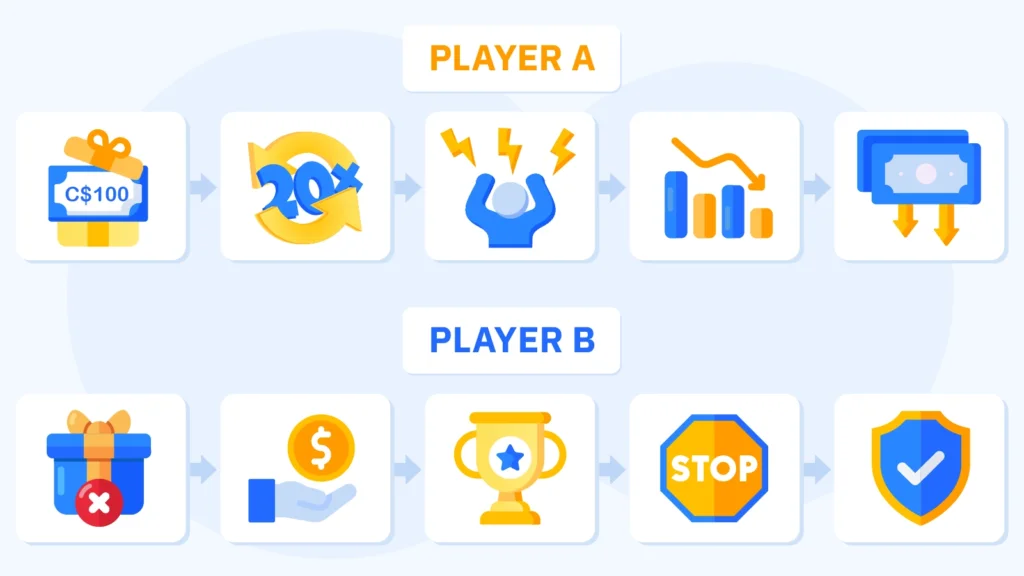
- Player A ran into exactly this in month 4, where a rough patch put them in a position to lose the entire balance they’d built up, before clearing the wagering requirement. There was no other option, either keep playing to try to finish the requirement, or stop and lose all the progress made up to that point. That’s exactly what a wagering requirement does: it keeps the player in the game.
- Player B never had to face a decision like this, because there was no requirement holding them hostage. Any win they landed could be withdrawn right away, and a losing session could be ended right away too. That freedom to stop exactly when you want to is worth more than you might think.
When Bonuses are Better
Bonuses aren’t a trap for you as a player, they can actually work in your favor too, as long as you stick to a few simple conditions.
- You’re playing for fun and see the wagering requirement as the price you pay for extra playtime. Don’t think of it as an investment you’re supposed to profit from.
- Pick a bonus with a low wagering requirement, ideally under 20x, that applies only to the bonus amount.
- The bonus is only eligible on high-RTP games, ideally above 96%. If the offer is tied to low-RTP games instead, the house edge gets quietly inflated.
- The bonus you’re about to activate is small, like a reload or cashback offer, not a big bonus that ties up your gambling budget.
If you stick to all these conditions, a bonus really can help you land extra spins, a longer play session, or even some extra cash. We’re looking forward to hearing in the comments whether you’ve stuck to these conditions, and what the result of your gambling session was.
Strategic Recommendation by Player Type
The right answer depends on the reason why you play. It all comes down to what type of player you are. Here’s how we, the CasinoAlpha experts, have broken this down, along with the advice we’d give you:
- The budget-conscious player: You avoid most bonuses. You’d rather play clean, with no wagering requirements, and keep your total cost as close as possible to what you actually deposit.
- The entertainment player: You go for small bonuses with low wagering requirements. These give you extra playtime.
- The occasional high-roller: If this is your type of player, you need to read the terms around maximum bet limits. Unfortunately, large bets can void your bonus.
- The analytical player: Do your math before activating a bonus. If the wagering requirement is high, this bonus will rarely work in your favor.
How We Verified This
Keep in mind that this comparison is simply an illustrative, constructed scenario. It’s not a real study with tracked players.
We, the CasinoAlpha team, built these figures, month by month, starting from the ground up: each player’s net loss equals total deposited minus total withdrawn, and the wagering requirement math behind Player A’s inflated betting volume reflects real-world requirement structures (roughly 20x to 45x on the bonus amount, most commonly 35x, applied to realistic match-bonus sizes rather than the full deposit).
And the final C$720 gap between the two players checks out exactly against the underlying deposit and withdrawal figures.
We didn’t run an independently audited experiment. So we won’t lie to you! That’s exactly how we’re presenting it to you, and the real value of this exercise is that it shows precisely how wagering requirements actually work.
A Note on Responsible Gambling
Responsible gambling reminder: treat online casino play as entertainment with a real cost, not as a way to make money, and set a budget you’re comfortable losing before you start.
If gambling stops feeling like entertainment, provincial resources like ConnexOntario, Info-Aide Jeu (Quebec), or the Responsible Gambling Council can help, and most provinces offer self-exclusion programs through their licensed operators. This article is for informational purposes only and is not financial or gambling advice.