This article provides predictive analysis about cryptocurrency gambling regulation in Canada based on international trends, provincial regulatory evolution, and crypto adoption patterns as of January 2026. This is not legal advice or financial advice. Cryptocurrency regulations change rapidly. Predictions are analytical opinions, not guarantees.
Canada Crypto Casinos: Bitcoin Legal in Online Casinos by 2029
By Anca Iamandi

Summary
- Bitcoin Casinos: Legal Offshore, Banned in Regulated Markets
- Why Provincially Licensed Casinos Don’t Accept Crypto (Yet)
- Bitcoin Volatility Creates Additional Challenges
- Why Canada Could License Crypto Gambling by 2029
- Predicted Timeline: When Crypto Licensing Happens
- What Crypto Licensing Means for Players
- Obstacles to Crypto Licensing
- What Players Should Do Now
- Summary: Crypto Gambling Regulation Timeline
- Sources
Bitcoin Casinos: Legal Offshore, Banned in Regulated Markets
 The CasinoAlpha team came across something interesting while researching Canada’s gambling market. Canadian players can gamble with Bitcoin, Ethereum, and other cryptocurrencies since offshore casinos are legal. However, there’s one surprising detail: not a single licensed casino in Ontario or Alberta currently accepts cryptocurrency payments. This is an atypical situation.
At the federal level, there are no laws that prohibit gambling with cryptocurrencies, and many Canadians already use digital currencies such as the ones in Bitcoin casinos. Even so, players in Ontario and Alberta are still unable to use cryptocurrencies as a payment method at provincially regulated online casinos.
What’s the situation right now?
CloudBet, BitStarz, and Stake.com are some of the casinos accessible to Canadian players that allow deposits and withdrawals in Litecoin, Bitcoin, Ethereum, and USDT. These casinos process transactions quickly, similar to fast payout casinos, usually confirmed within minutes and fees are low.
On the other hand, research by the CasinoAlpha team found that the 49 licensed operators in Ontario accept only traditional payment methods: Visa/Mastercard and e-wallets like Skrill, Neteller, and in some cases, PayPal. Bitcoin and other cryptocurrencies are not available at all. We expect Alberta and Ontario to allow cryptocurrency payments at licensed casinos by 2028-2029.
As international regulations become more supportive and digital assets gain wider acceptance, regulators are likely to become more open to this technology. From the CasinoAlpha team’s perspective, Bitcoin and other cryptocurrencies could become common payment methods in Canada within the next few years. See more in our guide about the difference between Ontario-licensed and offshore sites.
Why Provincially Licensed Casinos Don’t Accept Crypto (Yet)
 Ontario and Alberta aren’t against cryptocurrencies as a technology. They just haven’t brought them into the regulated casino system yet, mainly because they’re being careful with the rules, especially those around anti-money laundering (AML).
What are the AML challenges?
FINTRAC is responsible for Canada’s anti-money laundering rules, which means casinos have to verify where players’ funds come from. If something looks suspicious, it also has to be reported. For example, imagine a player deposits 5 Bitcoin worth around C$350,000. How can authorities actually tell where that money came from? Was it earned legally, or could it have been converted from other sources, including illegal ones?
With traditional banking, things are much easier to track. You have clear statements and financial records that show the flow of money. Crypto transactions are recorded on the blockchain as well, but tracing them back to the original source is still much more complicated. You can check more on the federal legal framework for Canadian gambling in our guide.
Bitcoin Volatility Creates Additional Challenges
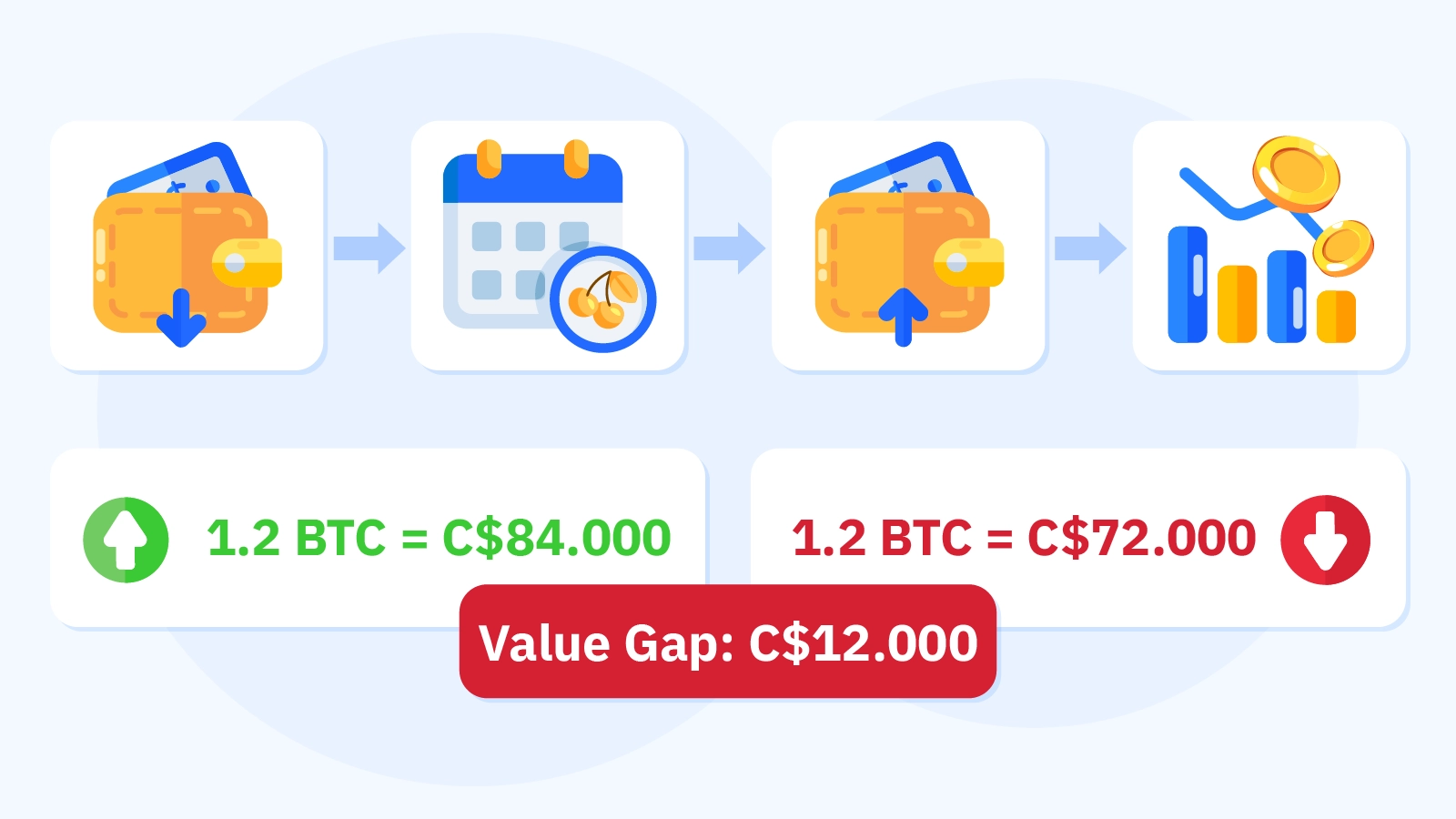 Bitcoin’s price swings create real concerns when it comes to protecting players. Regulators are still trying to figure out how to deal with these issues. For example, imagine a player deposits 1 BTC when Bitcoin is worth C$70,000 and plays for a week.
By the end, they withdraw 1.2 BTC, meaning they’ve won 0.2 BTC. But during that time, Bitcoin drops to C$60,000. So instead of being worth C$84,000, their 1.2 BTC is now only worth about C$72,000.
Questions Regulators Still Need to Address
How do you actually apply responsible gambling rules when the value of a currency can swing 10-20% in just a few days? Our team always promotes responsible gambling, so this is definitely a real concern. Bonuses also need to be taken into account.
What happens if the value of the cryptocurrency drops before the wagering requirements are completed? Based on our experience in this industry, immediately converting crypto deposits into Canadian dollars would help solve part of the problem.
For now, regulators in Ontario and Alberta have decided to leave cryptocurrencies out of their regulated markets. However, this may only be a temporary decision. As regulatory frameworks evolve and the industry gains more experience with digital assets, crypto payments could eventually become part of Canada’s regulated online casino market.
Why Canada Could License Crypto Gambling by 2029
Cryptocurrencies are not currently available at regulated online casinos. The CasinoAlpha team believes that this will change within the next five years.
Growing International Adoption
At present, Europe is clearly leading the way. The Malta Gaming Authority already licenses operators that accept cryptocurrency payments. In Curaçao, for example, CasinoAlpha experts have identified hundreds of online casinos that allow players to make payments using digital currencies.
It is possible that the U.S. will soon introduce cryptocurrencies in casinos. Some operators in Nevada already accept Bitcoin. The CasinoAlpha team believes that cryptocurrencies will eventually become part of Canada’s gambling market.
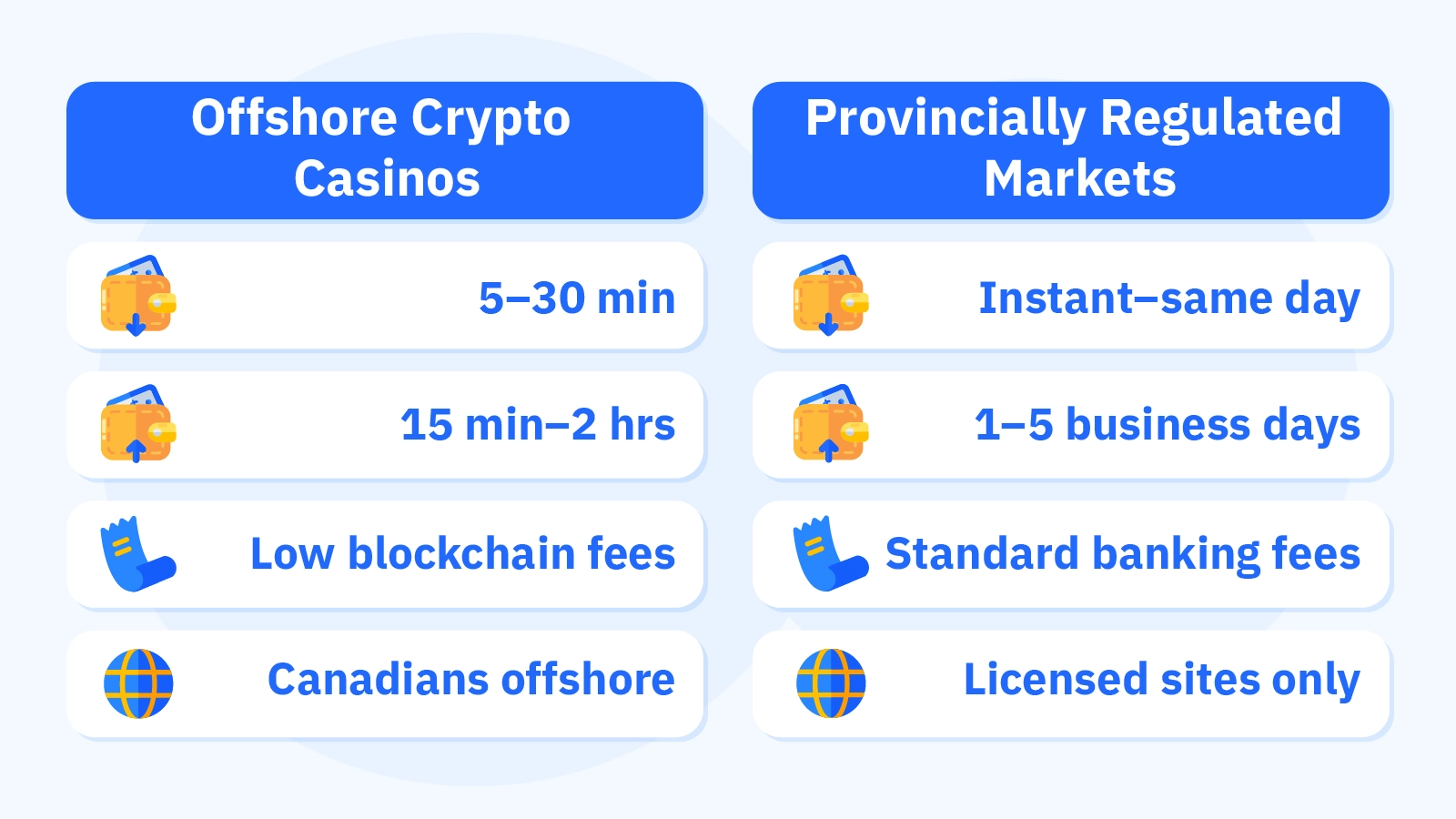
Competitive Pressure from Offshore Casinos Without crypto payments, provincial casinos cannot offer the same benefits as offshore crypto casinos. Over time, we have analyzed hundreds of casinos and reached the following conclusion. Offshore crypto casinos generally offer near-instant deposits, while provincial casinos process deposits within 24 to 72 hours.
Regarding withdrawals, offshore crypto casinos are fast, with funds reaching the player’s wallet within 0–24 hours. At provincial casinos, withdrawals can take up to 72 hours to process.
Fees involved Fees are another advantage of cryptocurrencies, as costs are usually low, with blockchain fees generally ranging between C$2 and C$10. In contrast, provincial casinos typically do not charge direct fees. In terms of privacy, crypto casinos provide a higher level of pseudonymity, whereas provincial casinos require full identity verification (KYC).
If you are a player who values international accessibility, crypto is for you! Crypto wallets can be used globally, while provincial casinos are primarily designed for Canadian users. Regarding volatility, players using cryptocurrencies assume the risk of price fluctuations of digital assets such as Bitcoin. At provincial casinos, transactions are conducted in Canadian dollars (CAD), eliminating such risks.
As online casino experts, we believe that players who value privacy, speed, and international access will continue to choose offshore crypto casinos. Provincial casinos risk losing players if they fail to introduce cryptocurrency payment options. Due to growing competitive pressure, Ontario and Alberta may add crypto payments in the near future.
Predicted Timeline: When Crypto Licensing Happens
Based on international regulatory maturity, Canadian crypto adoption trends, and provincial market evolution, here’s our implementation timeline.
2026-2027: Phase One
The way other jurisdictions regulate cryptocurrency gambling will be analyzed. Close collaboration with FINTRAC is the best approach to ensure clear guidelines for compliance with anti-money laundering regulations. We must not forget about infrastructure! Blockchain transaction verification systems and tools designed to manage associated risks will be required.
2027-2028: Pilot Program
In our opinion, based on years of experience, one or two Ontario-licensed operators are likely to pilot cryptocurrency payments in the first phase. Most likely, these will be major brands with prior experience, such as Bet365 or PokerStars – assuming they have already implemented crypto payments in other jurisdictions. The rollout will be limited, with Bitcoin accepted initially. There will be strict AML requirements in place.
For example, identity verification (KYC) will be mandatory before any deposit can be made. Cryptocurrencies will be converted immediately into Canadian dollars (CAD). To ensure the system operates effectively, all pilot programs will be conducted in accordance with FINTRAC regulations. If the results prove positive and player demand is strong, AGCO is expected to approve the use of cryptocurrencies across all licensed casinos.
2028-2029: Final Implementation
Casino Alpha believes that by 2028, or at the latest by 2029, AGCO/AGLC will publish the official standards required for cryptocurrency payments. From that point onward, all licensed casinos will be able to offer players the option to pay with cryptocurrencies such as Bitcoin, Litecoin, Ethereum, and USDT.
What are the requirements? FINTRAC-compliant AML procedures, verification of the source of funds for large deposits (over C$10,000+), blockchain transaction monitoring, and immediate conversion into Canadian dollars. Responsible gambling tools would also apply, including deposit limits calculated in CAD.
2029-2030: Widespread Adoption
From our perspective, by 2029 most licensed casinos in Alberta and Ontario will already offer cryptocurrency payment options. Along with this shift, player adoption is expected to increase as well. We estimate that around 20–30% of users will choose this payment method.
CasinoAlpha CA believes that the use of cryptocurrencies will be fully authorized in Ontario and Alberta by 2029. However, there are a few important factors that could influence this development, such as the clarity of FINTRAC’s AML guidelines for cryptocurrencies and overall player demand. Make sure to check our site regularly to stay updated on any changes.
What Crypto Licensing Means for Players
When provincially licensed casinos accept cryptocurrency, Canadian players gain advantages currently available only at offshore casinos, but with provincial regulatory protection.
What will be the advantages of licensed casinos that accept cryptocurrencies? First and foremost, players benefit from faster deposits and withdrawals. In general, Bitcoin transactions are processed within 10 to 60 minutes.
Transaction costs are also lower, with blockchain fees typically ranging from C$2 to C$10. In addition, international accessibility is a major benefit. Cryptocurrency wallets can be used globally, making them a convenient payment option for travelers, expatriates, and players who frequently conduct cross-border transactions.
What are the trade-offs compared to offshore crypto casinos? Cryptocurrencies offer a significant advantage in terms of transaction speed. According to CasinoAlpha testing, crypto transactions are processed almost instantly, compared to the 24–72 hours typically required for Interac transfers. However, they may introduce volatility risk if funds are not immediately converted into Canadian dollars (CAD). In terms of privacy, the experience is largely similar.
KYC verification is mandatory regardless of which payment method a player chooses to use. Another advantage is lower transaction costs, as cryptocurrency payments generally involve lower fees due to the efficiency of blockchain networks. International accessibility is superior, since cryptocurrencies can be used globally, making them a convenient option for players who travel frequently or conduct cross-border transactions.
Obstacles to Crypto Licensing
Although the confidence level of this prediction is 65%, based on the information analyzed by CasinoAlpha experts, there are several significant obstacles that could delay the integration of cryptocurrencies into the Canadian market.
FINTRAC’s AML Requirements Are Too Complex
If complying with AML regulations for cryptocurrencies proves too difficult for operators, AGCO and AGLC may decide that the benefits do not outweigh the regulatory burden. Among the requirements are blockchain analysis tools such as Elliptic and Chainalysis, advanced monitoring systems, and qualified compliance personnel. What does this mean in practice? Additional costs for operators. A conservative approach from regulators could lead to delays until cryptocurrencies become more widely adopted.
The Volatility Issue Remains Unresolved: CasinoAlpha’s solution
Cryptocurrency prices fluctuate constantly. Our proposed solution is the immediate conversion of funds into Canadian dollars (CAD). Until then, the introduction of cryptocurrency payments may continue to be delayed. Another reason is the lack of player interest.
Here’s a clear example: if only two out of ten players are interested in using cryptocurrencies for payments, integrating this payment method is not currently a priority. On the other hand, if more players want this option, the situation could change.
What Players Should Do Now
Canadian players wanting cryptocurrency gambling have clear current options and should prepare for eventual licensed crypto casino availability.
Current Strategy and Near Future (2026-2028)
BitStarz, Stake.com, and CloudBet are the casinos we currently recommend. These operators accept cryptocurrency payments. Always verify that the casino holds a legitimate license. CasinoAlpha recommends choosing licensed operators. In addition, be aware of volatility risk. Bitcoin prices fluctuate, meaning that a deposit of C$1,000 could be worth C$900 or C$1,100 the following day.
Next Stage: Licensed Crypto Casinos (2028-2029)
The KYC process will be required even for crypto casinos. You will need a government-issued ID and proof of address. All licensed casinos, regardless of payment method, require KYC. Additionally, be prepared for initial immediate conversion into Canadian dollars (CAD).
Tax Implications
Winnings from cryptocurrency gambling are tax-free in Canada, just like winnings in fiat currency. There is one important consideration: if you purchased BTC at C$50K and used it at a casino when BTC is worth C$70K, the C$20K gain is subject to capital gains tax.
Summary: Crypto Gambling Regulation Timeline
Currently, in 2026, Bitcoin and other cryptocurrencies are fully legal at offshore casinos, such as Stake, BitStarz, and CloudBet. However, no provincially licensed casino accepts crypto. At the moment, they are excluded due to volatility issues, specifically the risks associated with price fluctuations.
Regulators prefer to remain cautious, as this is a new payment method, and they are waiting for an international precedent. Based on analyses conducted by CasinoAlpha experts, we believe that licensing will come in the next few years.
Why? There will be widespread adoption of cryptocurrencies (Canadian banks are offering crypto, ETFs are available). Additionally, competitive pressure will increase (offshore crypto casinos offer faster transactions and lower fees). Finally, there is player demand, with 15-20% of users currently using crypto at offshore casinos.
Estimated Timeline by CasinoAlpha
- In 2026 and 2027, AGCO and AGLC will study the possibility of integrating cryptocurrencies into licensed casinos.
- Pilot programs are expected to launch in 2027-2028.
- Full implementation is planned for 2028-2029, with federal standards expected to be introduced by 2030.
Licensed crypto casinos will combine the protection offered by provincial authorities (AGCO/AGLC) with the advantages of crypto payments, such as faster transactions, lower fees, and international accessibility. It should be noted that the KYC process will be mandatory!
What are the potential obstacles identified by CasinoAlpha?
As with any major change, there may be some obstacles. These include the lack of a clear solution for managing volatility, uncertainty regarding player demand, and possible changes to federal cryptocurrency regulations.
Tips for Players Currently, players can safely use crypto offshore casinos licensed by MGA or Gibraltar, prepare the necessary KYC documentation, understand the risks associated with volatility, and monitor AGCO and AGLC announcements regarding crypto payments. A provincially licensed crypto option could become available by 2029.
The CasinoAlpha team will continue to monitor developments in this area and provide players with updates, insights, and practical guidance. In conclusion, the licensing of casinos that accept cryptocurrencies is inevitable in Canada’s regulated markets between 2028 and 2029. Bitcoin gambling will transition from being an option available only at offshore casinos to a fully licensed provincial alternative.
Sources
- iGaming Ontario, Annual Report 2023-2024 (FINTRAC reporting data): https://igamingontario.ca/en/annual-report-2023-2024
- Montreal Gazette, Best Bitcoin Casinos in Canada (2026), August 29, 2025: https://montrealgazette.com/sponsored/best-bitcoin-casinos-canada
Meet Our Experts

Author
Anca Iamandi
Senior Author & Editor
Anca Iamandi is a Senior Author at CasinoAlpha, specializing in licensing analysis and casino reviews. She uses her linguistic precision to decode regulatory grey areas, and offshore jurisdictions. Since joining CasinoAlpha in 2019, she has written 300+ casino reviews and 150+ bonus guides.

Recommended Articles

VIP Program Value Analysis: When Loyalty Beats Welcome Bonuses
Have you ever calculated how much a welcome bonus is worth and realized that a casino’s VIP program might offer you more benefits? You’re not the only player who’s experienced this. Welcome bonuses may seem more attractive, but the reality is different. We’ve put together a guide to help you understand how both bonuses and VIP programs work.
By Isabell Dreghiciu

Playing While Traveling: VPN, Geolocation, Cross-Border Rules
Have you left Canada for a few weeks and want to play online casino games? Your password works, your account is still active, but are you actually allowed to play while you’re abroad?
By Isabell Dreghiciu
AGCO Penalties for Relax Gaming and Arrise Solutions
On 7 May 2026, many players saw that some games were missing from Ontario casinos. We had no clue why this was happening, but things got clear days later. AGCO issues penalties against Relax Gaming and Arrise Solution because their games were available on unregulated websites outside Ontario.
By Adela Mariuta

Payment Method Comparison for Canadian Players
Did you know that if you choose the wrong payment methods, it will cost you hundreds of dollars in fees, you will encounter withdrawal delays, and you will miss many promotions, especially if you’re a Skrill or Neteller user?
By Adela Mariuta

Interac e-Transfer Timing Study: When to Withdraw for Fastest Payment
To understand just how much the timing of your withdrawal matters, the CasinoAlpha team ran tests for a week. We made withdrawals on different days, at different times, and kept track of everything. What did we find out? Find out for yourself in the paragraphs below!
By Isabell Dreghiciu
Most Read
1.