If you’re planning to gamble in Canada, the first thing you need to know is that the legal age isn’t the same everywhere. Depending on the province you’re in, the minimum is either 18 or 19. In this guide, the CasinoAlpha team breaks down everything you need to know from age requirements by province to verification rules and penalties for underage gambling.
Gambling Age in Canada: 18 or 19? A Province-by-Province Guide
By Isabell Dreghiciu

Summary
- What Is the Legal Gambling Age in Canada?
- Gambling Age by Province: Complete Table
- Why Age Requirements Differ: 18 vs 19
- Age Verification Process: How Casinos Check
- Penalties for Underage Gambling
- Common Questions: Age Requirements
- Age Verification Technology
- International Players in Canada
- Youth Protection: Why Age Restrictions Exist
- Summary: Gambling Age in Canada
- Sources
What Is the Legal Gambling Age in Canada?
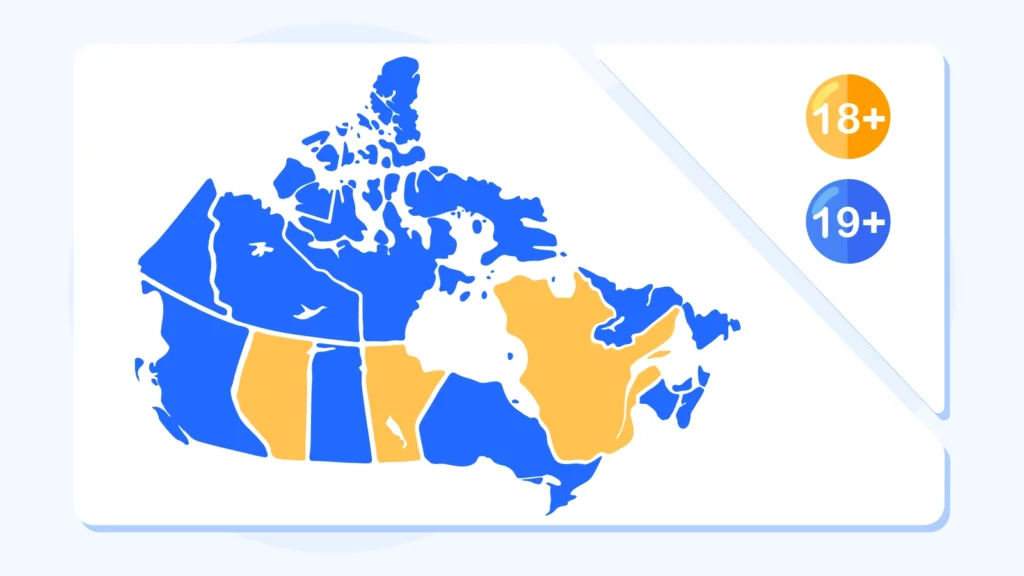
The legal gambling age in Canada is 18 or 19, depending on the province you live in. In Alberta, Manitoba and Quebec the minimum is 18, while in all other provinces you need to be 19 or older.
This requirement applies to online casinos, land-based casinos, sports betting, lottery, poker and bingo. If you think you can fool the casino, think again when registering on an operator’s site you’ll need to provide a valid ID. Gambling is and will remain illegal for minors.
Gambling Age by Province: Complete Table
As you can see, in most Canadian provinces the legal gambling age matches the age of majority. You can notice a few exceptions in Ontario and Saskatchewan. There you become an adult at 18, but you only get access to gambling once you turn 19.
Why Age Requirements Differ: 18 vs 19
18+ Provinces (Alberta, Manitoba, Quebec)
In these provinces, the age of majority is 18, which is also the legal age from which you can start playing at a casino. Once you turn 18 you’re considered a legal adult. You can vote, sign contracts, and automatically gain access to gambling as well.
19+ Provinces (All Others)
In Ontario and Saskatchewan, the age of majority is 18, but the legal gambling age is 19. Why the difference?
In most provinces with a 19+ limit, the age of majority lines up with the legal drinking age. Ontario is a different case though, things work differently there. You’re considered an adult at 18, but both alcohol and gambling are only permitted at 19. This policy decision is meant to protect young people. Gambling is kept away from high school students, since many Grade 12 students are still 18.
Age Verification Process: How Casinos Check
Before your first withdrawal or your first step onto the casino floor, you’ll go through an age verification process. Here’s what to expect on both sides.
Online Casinos (KYC – Know Your Customer)
All licensed casinos are required to verify your age before allowing you to withdraw your winnings. This process happens in 2 steps:
Step 1: Registration (Age Declaration)
When you create a casino account you enter your date of birth. If you’re not of legal age, the casino will automatically block your registration. That’s the moment where you declare on your own responsibility that your age is correct.
Step 2: Document Upload (Identity Verification)
Before making a withdrawal from the casino you need to verify your identity. That means uploading a photo of a valid ID that belongs to you. On top of that, you also need to provide proof of address, a utility bill, a bank statement issued within the last 3 months, or an official government letter.
How long does verification take?
The time varies depending on which casino you’re playing at. For iGaming Ontario licensed casinos, you can expect to wait between 24 and 72 hours. The same timeframe applies to offshore casinos as well. Things change with Curaçao licensed casinos, where you may have to wait up to 7 days.
What exactly do casinos check?
- Your name matches the ID you uploaded.
- Your date of birth confirms you meet the legal age requirement.
- Your address matches the one on your account.
Land-Based Casinos (In-Person Verification)
Entrance verification:
When entering the casino, security staff will ask for your ID for a quick check. If you’re not of legal age, you won’t be allowed in. No exceptions to this rule!
Random checks on the floor:
Once you’re inside, that doesn’t mean things stop there. Casino staff can ask for your ID at any time. On top of that, slot machines may ask for your ID again to verify your age, and table game dealers will also check how old you are.
Penalties for Underage Gambling
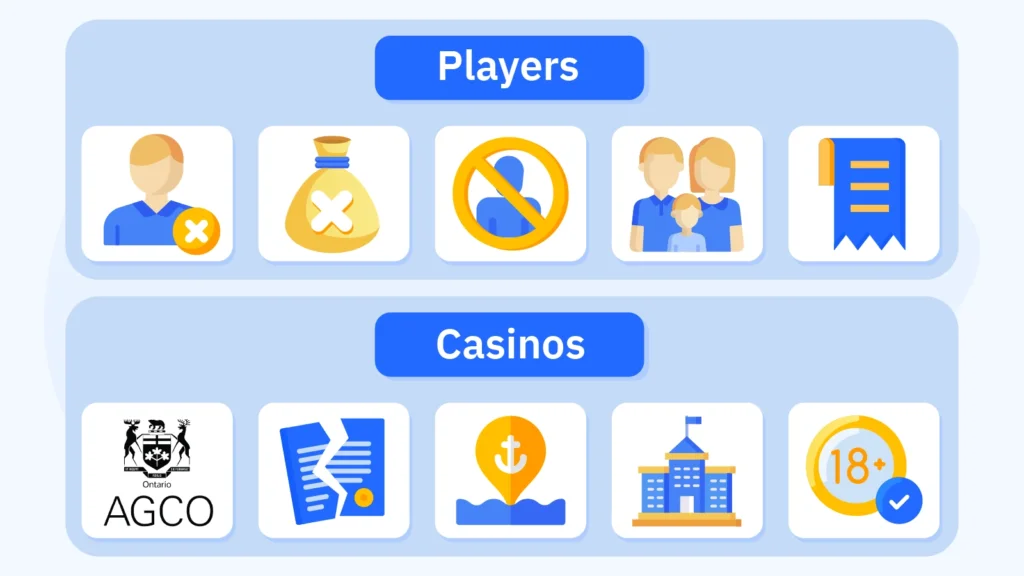
Breaking the rules comes with real consequences for players and casinos alike. Here’s what’s at stake on both sides.
For Underage Players
If you go down this path, your account will be closed and the casino will confiscate your winnings. The casino can then choose whether or not to return the amounts you deposited. On top of all that, you’ll be permanently banned. If the incident takes place at a land-based casino, your parents will be notified.
There are also legal consequences, but these are rarer. You can receive a fine or an official provincial offence notice. If it’s your first offence, you won’t end up with a criminal record.
In reality, at most casinos the consequences stay at casino level. Your account gets closed and your winnings get confiscated. Criminal charges are very rare!
For Casinos Allowing Underage Gambling
Licensed casinos risk a lot if they allow minors to play. The AGCO can apply fines of up to $100,000 per incident and can revoke the casino’s license. For offshore casinos, fines can reach up to €500,000. Casinos are also required to report any incident to the regulatory authorities.
Why do casinos enforce the rules so strictly?
Because they have a lot to lose! They can lose their license, face large fines, and be held legally liable. That’s exactly why licensed casinos verify age so carefully!
Common Questions: Age Requirements
Still have questions? You’re not alone. Here’s what Canadian players ask us most often about gambling age requirements.
Can I gamble at 18 if I’m visiting a 19+ province?
No. The legal age applies based on where you’re playing, not where you live. If you live in Quebec and you’re 18 and you visit Ontario where you need to be 19 to play, you won’t be able to enter the casino. The same applies online. This is why you should always check the age requirement for each province.
Can I use fake ID to gamble underage?
No, this is strictly forbidden and can have serious consequences. You can face criminal charges for fraud or forgery, you’ll be permanently banned from the casino, your winnings will be confiscated, and in more serious cases you could even face jail time.
Modern casinos use specialized ID verification software that quickly detects fake documents. The chances of going unnoticed are very small!
What if I turn 18/19 between registration and withdrawal?
What matters is the age you were when you created your account, not when you withdrew the money. If you registered at the casino and played legally, meeting the minimum age requirement, there won’t be any problem.
If you registered at 17, played, and requested a withdrawal after turning 18, we have a problem. The casino will confiscate all your winnings because you played while you were a minor. As we’ve already told you, this is illegal!
Can offshore casinos accept younger players?
No, even offshore casinos licensed by MGA, UKGC or Kahnawake are required to verify your age at registration and comply with provincial requirements. When it comes to unlicensed casinos, things are different. They may not verify this at registration, and we strongly recommend you stay away from them. They’re not safe!
Age Verification Technology
Wondering what actually happens when you upload your ID? We do too, the CasinoAlpha experts go through this process ourselves when reviewing online casinos. Here are the steps you’ll need to complete!
How Online Casinos Verify Age
The most common method is automated ID verification. You upload a photo of your ID, and an artificial intelligence software analyzes the document in detail. It checks the security features, holograms, watermarks, extracts personal data such as your name, date of birth and address, and compares the document against known official formats to detect any potential fakes.
In some provinces, the information is also checked against government databases. If the automated system raises any concerns, a human employee goes through the verification manually. At the end of the process, you either receive approval or get asked for additional documents.
The whole process typically takes between 24 and 72 hours.
Some casinos go further though and use more advanced verification methods. These include facial recognition, you take a selfie which is automatically compared to the photo on your ID or liveness detection, where you record a short video clip to prove you’re a real person and not just a photograph. Certain casinos also use credit bureau checks to confirm the player’s identity.
Privacy Concerns
When you upload your ID documents to an online casino, there are a few important rights you should know about.
The casino is required to protect your documents through encryption and secure storage. It’s not allowed to share them with third parties, except with regulatory authorities when necessary.
If you request the deletion of your data, the casino must do so after the legal retention period expires. On top of that, you have the right to know exactly how your personal information is being used the casino has an obligation to inform you transparently.
International Players in Canada
Not from Canada? Here’s what international players need to know before gambling in the country.
I’m visiting Canada from US/Europe. Can I gamble?
Yes, but there are a few conditions you need to meet. First, you need to be of legal age for the province you’re in and have a valid ID. Then you need to choose a casino that accepts international players but don’t worry, most of them do.
Keep in mind that the legal age applies based on the province you’re in. If you’re 18 and want to play in Ontario, you can’t. The limit there is 19.
Online casinos are a different story. They directly block IP addresses from outside Canada. There are also offshore casinos that accept international players visiting Canada.
Youth Protection: Why Age Restrictions Exist
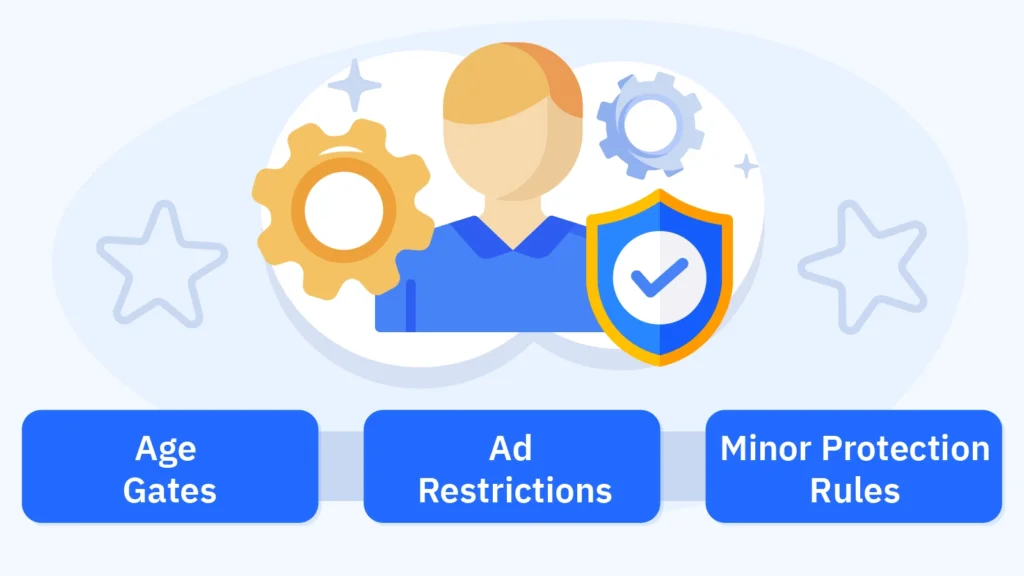
The CasinoAlpha experts have studied this topic carefully and found that the human brain continues to develop until the age of 25. This means that teenagers are much more vulnerable to gambling addiction. As you probably know, young people don’t yet have a solid financial education. They don’t fully understand the value of money or what the consequences of repeated losses look like.
Canadian provinces are aware of this, which is why they’ve put clear age restrictions in place. This way young people are protected from the negative effects that come with gambling.
Things don’t stop there though. Gambling advertising cannot target minors. All online casinos are required to display an age gate before allowing access. Advertising is also not permitted on social media platforms, with TikTok being a concrete example of this.
Summary: Gambling Age in Canada
The legal gambling age in Canada is 18 in Alberta, Manitoba and Quebec, and 19 in all other provinces and territories. If you haven’t reached the minimum legal age, don’t try to fool the casino.
You won’t succeed anyway. Age verification is mandatory and there are no exceptions to this step. At online casinos you need to upload a photo of your ID, and at land-based casinos the check happens right at the entrance.
If you’re caught playing without being of legal age, the casino will close your account immediately and confiscate all your winnings.
Casinos don’t bend these rules because they have a lot to lose if they don’t follow them, especially their license. We draw a simple conclusion from everything we’ve presented to you.
It’s not worth trying to play if you haven’t reached the minimum required age. Even if you manage to fool the system for a few minutes, the casino will still find out you broke the rules and will confiscate your winnings.
Sources
- Provincial Gaming Acts (Various), Legal Gambling Age Requirements, 2026
- AGCO Standards for Internet Gaming, Age Verification Requirements: https://www.agco.ca/
- iGaming Ontario, Player Protection Standards: https://igamingontario.ca/
Meet Our Experts

Author
Isabell Dreghiciu
Author
Isabell Dreghiciu, an Author at CasinoAlpha since 2021, personally tests every bonus with real C$ deposits and withdrawals to uncover hidden terms, explains provincial gambling laws and tax implications on Canadian winnings using plain language, and continuously updates content to reflect regulatory changes.

Recommended Articles
AGCO Penalties for Relax Gaming and Arrise Solutions
On 7 May 2026, many players saw that some games were missing from Ontario casinos. We had no clue why this was happening, but things got clear days later. AGCO issues penalties against Relax Gaming and Arrise Solution because their games were available on unregulated websites outside Ontario.
By Adela Mariuta

Sticky Bonuses Costing You Hundreds: How to Identify and Avoid
You deposited C$500, got C$500 as a bonus, and wagered 35 times. In the end, you are left with C$1,200 in your account. You ask for a withdrawal, and they send back C$700. Where did the rest C$500 go? It was taken away immediately once you asked for a withdrawal because the bonus was sticky.
By Adela Mariuta

Playing While Traveling: VPN, Geolocation, Cross-Border Rules
Have you left Canada for a few weeks and want to play online casino games? Your password works, your account is still active, but are you actually allowed to play while you’re abroad?
By Isabell Dreghiciu

Casino Red Flags: 15 Warning Signs Before Depositing
In our newest guide for Canadian players, we will show you 15 red flags that you must know to identify fraudulent Canadian online casinos in %an%. In our 10+ years of experience, we have seen many red flags.
By Adela Mariuta

Why You Should Never Use Credit Cards: The Cash Advance Trap
Have you ever wondered why a C$100 casino deposit made with a credit card can quietly turn into C$105 or even more before you’ve placed a single bet? The answer comes down to how Canadian card issuers classify these transactions.
By Isabell Dreghiciu
Most Read
1.