The online gambling industry in Canada is undergoing significant changes, and the differences between the rules applied in each province are becoming increasingly apparent. While some provinces have adopted modern and competitive models, others continue to operate under completely different systems. Could Canada eventually adopt a single federal framework to regulate the gambling industry?
Federal Gambling Regulation in Canada: What's Coming by 2030
By Isabell Dreghiciu
Summary
- Why Federal Gambling Regulation Is Inevitable
- Evidence: Why Federal Regulation Is Coming
- What Federal Regulation Could Look Like
- Timeline Prediction: When Federal Regulation Happens
- What Federal Regulation Means for Players
- Counter-Arguments: Why Federal Regulation Might Not Happen
- How to Prepare for Federal Regulation
- Summary: Federal Regulation Outlook
- Sources
Why Federal Gambling Regulation Is Inevitable
Canada’s current gambling framework was designed in 1985, long before the internet even existed. Since then, every province has built its own system. Ontario has competitive licensing, Alberta has a hybrid model, and Quebec operates under a monopoly. What do we notice here? The systems don’t match. The differences are clear and hard to ignore.
What does the CasinoAlpha team think will happen?
We believe that by 2029-2030, Canada will have a national gambling framework. We are 55% confident on that. Either a full federal licensing system will be introduced, or there will be amendments to the Criminal Code that establish standards for all provinces.
Gambling ads from Ontario reach Quebec too, even though the two provinces operate under completely different rules. For players, everything is confusing, and offshore casinos are taking advantage of these regulatory gaps. We believe the moment will come when the government can no longer look the other way.
Evidence: Why Federal Regulation Is Coming
Advertising Regulation Pressure (Senate Bill S-211)
In 2025, the Canadian Senate passed Bill S-211. The bill proposed federal restrictions on sports betting advertising, but it ended up stalling. We read a clear message in this: the government is willing to step in, but only when provinces create problems.
What is the concrete problem?
There are 46 licensed operators in Ontario. All of them advertise aggressively on TV, on social media, and through various sports sponsorships. This isn’t a problem for Ontario — but those ads reach Quebec, BC, and other provinces where these operators aren’t even licensed.
Public health groups are raising the alarm, saying that aggressive advertising is increasing gambling addiction across all of Canada, not just in Ontario. The Canadian Centre on Substance Use and Addiction called for a national strategy in 2024 to address the situation.
CasinoAlpha believes a solution will be found
We are confident that the federal government will step in. This isn’t the first time Canada has been through something like this. There have been similar issues with cannabis and carbon pricing, and the federal government has always intervened.
Provincial Regulatory Divergence Creates Problems
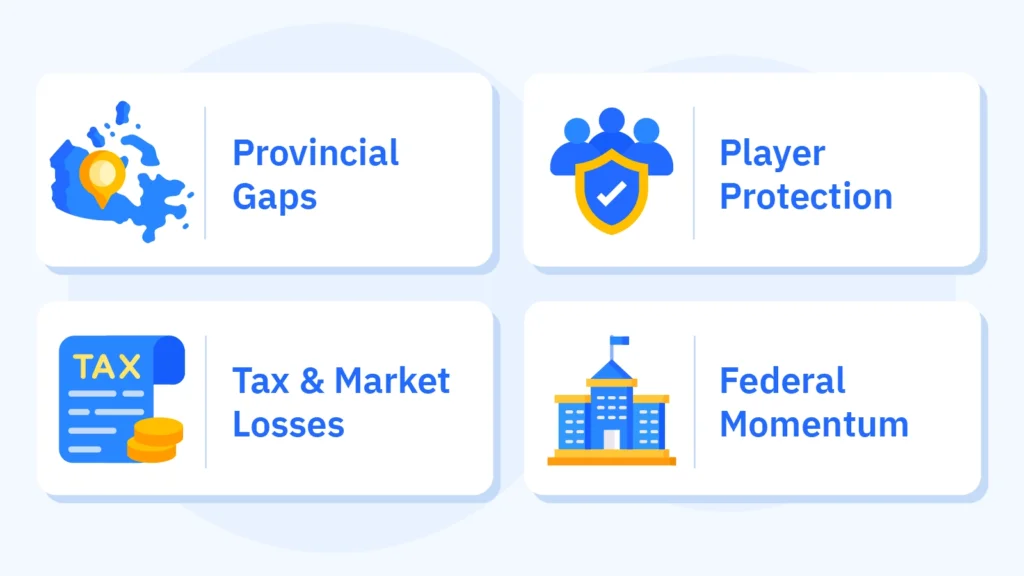
Right now, Canada has four different provincial systems that create confusion for players.
Ontario and Alberta have competitive licensing: There are private operators, tax revenue for the budget, and clear player protection.
- Quebec and BC operate under a monopoly: There is only one government-run site. Offshore casinos are available, but unfortunately nobody oversees them.
- Alberta and the conflict of interest: AGLC regulates private operators while at the same time operating PlayAlberta.
- The other 6 provinces: They have no regulation for online gambling whatsoever. Players use offshore platforms and have no local protection.
All of this has created chaos for players. For example, self-exclusion doesn’t work across provinces. If you self-exclude in Ontario, you can still play in Alberta. Similarly, ads from Ontario reach provinces where those casinos aren’t even licensed.
International Precedents: Federal Regulation Trend
- The United States let each state do whatever it wanted. The federal government stayed out, and New Jersey, Pennsylvania, and Michigan created their own rules. But problems emerged there too. Today, there are serious discussions about a federal framework.
- Australia went through a similar process. States had different regulations, and in 2001 the government imposed a set of standards that applied everywhere.
- The European Union works in a similar way. Each country has its own rules, but there are a few common directives that apply to everyone:for example, data protection and responsible gambling tools.
- We believe Canada will follow the same path. Ontario and Alberta have already experimented with this, and we think the same will happen in Canada by 2029-2030.
What Federal Regulation Could Look Like
Federal intervention could look like several different things. Either a few common rules, or a fully Ottawa-controlled system. We see 3 possible scenarios:
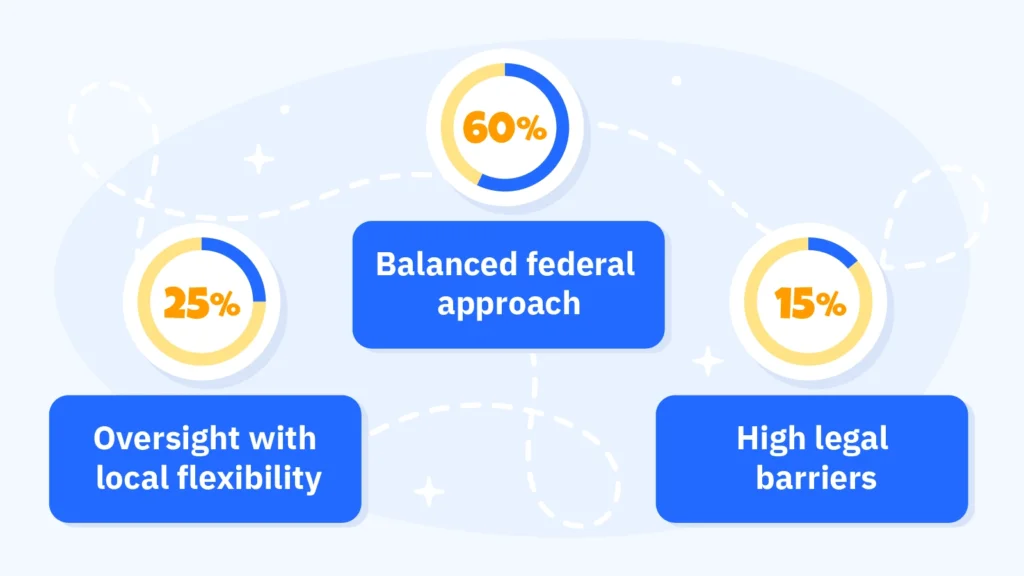
Minimum standards for all provinces (60% – most likely)
The government will not take full control, but it will establish a set of basic rules that every province must follow. Otherwise, gambling will not be regulated.
Mandatory rules everywhere:
- Minimum age of 19
- Responsible gambling tools such as deposit limits and self-exclusion
- Advertising restrictions, no ads targeting minors
- Self-exclusion that works across all provinces
Scenario B: Federal Licensing (25% confidence)
We are less confident about this scenario, to be honest. That said, there is a chance the federal government creates a national licensing body, similar to what CRTC does for television. Under this model, an operator would first need to obtain a federal license, and then a provincial one, if the province requires it.
So what would this actually look like in practice?
First, a federal license would cover the basic requirements, financial stability and game fairness. On top of that, a provincial license would add more specific requirements for each province, such as language and higher taxes.
We believe this scenario would be useful because operators would no longer need to apply separate rules for each province. Everything would be simpler, faster, and with less bureaucracy.
We know provinces won’t be very happy about this and could argue that such a system would violate their constitutional jurisdiction. The federal government would need to find a solid justification.
Scenario C: Full Federal Takeover (15% confidence)
This is a scenario where the federal government takes complete control. That means Section 207 of the Criminal Code would be amended, and gambling regulation would shift from the provinces to the federal level. What does that mean? One single national system replaces all provincial systems.
We believe this scenario is unlikely to happen. Since 1985, gambling has been a provincial jurisdiction. No federal government wants a constitutional battle of this scale.
Only one thing could change that. A major scandal, such as money laundering, could force a federal emergency intervention. It remains to be seen! On our website you will find the latest information!
Timeline Prediction: When Federal Regulation Happens
Our team analyzed legislative cycles, how provincial regulations evolve, and how long it takes for problems to emerge. Here are our conclusions:
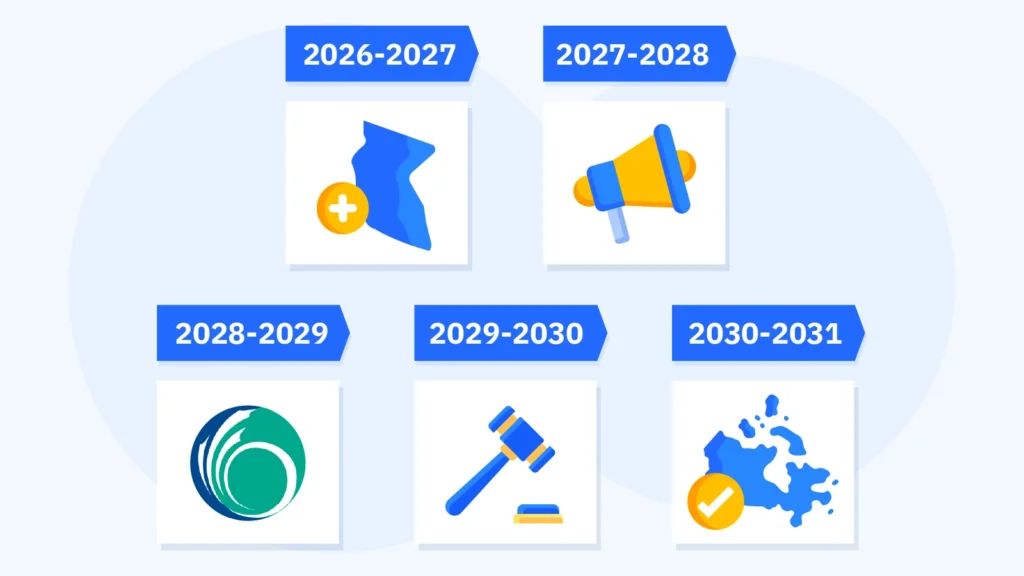
We believe that by 2029-2030, the federal government will impose a common set of rules for all provinces. We are 55% confident on that! Keep one thing in mind though, we are not talking about a full takeover, but a basic framework!
What could trigger this intervention?
There are several things that could lead to this, such as ads from Ontario reaching all of Canada, and self-exclusion not working across provinces. On top of that, there is the growing pressure from public health groups. The day will come when the federal government can no longer sit on the sidelines!
What Federal Regulation Means for Players
Federal involvement would bring both benefits and potential restrictions for Canadian players. Find out in the following lines what the CasinoAlpha team’s experts think.
The benefits of a federal framework
Self-exclusion would finally work everywhere. As we mentioned before, if you self-exclude in Ontario, you can still play in Alberta. This is not fair for a player who genuinely wants to self-exclude. A federal framework would create a national self-exclusion registry that blocks your access across all provinces and all licensed operators.
Clear rules everywhere. Deposit limits and reality checks would work the same way in every province. This would eliminate the confusion around different provincial requirements. All operators would have a similar system that meets federal standards.
Fewer gambling ads. Advertising restrictions applied at a national level would also help reduce the number of gambling ads. Right now, Canadian media is flooded with ads on TV, radio, and online.
Potential restrictions
Rules could become even stricter. If the federal government imposes income-based deposit limits, all provinces must comply. What does that mean? More protection, but less freedom for players!
Harder access to offshore casinos. Even if provinces can’t block offshore sites, the federal government can. That means you, as a player, will have far fewer options.
Smaller bonuses. Right now, provinces keep all gambling tax revenue. What if the federal government wants its own share? That would mean smaller bonuses for players!
Counter-Arguments: Why Federal Regulation Might Not Happen
The Constitution stands in the way of change. Provinces have had the legal right to manage gambling since 1985. What does that mean? For the federal government to take control, a solid constitutional justification must be found. Quebec will certainly be against it.
Nobody truly wants this. The federal government is focused on healthcare, the economy, and climate. Gambling is not a priority right now.
Provinces already have their own systems. Ontario and Alberta have invested heavily in AGCO, AGLC, and iGaming Ontario. They certainly don’t want Ottawa stepping in.
The industry doesn’t want federal regulation. Operators prefer working with provinces. That way everything is more flexible and easier to influence.
The current system works. Ontario proves every day that the competitive model works, and Alberta is following its example. Why change something that works?
How to Prepare for Federal Regulation
There are a few clear signals you can watch for to get a sense of whether federal regulation is getting closer. We will help you understand what to look out for and how it could affect you.
Signals that federal regulation is approaching
If you see news about a parliamentary committee reviewing Section 207, bills about advertising, or agreements between provinces on self-exclusion, things are moving.
What does each scenario mean for you?
- Scenario A – minimum standards: The least disruptive. You continue playing as you do now, but with added protections. Offshore casinos remain accessible too.
- Scenario B – federal licensing: Operators need to obtain a new federal license. Casinos will go through a transition period. In the long run though, more casinos could operate across all provinces with a single license.
- Scenario C – federal takeover: The most disruptive scenario. If it happens, all provincial systems disappear and everything is rebuilt from scratch. Access to offshore platforms could be restricted.
Summary: Federal Regulation Outlook
Canada currently has 4 different provincial systems for gambling. This creates confusion for players and opportunities for those who want to take advantage of the regulatory gaps.
Why do we think things will change?
Ads from Ontario reach all of Canada, and self-exclusion doesn’t work across provinces. Right now, public health groups are putting on the pressure. At some point, someone has to fix these problems, right?
We believe that by 2029-2030, the federal government will impose a clear set of rules for all provinces. From that point on, you will be able to enjoy self-exclusion that works across all of Canada, clear regulations, and more control. Keep in mind that there is a chance you may no longer be able to access offshore casinos. It remains to be seen.
Our advice is to follow the news, keep an eye on our website, and play on multiple platforms. In the event of a federal transition, you may experience temporary disruptions.
Sources
- Canadian Gaming Business, 7 Big Canadian Gaming Questions Awaiting Answers in 2026, January 6, 2026: https://www.canadiangamingbusiness.com/2026/01/06/7-canadian-gaming-questions-2026/
- CCSA, Calls for National Strategy to Tackle Gambling Harms, July 3, 2024: https://www.canadiangamingbusiness.com/2024/07/03/ccsa-national-strategy-gambling-harms/
- Criminal Code of Canada, Section 207: https://laws-lois.justice.gc.ca/eng/acts/C-46/section-207.html
Meet Our Experts

Author
Isabell Dreghiciu
Author
Isabell Dreghiciu, an Author at CasinoAlpha since 2021, personally tests every bonus with real C$ deposits and withdrawals to uncover hidden terms, explains provincial gambling laws and tax implications on Canadian winnings using plain language, and continuously updates content to reflect regulatory changes.

Recommended Articles

UK Financial Risk Checks Are Coming to Canada: What Deposit Monitoring Means
This article provides predictive analysis about potential Canadian adoption of UK-style financial risk assessments based on international regulatory trends as of January 2026. This is not legal advice. Predictions are analytical opinions. Actual regulatory implementation may differ significantly from UK model.
By Adela Mariuta

Casino Bonus vs No Bonus: 6-Month Total Cost Analysis
Should you take the welcome bonus or not? The question sounds simple, but the answer comes down to a single factor most players overlook: the wagering requirement. To see exactly what difference it makes, we compared two players with the same C$5,000 budget, the same games, and the same six-month period – one claimed every bonus offered, the other played with cash only. The numbers at the end show a C$720 gap between them, and the reason behind that gap is worth understanding before you hit “claim bonus” next time.
By Isabell Dreghiciu

New Casino vs Established: Risk Analysis
A brand-new casino with a huge bonus, or an older one with a solid reputation? The choice is never as simple as it looks. Each option comes with its own advantages and risks, and the real difference doesn’t necessarily come down to the casino’s age, but to what’s actually standing behind it.
By Isabell Dreghiciu

Problem Gambling Early Warning Signs: Self-Assessment
Gambling can be a form of entertainment, but for some people, the line between fun and a genuine problem becomes hard to see. In this guide, we explain what gambling addiction means from a clinical standpoint, the criteria specialists use to identify it, and how you can recognize the signs early on. Our goal is to help you better understand this topic, whether it concerns you directly or someone close to you.
By Isabell Dreghiciu

Europe's Gambling Crackdown Playbook: Which Canadian Provinces Will Copy Germany's Rules
This article provides predictive analysis about potential Canadian adoption of European-style gambling restrictions based on international regulatory trends as of January 2026. This is not legal advice. Predictions are analytical opinions. Canadian regulations may differ significantly from European models.
By Isabell Dreghiciu
Most Read
1.