Everyone tells you to set a limit and stick to it, as if it were that easy. The problem is that very few players manage to stick to that limit. We analyzed six different methods, compared them, and have presented the results to you. We found significant differences, but it’s best if you take a look and decide for yourself which method works best for you.
6 Stop-Loss Methods That Actually Keep You in Control
By Isabell Dreghiciu

Summary
Why Stop-Loss Usually Fails

There’s the sunk cost effect meaning the more you’ve lost, the harder it is to stop without feeling like you have to recoup your losses. Then there’s the just one more spin mindset. Even if you set a limit an hour ago, you tell yourself that one more spin will bring you that much-desired win.
There may also be the temptation to place larger bets, driven by the desire to recoup your losses. That’s how you end up raising the stakes and exceeding the limit you’d just set for yourself.
We believe there’s a deeper reason why these situations are so difficult to manage in the moment. The decision to set a limit and the decision to break it are two completely different mental states. We’ve learned that psychologists call this phenomenon “hot-cold empathy.” Basically, you set your limit when you’re calm, before you start playing, and the decision to exceed it arises when you’re in an intense emotional state, after you’ve already lost a lot of money.
Illustrative Testing Setup
We compared six different methods using an illustrative testing scenario designed to show how each approach might perform.
Keep in mind that we included both slots and live dealer games, as well as long and short sessions. When we say sticking to the limit, we mean that the player stopped at the limit or before reaching it. We allowed only one extra spin or bet!
Here’s what Alexandra Camelia Dedu, the editor of this article, discovered.
Set a Loss Limit
Before you start playing decide when to stop. Think about the budget you’ve set for the session, and set a limit of 50%. If you start with C$100, stop at C$50.
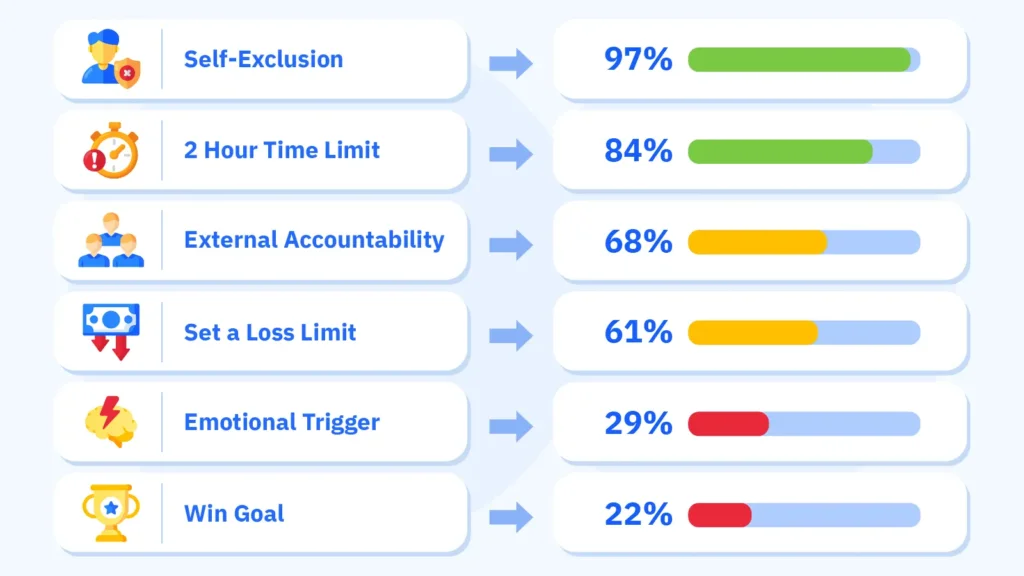
In the sessions we tested, the limit was adhered to in 61% of cases, which puts us roughly in the middle of the pack. We’d say that’s a concrete and easy-to-understand limit, right?
The problem arose when players had to track their losses. Many relied on estimates and didn’t check their actual balance themselves.
We recommend that you avoid doing mental math and actually check your balance. Another thing you can do is set an exact amount instead of a percentage.
Time-Based Limit
You set a clear time limit, usually two hours and stop when the alarm goes off, regardless of whether you’re ahead or behind.
The result was that 84% of participants stuck to the limit, and as you can see, this becomes the second most effective method tested. We think it’s easier to stick to a time limit than a money limit, so when the alarm goes off, all you have to do is stop.
It’s best to use a real alarm on your phone don’t try to estimate how long you’ve been playing. Time can fly by very quickly while you’re playing, so you might get carried away.
Win Goal
You decide in advance that you’ll stop once you’ve managed to double your initial budget. You no longer use a loss limit as a stop signal instead, you use a profit target directly.
Only 22% of participants stuck to this limit, the lowest percentage among the six methods tested. Keep in mind, that doubling your money is a rather arbitrary threshold when you’re winning, you might get too excited and want to keep playing.
Our advice is to use a clear profit target. When you reach that point you must cash out.
Emotional Trigger
Stop as soon as you notice that you’re feeling frustrated or nervous. Don’t base your decision on a specific amount or time limit, but only on your emotional state.
Only 29% of participants stuck to this limit. It’s the second least effective method. This method relies on self-control, and that’s exactly where the problem lies. When you’re frustrated, it’s hardest to assess your state of mind and make good decisions.
Our advice is that if you want to use this method, combine it with a clear time or money limit.
Casino-Provided Limits
This is a real feature offered by regulated operators, not just a hypothetical scenario. It could be a session limit, a deposit limit, or even a cooling-off period you choose directly from your account.
The result is a 97% compliance rate, so we can quicky see that this is the most effective method. Since this is a system-wide limit, there’s no room for negotiation. You can’t play for 5 extra minutes, even if you want to.
Our advice is to set up this feature before you need it.
External Accountability
With this method, you need to talk to your partner or someone close to you and tell them about the time limit you’ve set for yourself. That person should contact you after the time has elapsed to see if you stuck to it.
The results are good in fact, this method ranks high on our list. It works because it introduces an external accountability you’re no longer making the decision on your own; you’re explaining it to someone else. However, its effectiveness also depends on the other person involved, so be careful who you choose.
We recommend choosing someone you trust and who will help you stick to the time limit.
Best Combinations and How to Implement
Self-exclusion tools should not be combined with other methods, they are already very effective. The reason is simple, they do not depend on a decision you make right at that moment. But what do you do when the casino does not offer such tools.
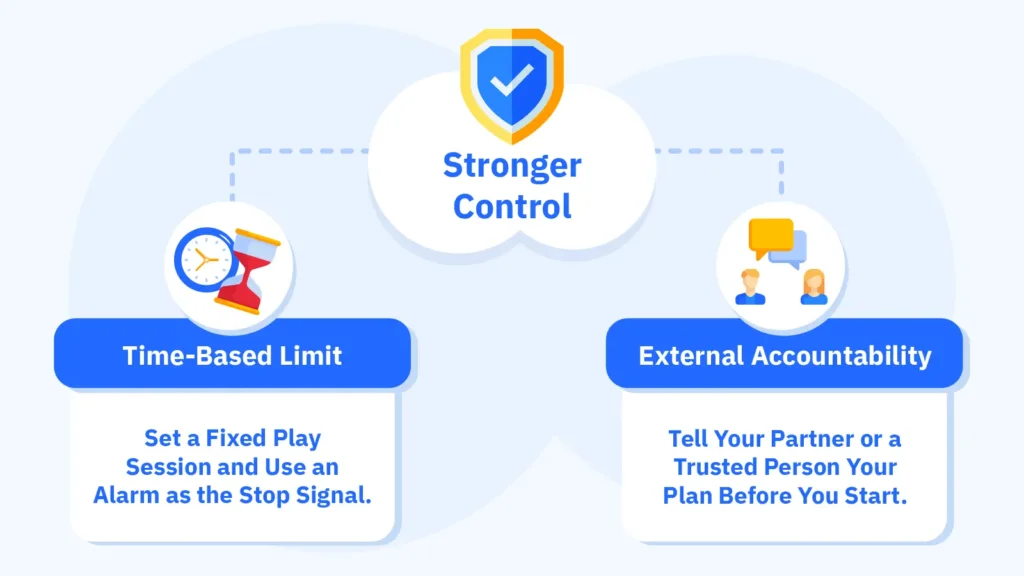
Our opinion, as the experts at CasinoAlpha, is that the most effective approach is to combine a time limit with letting a partner know about your plan.
What Gambling Control Tools Are Available in Canada?
In Ontario, these tools are already mandatory, so you’ll find them at all casinos registered with iGO. As a player, you have access to deposit and loss limits, cooling-off periods, and notifications regarding your gaming session. If you want to self-exclude, the best option is the BetGuard Centralized Self-Exclusion Program, where you can block your access to all iGO operators for 6 months, 1 year, or even 5 years. The choice is yours.
Alberta now also has a regulated iGaming market. It launched in July 2026, and casinos are now required to offer a centralized self-exclusion system. So rest assured if you’re playing at a casino in Alberta, you can set time and money limits, just like in Ontario.
The Bottom Line for Players
Let’s take a look at all six methods do you notice the same pattern? The rules that don’t depend on decisions you make on a whim work best. Methods that rely on your self-control as a player yield poorer results, that’s the truth.
That doesn’t mean you lack willpower don’t get us wrong. It’s simply that self-control works differently when real money and emotions are involved.
We recommend taking a few minutes before you play to set up a tool that will reduce your need for self-control. It could be a limit set directly by the casino or an alarm on your phone. Or how about talking to your partner and asking them to help you? One thing is clear: any method works better when you set it up before your session, not while you’re playing.
How We Verified This
The claims you’ll find in our article where we state that automated tools and set limits are more effective are based on established research on self-control. We did not make these claims on our own without backing them up with verifiable evidence. Additionally, we took into account the hot-cold empathy gap phenomenon. On our website you’ll always find conclusions based on verifiable sources.
We want you to keep one very important thing in mind. The scenario we’ve presented in this article is just an illustrative example, it’s not a real-life study. We believe it will help you better understand the differences between the methods described above and how you can put them into practice.
If you find that you’re unable to stick to any of the loss-limiting methods even the automated ones, it’s worth taking this seriously. It may be a sign that you need a little extra support. In Canada, services like ConnexOntario are available for people who need help or someone to talk to.
Meet Our Experts

Author
Isabell Dreghiciu
Author
Isabell Dreghiciu, an Author at CasinoAlpha since 2021, personally tests every bonus with real C$ deposits and withdrawals to uncover hidden terms, explains provincial gambling laws and tax implications on Canadian winnings using plain language, and continuously updates content to reflect regulatory changes.
Recommended Articles

Canada Crypto Casinos: Bitcoin Legal by 2029
This article provides predictive analysis about cryptocurrency gambling regulation in Canada based on international trends, provincial regulatory evolution, and crypto adoption patterns as of January 2026. This is not legal advice or financial advice. Cryptocurrency regulations change rapidly. Predictions are analytical opinions, not guarantees.
By Anca Iamandi

PIPEDA and Online Casinos: Your Data Privacy Rights Canadian Operators Must Follow
When you register at an online casino, you hand over a lot of personal information. But what happens to it after that? PIPEDA is the Canadian law that protects your data and guarantees you clear rights against any operator. Here’s what you need to know.
By Isabell Dreghiciu

Federal Online Gambling Regulation Is Coming to Canada: Criminal Code Review Analysis
The online gambling industry in Canada is undergoing significant changes, and the differences between the rules applied in each province are becoming increasingly apparent. While some provinces have adopted modern and competitive models, others continue to operate under completely different systems. Could Canada eventually adopt a single federal framework to regulate the gambling industry?
By Isabell Dreghiciu

A Province-by-Province Dispute Resolution Guide
We saw many situations when a Canadian customer plays at a random casino and asks for a cashout, and all he receives is silence, or in the worst cases, refusals. Why do these things happen, you may ask?
By Adela Mariuta

Online Gambling Age Requirements by Province: 18 vs 19 and Verification Rules
If you’re planning to gamble in Canada, the first thing you need to know is that the legal age isn’t the same everywhere. Depending on the province you’re in, the minimum is either 18 or 19. In this guide, the CasinoAlpha team breaks down everything you need to know from age requirements by province to verification rules and penalties for underage gambling.
By Isabell Dreghiciu
Most Read
1.