What Casinos Tell You About RTP: The Marketing Claim
You search for a slot at a random Canadian casino in 2026 and you see Blood Suckers by NetEnt with 98% RTP. After that, you see Starburst with a 96.09% RTP and Book of Dead with a 96.21% RTP. You use the filter and get every high RTP slot immediately in front of you.
After that, you think that Blood Suckers with a 98% payout rate will get you back C$98 after each C$100 wagered, and you choose high RTP slots from the library because of that. You also think that if you choose low RTP games, you will not encounter the same positive experience.
What Casino Marketing Suggests:
- Higher RTP = better returns for YOU
- 98% RTP = lose only C$2 per C$100 bet
- RTP can show your session results, like a prediction
- Always choose the highest RTP available
This sounds logical. If one slot returns 98% and another returns 94%, you should obviously play the 98% slot and keep an extra C$4 per C$100 wagered. Casinos reinforce this by prominently displaying RTP, featuring “high RTP slots” categories, and letting players filter by RTP percentage.
The Problem: What players consider true is not because you need to play millions of spins to experience the true RTP. For your 100-500 spin session this weekend, the RTP tells you almost nothing about what the outcome of your session will be.
For example, a 98% RTP slot can easily drain C$500 in 200 spins, while a 94% RTP slot can hit a bonus round that will give you C$800 instantly.
The Quick Heads UP: The reality is that RTP is a long-term mathematical approach that requires sample sizes most players will never experience in a single session. Never forget that your short-term outcomes are dominated by variance, hit frequency and bonus rounds, metrics that casinos don’t advertise because they’re harder to market, so it’s simple to let players consider the RTP concept via misconceptions.
What RTP Actually Means: Infinite Spins Only
RTP means Return to Player, and it’s a percentage that shows how much a slot can give back to the player over its lifetime. For example, a 96% RTP means the slots are designed to return C$96 for every C$100 played across all users, sessions, and spins, every time.
The Critical Qualifier: Sample Size So, the accuracy of the RTP needs high sample sizes approaching infinity. A slot RTP triggers its programmed percentages if the spins increase. This is why best payout casinos rank sites by verified RTP across thousands of games and not individual session results. 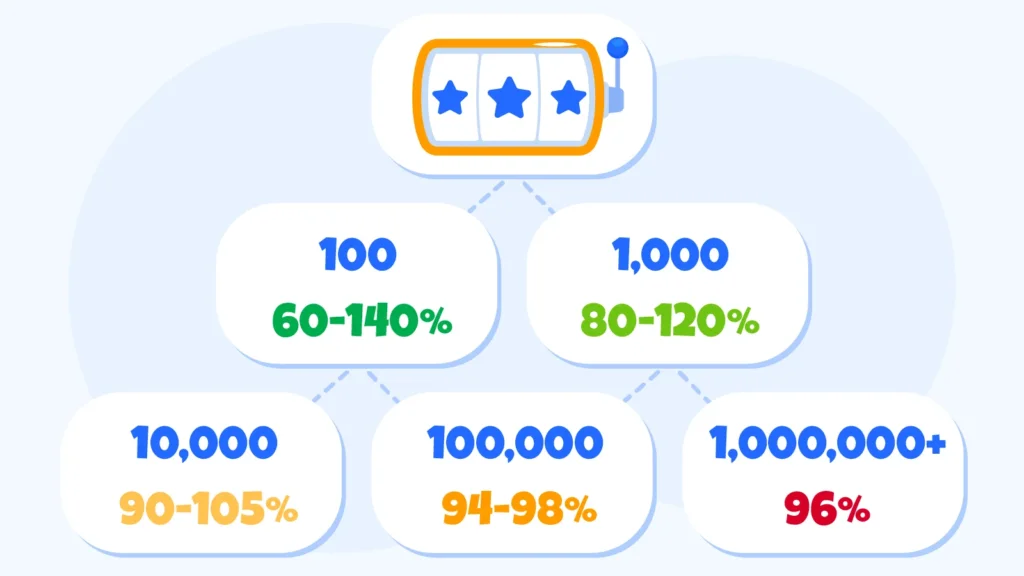
- 100 spins: This is the wild variance, and the outcome can be from 60% to 140%.
- 1,000 spins: This is the high-variance scenario when the outcome can be between 80% and 120%.
- 10,000 spins: In a moderate-variance scenario, the results will range from 90% to 105%.
- 100,000 spins: Results range from 94% to 94%-98% (low variance). This is the low-variance phase, and the outcome ranges from 94% to 98%.
- 1,000,000+ spins: The results are close to 96%, which means that it will match the RTP.
So, in conclusion, for a slot to show its true 96% RTP, it needs to be tried by players millions of times by thousands of players over months or years. For example, your 200 spin session tonight means 0.00002% of the sample size you need for the RTP to be predictive.
The Mathematical Reality: The RTP is calculated via this formula, which is the Total Amount Returned to Players/ Total Amount Wagered x 100. But remember that this is measured across the slot’s operational lifetime, meaning every spin by every player at every casino gives you the chance to play those slots.
If you play 300 spins at a slot, you’re not experiencing the RTP, but a little random sample from an infinite distribution where singular samples have high variance.
What Game Developers Actually Test: So, when providers like NetEnt start testing a new slot that claims to be 96.5% RTP, they run simulations of 10-100 million spins to check the maths.
Be aware that they’re not testing if you will get 96.5% back in your sessions. On the contrary, they verify that across infinite play. Basically, the RTP tells you nothing about the next 100 spins you’re about to play.
Our Testing: 10,000 Spins vs 100 Spins Results
We played Starburst, which has 96.09%, in multiple sessions to make this comparison between 10,000 and 100 spins. We did this to see when the actual RTP is getting predictable. We used Interac e-Transfer to fund our test sessions because there are zero fees and deposits land in under 60 seconds.
The Test Setup
The slot we picked was Starburst, and we played C$1 via 10,000 spins. We experienced 100 separate sessions with 100 free spins, and we checked the spin result. We also recorded balances at 100-spin intervals, and we calculated the actual RTP at every checkpoint.
10,000 Spin Results (Long-Term)
After we finished all of the 10,000 spins, this is the result:
- Total wagered: C$10,000
- Total returned: C$9,620
- Actual RTP: 96.2%
- Deviation from advertised 96.09%: +0.11%, which is good
After 10k spins, we saw that the slot started to perform as we expected mathematically.
100 Spin Results (Short-Term)
We took 100 separate 100-spin sessions from our 10,000-spin data to see short-term variance:
1
00-Spin Session Range:
- Lowest return: 54%
- Highest return: 142%
- Spread: 88 percentage points
- Average: 96.3% (matches long-term, but useless for predicting individual sessions)
What the Data Shows
So, at 10,000 spins, the RTP becomes predictive because we got 96.2% that matched the 96.09% advertised. Still, at 100 spins, the individual sessions ranged from losing 46% to getting 42%, despite the identical RTP. The 96% average across 100 spins is correct mathematically, but it will not help you predict your next session.
Visual Representation of Variance: Take all 100 sessions and put them into a chart. The 10,000 spin outcome is 96%, which is a very solid, predictable number. Yet, the 100 spin result is 54% to 142%, which is quite an erratic cloud with each point randomly landing anywhere in between.
It is the explanation behind why the RTP value is meaningless when it comes to your session. You are obviously not spinning for 10,000 rounds tonight. Instead, you’ll play for 100-500 spins, but the outcome will be determined by the bonus round and not by the RTP.
The Data: Why 100-Spin Sessions Range 60%-140%
As you will play in short bursts, there will be higher variance. There is nothing random about this; that’s just the way that the bets on slots match work. For understanding that, you need to know how today’s slots generate their results.
How Slot Variance Creates Wide Ranges
So, the slots will not pay steadily at 96% per 100 spins. They pay via many wins, which creates extreme variance over short samples.
Typical 100-Spin Session Patterns: 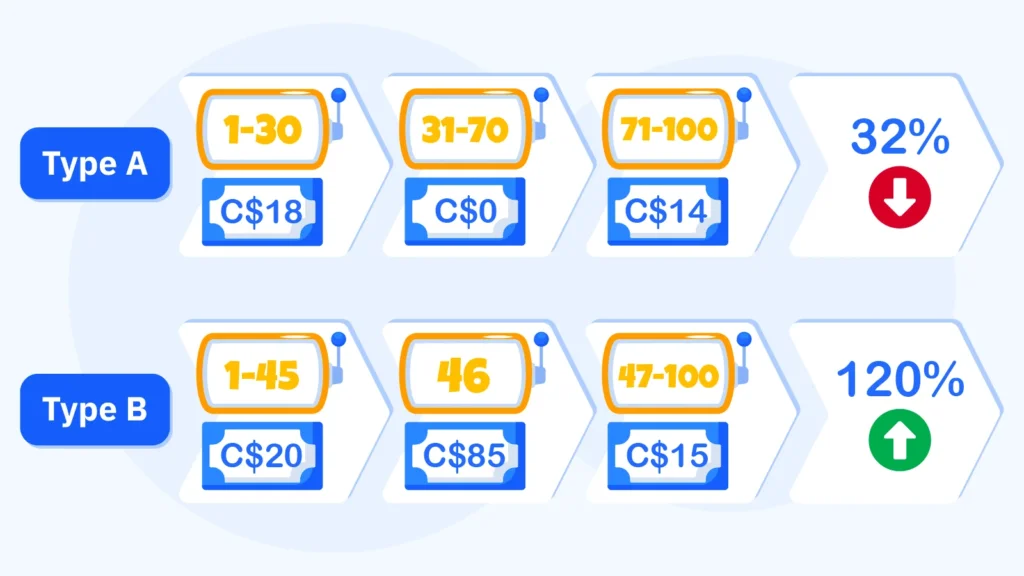
Session Type A: With No Bonus (60% return)
- Spins 1-30: Small wins (10x, 5x, 3x) totaling C$18
- Spins 31-70: Dead spins, no wins
- Spins 71-100: Small wins (8x, 4x, 2x) totaling C$14
- Total return: C$32 on C$100 wagered = 32% actual RTP
Session Type B: One Bonus (140% return)
- Spins 1-45: Small wins totaling C$20
- Spin 46: Bonus trigger, pays C$85
- Spins 47-100: Small wins totaling C$15
- Total return: C$120 on C$100 wagered = 120% actual RTP
Both these sessions were played with the same 96% RTP slot. The difference is that one experienced a bonus and the other didn’t.
The Bonus Feature Problem
The modern slots always concentrate returns in infrequent bonus features rather than regular traditional wins. This is where the short-term variance comes from.
Example: Book of Dead (96.21% RTP)
- The hit frequency of the base game: 26% (win on 26 of 100 spins)
- Bonus trigger frequency: 1 in 215 spins
- Average bonus payout: 45x-60x bet
If you’re on a 100 spins session, you will have a 46% probability of not getting the bonus because 100 spins are not enough to guarantee getting a 1-in-215 event. So, without a bonus, you’re playing a 93% RTP base game. With a bonus, you can see a 150% return.
Your 100-Spin Outcome Depends On:
- If you experienced a bonus round, but there is a 46% chances you didn’t
- If yes, did it pay well?
- If not, did you get lucky with the base game?
Real Player Session Data
We observed 50 players by tracking their actual sessions on high RTP slots (96%+):
Even between 500-1000 spins, we saw that only 38% of the players had experienced returns within 2% of the advertised RTP. The majority saw a lower percentage, far from that 96% RTP.
The Takeaway: The RTP never fails; it’s just not enough to measure the RTP for short sample sizes. The slots will hit a 96% RTP over their lifetime via millions of spins from many players. The outcome of the session will be determined by whether you get a bonus round and how well you perform in the bonus round.
Why YOUR Results Don’t Match 96%
You gamble on a 97% RTP slot for 300 turns, and in reality, you end up losing C$250 from the C$300 that you have just staked, giving you an actual payout rate of 83%. This makes you think that you have been scammed, since how can a 97% RTP give you only 83% returns?
The Sample Size Problem
The promise of 97% RTP is that after infinite plays, the machine will pay back C$97 for every C$100 played by the gambler. The 300 plays that you did amount to 0.00003% of the sample size needed to make the figure statistically significant.
Conclusion RTP on 300 spins is equivalent to flipping a coin 10 times and getting seven heads; therefore, you conclude that the coin is biased. After more flips, you get a fifty-fifty result. Similarly, after more spins, the results will be 97%.
When Players Expect RTP to Apply
You place C$1 bets on a 96% RTP slot for 500 spins, and you expect to win back around C$480 from that gamble. On paper, it may seem like sound reasoning, but it’s just not how things turn out.
The outcome of the 500 spins could be either a minimum of C$200 and a maximum of C$600 or even worse, a zero return. Your RTP does not reflect your game but rather reflects millions of games played by numerous other gamblers over a period of time.
The Variance Override
The short-term wins are dominated by variance, which means how clustered or spread out wins are, and not by RTP.
Two slots with identical 96% RTP: Slot A: With Low Variance
- You will see small wins frequently
- You can see Bonus features often (1 at 80 spins)
- Bonuses will pay modestly (10x-30x)
- 100-spin sessions range from 85% to 85%-110%
Slot B: With High Variance
- Major wins are rare
- You will see bonus features rarely (1 in 300 spins)
- Bonuses pay more (50x-500x)
- 100-spin sessions range 40%-200%
Both have the same 96% RTP, but slot A delivers consistent and near-RTP outcomes even in 100 spins because wins are frequent and moderate. However, slot B gives unusual variant results since everything depends on getting the rare bonus round.
Your 100-Spin Experience: On Slot A, you’ll likely return 90-105% regardless of luck. On Slot B, you’ll likely return 40-60% (no bonus) or 150-200% (hit bonus). RTP is identical, but your experience is completely different.
Why Casinos Don’t Explain This
It should be remembered that normally, the casino will take advantage of the ignorance of regular players regarding the meaning of RTP and its working mechanism. Slots with 97% RTP give players an illusion that they return 97%, and hence, they are more willing to play.
However, if casinos began informing players that their sessions of 300 spins would have nothing to do with 97% RTP but with variance, players would lose faith. Marketing slots with high RTP is a very successful strategy due to the fact that players are unaware of the nature of RTP. However, it is not a deception or an illegal action. RTP is clearly stated.
What Actually Matters for Your Sessions
After all, what does predict your results if RTP doesn’t? Let’s look at some metrics that actually determine the experience. 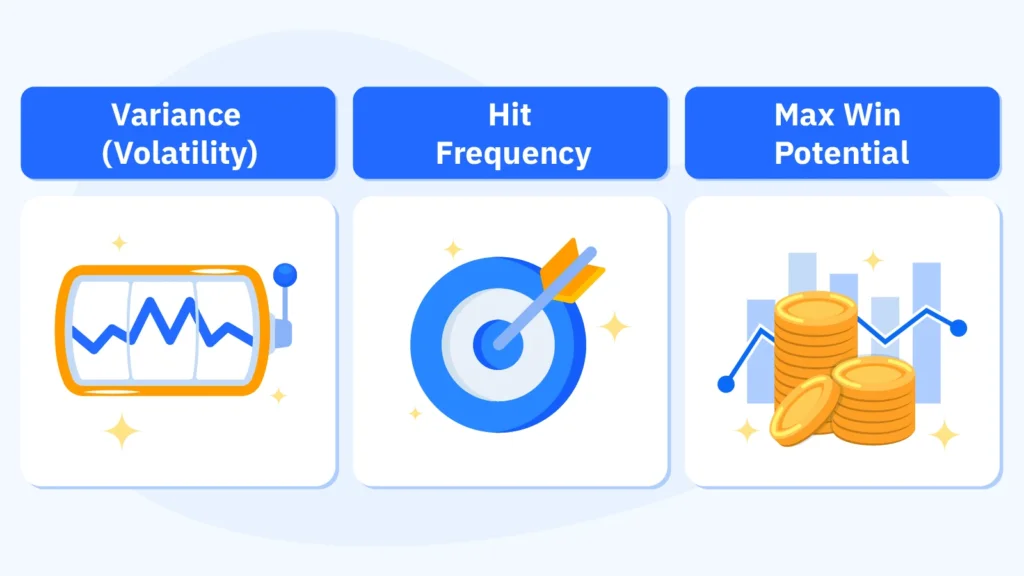
Variance (Volatility)
The variance measures how spread out the results are. For example, low variance means more results near RTP, while high variance means swings far from RTP.
Low Variance Slot:
- You will encounter more small wins
- The bonus rounds are often
- Your bankroll will decrease steadily
- Rarely bust quickly, rarely hit huge
- Starburst and Blood Suckers as best examples
High Variance Slot:
- Higher wins, but rarely
- Rare bonus round
- Rapid bankroll changes
- Often bust quickly OR hit massive results.
- Example: Dead or Alive 2, Book of Dead
Our team of experts consider that variance matters more than RTP. Why? Because you’d rather play a 94% RTP slot with low variance than a 97% RTP slot with high variance, especially if your bankroll is lower and you want 2-3 hours of gameplay.
The low-variance slot gives you consistent entertainment, even if the RTP is low. High-variance slots will drain your bankroll in 20 minutes, even if the RTP is better. If you budget is low, check our list with the best $1 deposit casinos in Canada for 2026.
Hit Frequency
The hit frequency is the percentage of spins that will produce a win.
High Hit Frequency (30-40%):
- Win on 30-40 of 100 spins
- Feels active and engaging
- Bankroll drains slowly
- You will play longer with peace of mind
Low Hit Frequency (15-25%):
- Win on 15-25 of 100 spins
- Long useless streaks
- Bankroll drains rapidly via dry spells
- You will be frustrated if no bonus rounds come
Example Comparison:
For example, Blood Suckers has the highest RTP, capped at 98%, and the highest hit frequency. You will get something on 1 in 3 spins, and it feels rewarding. Also, Dead or Alive 2 has a good 96.8% RTP, but a terrible hit frequency. Basically, you go 6-7 spins without winning, and your bankroll will drain while you wait for bonus rounds.
Why hit frequency matters: If you’re playing for entertainment over 200 spins, the hit frequency will determine the enjoyment more than RTP. Would you rather get something on 33 of 100 spins (Blood Suckers) or 14 of 100 spins (Dead or Alive)? Many Canadian players prefer frequent action events at a worse RTP.
Max Win Potential
The maximum win is the largest possible payout that a single spin or bonus round can produce, and it’s usually expressed as a multiplier such as 500x, 5,000x, or 10,000x.
Low Max Win (500x-1,000x):
- The results will be more consistent
- You will not experience life-changing wins
- The variance is lower
- Example: Starburst with 500x multiplier
Medium Max Win (5,000x-10,000x):
- The significant wins are occasional
- You can recover from bad sessions
- The variance is moderate
- Example: Book of Dead with 5,000x multiplier
High Max Win (20,000x+):
- The big takes are rare, but they’re high
- Variance is extreme
- You’ll often bust chasing it
- Example: The best pick is Dead or Alive 2 with a 100,000x multiplier
Why max win matters: The max win matters more than you think because if you’re playing a C$1 max bet and you desire to get C$10,000, this means that you must play a slot with a 10,000x+ max win multiplier. A 500x multiplier will give around C$500 regardless of luck. So, in conclusion, it’s a must to understand the maximum potential before you choose a game based only on RTP.
How to Use RTP Correctly
RTP is not useless information, but you’re just using it wrong. Here’s when it helps and when it doesn’t. 
When RTP Matters vs When It Doesn’t
For a full breakdown of how to grind through wagering efficiently, read our wagering requirements strategy guide. Also, before claiming any bonus, check the expiry period becausea 7-day deadline on a 35x wagering bonus makes RTP almost irrelevant because you’re racing the clock.
How to Pick the Right Slot
We strongly recommend you avoid picking a slot only by RTP. Instead, when you pick a slot, decide your goal:
Compare casino bonus offers before picking a slot for wagering because some bonuses restrict which games count toward playthrough.
Metrics That Actually Matter Short-Term
For your typical 200-500 spin session, these tell you more than RTP ever will.
How 3 Popular Slots Actually Play
All three have good RTP (96-98%). The playing experience is completely different. Blood Suckers keeps you spinning for hours. Book of Dead balances risk and reward. Dead or Alive 2 will probably eat your bankroll and so on. Want to try these slots yourself? Start with a C$10 deposit casino to test variance levels without risking your full bankroll.