Have you ever spent your entire gambling budget in a single evening? You’re not alone. Often, the problem is that you don’t have a clear limit for each session and you don’t allocate your budget properly. That’s exactly why we’ve put together a guide that will explain how to allocate your budget and how to set the right bet size.
Total Bankroll vs Session Bankroll: The 3-Layer System
By Isabell Dreghiciu

Summary
The Three-Layer Bankroll System Explained
The first level represents the total budget you allocate to gambling in a single month. Basically, it’s the maximum amount you’ve decided from the start that you can afford to spend. At the second level, you’ll divide the budget into smaller amounts. The last level is the bet per spin, determined based on your budget, not chosen at random.
Let’s see how the system would work in practice. If you have a monthly budget of 500 C$ and divide it into 5 sessions, that’s 100 C$ each. The bet is about 1% of the session’s budget, which means a bet of 1 C$ per spin.
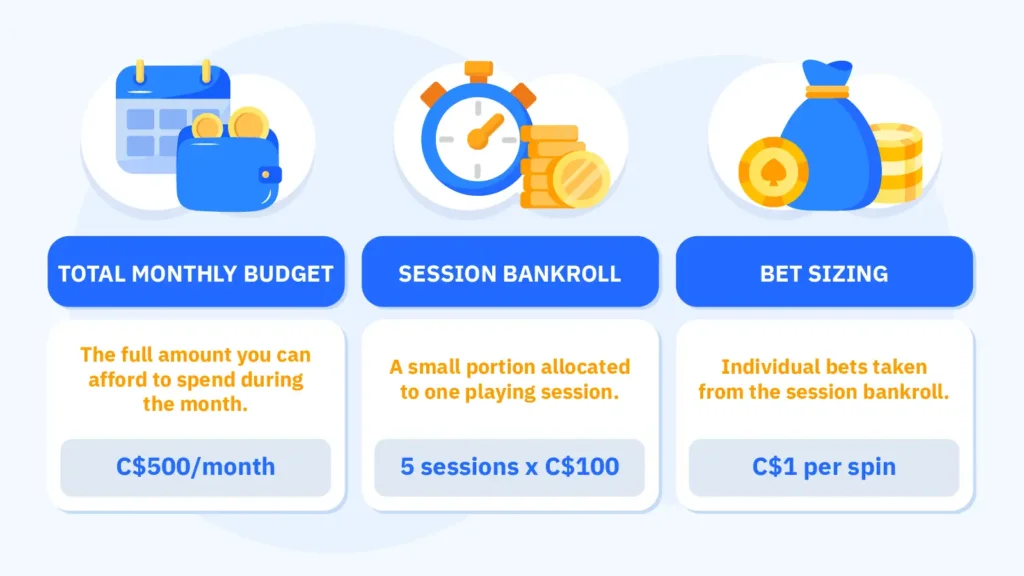
Your Total Monthly Budget
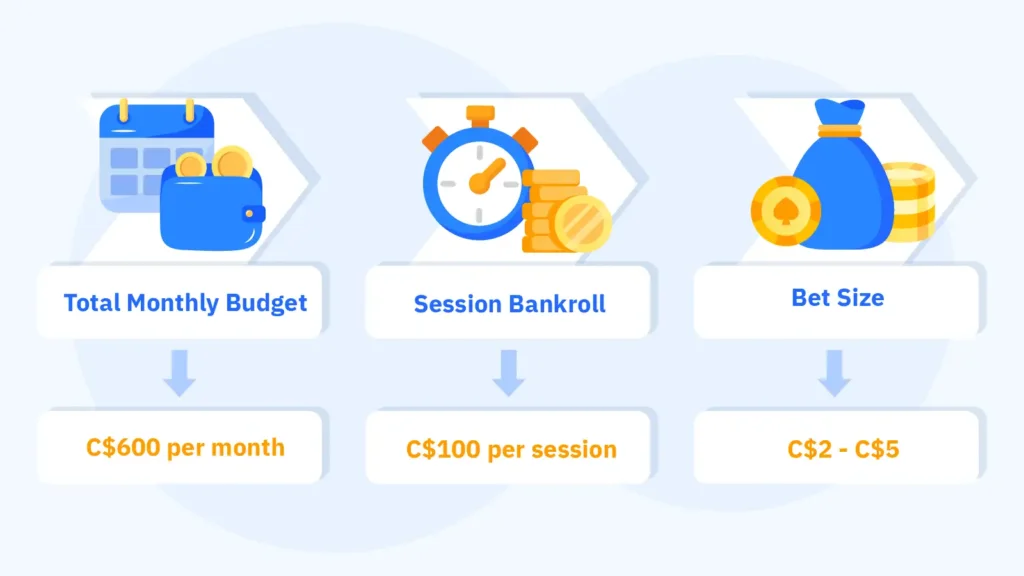
We won’t revisit the entire discussion here about how much you should spend on gambling. You may not know this, but we already have a guide on that topic. Here, we’ll move on to the next part. Just because you’ve set a budget doesn’t mean you’ll actually be able to stick to it. You could have C$500 for a month and spend C$400 in a single day. The first step sets the maximum limit you must not exced; the next two help you allocate your money and manage your spending as effectively as possible.
Session Bankroll
Well, this is where real budget management begins. Don’t think of those 500 C$ as money you can access at any time. It’s best to divide the money into fixed budgets for each session. We gave you an example with 5 sessions of 100 C$ each. That means one session per week, right?
We’ve just given you an example; you can divide your budget into more sessions with smaller amounts if you play more often. If you play less often, opt for fewer sessions with a larger budget. The math will always stay the same.
Here’s another tip we mentioned in our guide to budget planning: Keep the money allocated for each session in a separate account linked to Interac e-Transfer. That way, you won’t have all your money in a single checking account.
Bet Sizing
Once you’ve set your budget for each session, there’s one more step. You need to decide how much to wager on each bet. We recommend using about 1% of your session budget. If you have 100 C$ available, a wager of 1 C$ per spin is perfect and fits this principle.
Let’s clarify where this 1% figure comes from. It’s not a magic number, but rather our recommendation as experts at CasinoAlpha CA. We drew inspiration from professional sports bettors, who recommend wagering 1-2% of your available budget on each bet and not exceeding the 5% threshold, even when you’re very confident in an outcome. The advantage of a percentage based stake over a fixed amount is that it automatically decreases as your budget shrinks.
We want you to understand that there is no one-size-fits-all percentage that applies to everyone. 1% is a conservative option that helps you better manage your budget for a given session. However, it is not a scientifically proven figure. If you lose 20 consecutive bets, betting 1 C$ each, your total loss will be 20 C$, or 10% of your initial budget.
Why Separation Prevents a Catastrophic Month
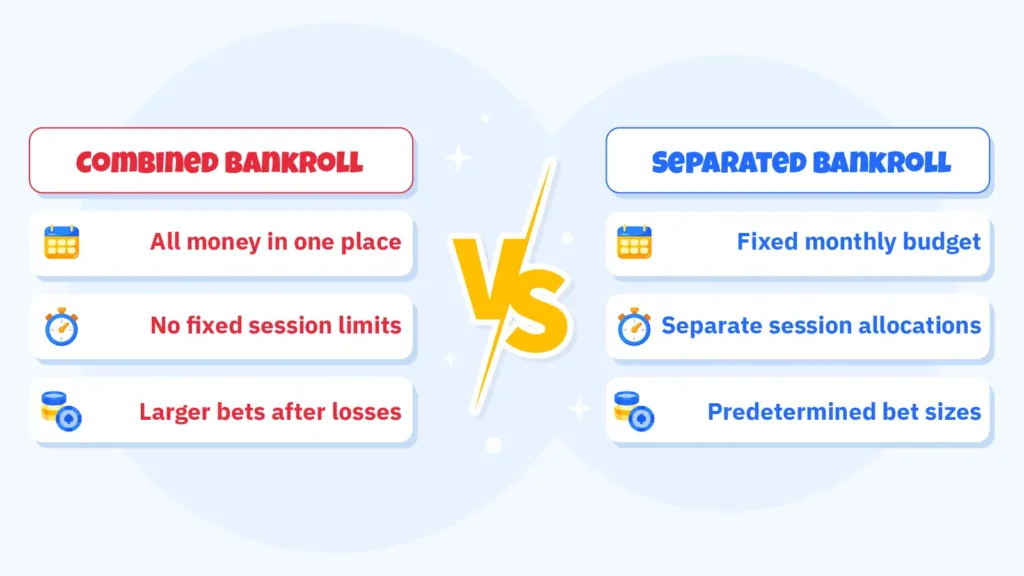
Let’s see what principle makes this system work. The money allocated to each level always remains separate. The C$100 set aside for Wednesday’s session won’t get mixed in with the C$400 remaining from the monthly budget. If things go wrong today and you lose the C$100, that’s it the session is over.
It’s a simple rule, but one that makes a big difference. It’s precisely the lack of this separation that’s one of the main reasons why many budget management systems fail in practice. Without a clear boundary between sessions, a bad Wednesday can lead to dipping into the money set aside for another session.
For this reason, we recommend that you separate your budgets, this way, you’ll be able to limit your losses. It all comes down to the basic rule: don’t transfer money from one level to another.
Replenishment Rules
The rule of separating budgets only works if you set it before the session begins, not after or while you’re playing. If you make this decision on the spot, you risk breaking your limits.
After a losing session, if you’ve used up all your money, the session is over. You don’t top off the amount using money set aside for another session, nor do you take from next month’s budget. You wait for the next scheduled session.
After a winning session, even disciplined players end up abandoning the rules they’ve followed up to that point. And so they keep playing. We recommend a different approach: set aside a substantial portion of your winnings in a separate account. That way, your winnings remain a net gain for you. If, however, you want to reinvest part of the money, decide from the start how you want to allocate it. The important thing is to make that decision before you start playing.
Variance Buffering
The 1% rule is a good guideline for medium-volatility slots. However, you should know that it doesn’t apply to all games. As we mentioned in our Slot Volatility Index guide, we recommend having a budget of C$30-50 for a session on a low-volatility slot. If you choose a high-volatility slot, your budget should start at C$120.
If your bet is C$1, that represents 2-3% of a C$30-50 budget, but if you have C$200 available, it’s only 0.5%. Keep in mind that volatile slots can go through long stretches without significant wins, so a larger budget helps in this situation.
Real Examples: 3 Player Types at Different Budgets
The logic behind the three levels remains the same, no matter what your budget is. The editor of this article, Isabell Dreghiciu, has put together a table with three realistic monthly budgets in CA.
You’ll notice that the C$30 budget allocated for Player A fits perfectly within the C$30-50 range, just as we recommended in our guide. You can try the games Blood Suckers or Starburst; they’re ideal for this budget.
The Bottom Line for Players
A budget management system doesn’t have to be too complicated to work. We recommend that you divide your monthly budget into smaller amounts one for each session. Keep your stakes low and if you have a good day, don’t use the remaining money to cover losses from a bad day. You have to accept that there are good days and bad days.
Of course, you first need to know what budget you can truly afford. If you didn’t understand, reread the paragraphs above. Then apply all the advice we’ve given you, one by one.
How We Verified This
We checked the recommendation to wager approximately 1% of your session budget. Keep in mind that this is a conservative approach to risk management, not a guaranteed formula.
We also compared the recommended budgets for different volatility levels with the values in our Slot Volatility Index guide.
We always encourage you to gamble responsibly. Stick to your limits whether you’re winning or losing. If you’re struggling, you can reach out to ConnexOntario.
We’ve written this article for informational purposes only; it is not financial advice or a gambling recommendation. Always adjust your budget based on what you can afford.
Meet Our Experts

Author
Isabell Dreghiciu
Author
Isabell Dreghiciu, an Author at CasinoAlpha since 2021, personally tests every bonus with real C$ deposits and withdrawals to uncover hidden terms, explains provincial gambling laws and tax implications on Canadian winnings using plain language, and continuously updates content to reflect regulatory changes.
Recommended Articles

Is Online Gambling Legal in Canada?
Check out this legal guide that will answer your question: Is online gambling legal in Canada? We’ve gone through legal documents, and that’s what we found:
By Adela Mariuta

AGCO Penalties for Relax Gaming and Arrise Solutions
On 7 May 2026, many players saw that some games were missing from Ontario casinos. We had no clue why this was happening, but things got clear days later. AGCO issues penalties against Relax Gaming and Arrise Solution because their games were available on unregulated websites outside Ontario.
By Adela Mariuta

Canada Crypto Casinos: Bitcoin Legal by 2029
This article provides predictive analysis about cryptocurrency gambling regulation in Canada based on international trends, provincial regulatory evolution, and crypto adoption patterns as of January 2026. This is not legal advice or financial advice. Cryptocurrency regulations change rapidly. Predictions are analytical opinions, not guarantees.
By Anca Iamandi

Ontario Licensed Casinos vs Offshore Sites
Here’s your newest CasinoAlpha.ca’s detailed legal guide to Ontario’s regulated iGaming marke where we analyse 49 licensed operators, AGCO player protections, $261M provincial revenue impact, and how Ontario’s model compares to other Canadian provinces and offshore casinos.
By Adela Mariuta

Which Canadian Banks Block Casino Deposits?
Let’s say your deposit just got declined, even if you have funds in your account, and the casino is also legit. This isn’t a technical error; it’s a situation when your bank is blocking gambling transactions.
By Adela Mariuta
Most Read
1.