Most players treat their relationship with a casino as something static, you sign up, you play, and that’s it. In reality, this relationship has a clear lifecycle (casino lifecycle), with five distinct phases: Selection, Entry, Growth, Maintenance, and Exit. Each phase comes with its own risks and key decisions. In this guide, we’ll show you exactly what to watch for at every step.
Casino Lifecycle Strategy: Selection to VIP to Exit
By Isabell Dreghiciu

Summary
The Casino Lifecycle Overview
This is the journey you, as a player, might go through. The duration is a rough range, based on typical patterns, so it’s not a fixed rule. If you’re a more cautious player, the Selection phase might take longer.

If you’d also like a graphical representation of value over time, the curve would look like this: low throughout Selection, rising quickly during Entry, and as bonuses and novelty peak, it will keep climbing as VIP-tier perks kick in.
From there, though, it will start to decline toward Exit. Many players make the mistake of assuming this curve only ever goes up. It’s normal for it to flatten out, and at some point, even decline.
Phase 1: Selection
Unfortunately, Selection is the phase everyone skips, but you shouldn’t. At this point, you’re not a customer yet, you’re just someone doing a careful check, so it’s normal for this stage to feel a bit boring. Still, this step can save you from potential problems down the line!
Why does the licence matter more than anything else?
The licence is the most important thing you need to check. Ontario and Alberta are currently the only provinces with a competitive, regulated online casino market. Everywhere else in Canada, you’ll have access to offshore-licensed sites.
What else to check, beyond the licence
Beyond the licence, a properly done Selection phase will help you even more. During this stage, you’ll want to look at the game library, the payment methods, and the casino’s terms. You can also check out what other players are saying about withdrawals.
The test almost nobody runs
We recommend making a small test deposit, then requesting a withdrawal too. This way, you’ll see whether the casino handles withdrawals smoothly, and whether it’s worth putting in more money.
What a proper Selection phase checks:
- What licence the casino holds and which body issued it
- What payment methods are available, and whether Interac e-Transfer is among them
- The game library and providers
- Independent reviews from players who’ve tested the casino themselves
- A small test withdrawal
Phase 2: Entry
This is where your direct relationship with the casino actually begins, when you make your first deposit, most likely paired with a welcome bonus. At this point, you’ll need to prove you’re exactly who you say you are.
KYC verification is a standard practice, whether you’re playing on an iGO-registered Ontario site or an offshore-licensed one. You’ll need to submit a government-issued ID, a document proving your address, and a bank statement issued within the last 90 days. If a casino doesn’t ask for any of these documents, that’s something that should concern you.
The best thing you can do in this phase is get verified early, not wait until the exact moment you want to make your first withdrawal. A first withdrawal will also trigger document verification, which can take a few business days. For every withdrawal after that, you’ll only wait 24-48 hours for an already-verified account.
A few things about the welcome bonus
When it comes to the welcome bonus, read the wagering requirements carefully before claiming the offer, not after. A bonus with a lower wagering requirement is often the better deal. The Entry phase is also your first real test of the customer support team, so you can send a simple question just to see how it’s handled.
Before drawing any conclusions, give this phase between 30 and 90 days, enough time to clear the welcome bonus requirements.
Phase 3: Growth
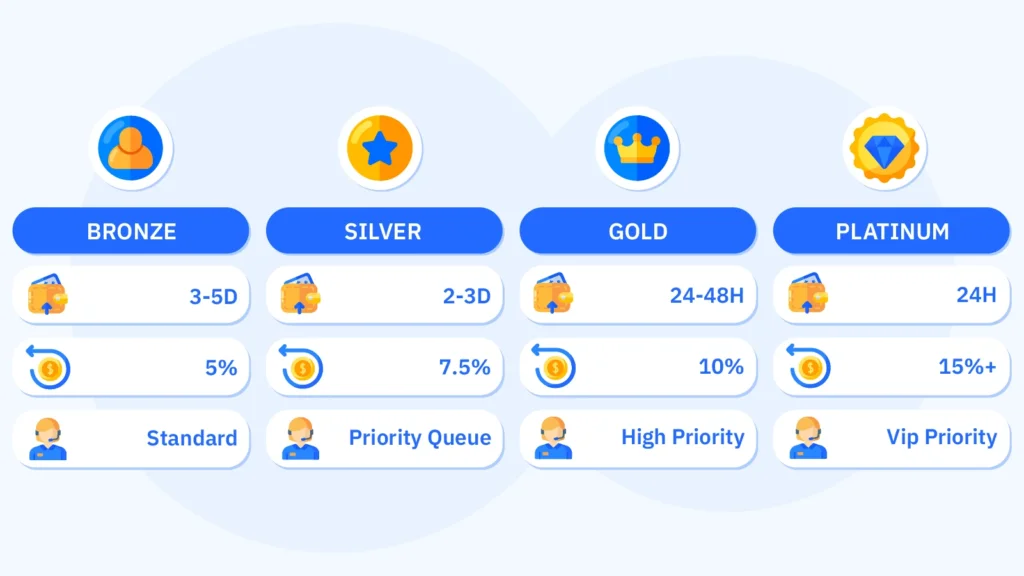
In this phase, the casino will try to turn you from a regular customer into a loyal one, usually through a VIP or loyalty program.
The mechanics are similar at pretty much any casino. As you wager, you earn points, and those points move you up through tiers like Bronze, Silver, Gold, Platinum.
What are the perks of a VIP program?
As you climb through the tiers, you’ll also get access to plenty of perks, like a personal VIP host, faster withdrawals, and periodic cashback. We can’t mention exact thresholds here, since these vary from casino to casino. The overall structure, though, stays the same.
In the Growth phase, the goal isn’t to climb as fast as possible, it’s figuring out whether it’s actually worth it. Tier progression is based entirely on your wagering volume, and that means money. If you end up betting more than you’d planned just to reach the next tier, it means the program isn’t actually working in your favor.
Generally, this phase lasts anywhere from 3 months to over a year, depending on how often you play. The Growth phase ends naturally once the pace of new perks starts to slow down.
Phase 4: Maintenance
Maintenance is the least interesting phase to talk about, and most players don’t even think about it. At this point, you already know the platform, you’ve settled into a certain tier, nothing’s new anymore, and playing has become a simple routine. In our view, it’s the healthiest phase of the entire cycle.
The risk in the Maintenance phase is autopilot. Once the relationship stops feeling new, small problems can start creeping in. The VIP program gradually cuts its cashback, customer support gets slower than before, withdrawals become harder to process. Unfortunately, it’s a normal pattern in the industry.
One simple thing can fix most of these issues. A check-in every 3 to 6 months will help you answer a simple question: Is it still worth putting money into this casino? Are there still enough perks to justify it?
Phase 5: Exit
Every relationship with a casino ends at some point, either on your terms or the casino’s.
If you’re leaving voluntarily
Before you go, request a withdrawal of your funds. An empty account is much easier to close. Wait for the money to reach your account, usually 24-48 hours. The rule about requesting funds at the start of the week, not on a Friday evening, still applies here too.
Once the money has landed in your account, you can ask for your gaming account to be closed, don’t just leave it sitting there inactive. Send an email to the support team and explicitly ask for your account to be closed.
If the reason behind closing your account also ties into concerns about your own gambling behavior, we’d encourage you to request self-exclusion directly instead. It’s a far more powerful, harder-to-reverse tool, built exactly for situations like this.
If the exit isn’t your decision
An involuntary exit, meaning the casino closes your account rather than you, works differently.
Deposited funds are almost always returned, even in cases of a terms violation. Winnings from normal play are typically returned as well, unless the account closure is tied to confirmed fraud or bonus abuse. These are the licensing conditions imposed by most reputable regulators (MGA, UKGC, Curaçao’s CGA).
There’s no guaranteed Canadian legal right that lets you force a resolution with an offshore operator, since Canadian courts can’t enforce any decision against an operator licensed in another country.
A clean exit, either way, looks like this:
- Withdraw your balance first, before requesting any account closure
- Take screenshots of your balance, transaction history, and any closure notice
- Request written confirmation of account closure and a zero balance, by email
- Choose self-exclusion over a standard closure if your reason for leaving is gambling-related
- Remove any saved payment methods and unsubscribe from marketing communications
Phase Transition Decision Points
At the end of each phase, a fork inevitably appears: you move forward, let things settle a bit longer, or step away for good.
From Selection to Registration: Move forward if the licence is verified and valid, if the deposit and withdrawal went smoothly, and if the casino’s terms didn’t raise any red flags. If you still have doubts about the licence, wait a little longer. Our advice is to walk away completely if support doesn’t respond or if withdrawals are difficult to process.
From Registration to Growth: Move forward if you passed KYC verification without issues, managed to withdraw your winnings, and support helped you resolve any problems along the way. If KYC verification drags on without reason, walk away.
From Growth to Maintenance: Once the rate of perks earned per dollar wagered flattens out, you’ve automatically entered the Maintenance phase. This happens regardless of whether you planned for it or not. Here, you need to decide whether it’s still worth wagering at the same volume.
From Maintenance to Exit: This is the transition you need to watch closely. In the sections that follow, we’ll help you understand exactly what this means.
Exit Signals to Watch For

Here are the main reasons why your relationship with a casino should come to an end. Keep in mind, though, that all 5 don’t need to happen at once, even a single reason can be enough to push you to close your account.
VIP value is declining: If you notice that your cashback rate is being quietly reduced, or your host suddenly stops responding to you, consider closing your account with that casino. If a loyalty program that used to offer you great promotions suddenly cuts its value, that’s reason enough to close your account.
You’ve found a better casino: If a competitor clearly outperforms the casino where you currently hold an account, nothing’s stopping you from opening a new player account elsewhere. Just make sure the operator is licensed.
You’re concerned about your gambling: If you find yourself chasing losses, spending more money than you planned, or noticing that gambling is affecting your mood, this is a signal you shouldn’t ignore. In this case, the best option is to self-exclude from the casino.
Casino quality is declining: If you notice that payouts have become much slower and support is less responsive, consider giving up your account. A casino that’s trustworthy now might not be as good two years from now, for example.
Licensing changes: If the operator’s licence has expired, this isn’t really a choice anymore, it’s a forced transition. Your priority becomes withdrawing your balance as quickly as possible.
Putting It Together: A Realistic Example
We’ve also prepared a clear example for you, so you can see how the 5 phases play out together.
Let’s say you spend a week and a half in the Selection phase. You checked whether the casino genuinely holds an MGA licence, read the terms of the bonuses you activated, and even managed to make a deposit followed by a small test withdrawal. You’re satisfied with the result so far, and you spend the following months activating various bonuses with low wagering requirements.
Over the next eight months, you move into the Growth phase, you start playing regularly, at a pace you keep up, and by month six you land a dedicated VIP host. At this point, you’re playing normally and picking up perks along the way. By month nine, the pace of new perks gradually slows down, and you move into the Maintenance phase.
After about 14 months, two red flags show up. Your VIP host stops responding, and a competitor casino catches your attention, it has more games and faster withdrawal times. That’s when you decide to request a final withdrawal and ask the casino to close your account. You move your funds to the new casino, and the cycle starts again from the Selection phase.
So, the 5 phases were gone through in order, and the cycle repeats itself.
The Bottom Line for Players
Once you start thinking in terms of the casino lifecycle, the whole relationship makes more sense, it’s a beginning, a middle part, and, at some point, an end, not something permanent. It’s best to pay special attention to the Selection phase, so you can protect yourself before putting any money on the line. In the Maintenance stage, discipline matters most, precisely because there’s no need to rush anywhere.
None of the 5 phases require chasing anything. Take things step by step, weigh each decision carefully, and walk away the moment you feel there’s nothing left to gain.
Meet Our Experts

Author
Isabell Dreghiciu
Author
Isabell Dreghiciu, an Author at CasinoAlpha since 2021, personally tests every bonus with real C$ deposits and withdrawals to uncover hidden terms, explains provincial gambling laws and tax implications on Canadian winnings using plain language, and continuously updates content to reflect regulatory changes.
Recommended Articles

Ontario Licensed Casinos vs Offshore Sites
Here’s your newest CasinoAlpha.ca’s detailed legal guide to Ontario’s regulated iGaming marke where we analyse 49 licensed operators, AGCO player protections, $261M provincial revenue impact, and how Ontario’s model compares to other Canadian provinces and offshore casinos.
By Adela Mariuta

When Will Quebec End the Espacejeux Monopoly? Timeline, Political Pressure, and Player Impact
This article from CasinoAlpha CA provides predictive analysis about Quebec’s online gambling regulatory future based on political climate, industry pressure, and international precedents as of January 2026. This is not legal advice. Predictions are analytical opinions, not guarantees. Timeline estimates may change based on elections, economic conditions, and political priorities.
By Isabell Dreghiciu

Kahnawake: Canada's Indigenous Gambling Regulator
The Canadian online gambling market is regulated by several licensing authorities, but few have a story as unique as the Kahnawake Gaming Commission (KGC). Established by the Mohawk community of Kahnawà and active since the early days of the internet, KGC has grown into one of the world’s oldest and most recognized online gambling regulators.
By Isabell Dreghiciu

Offshore Casinos in Canada: Legal Status, Grey Areas
Here’s everything Canadian players need to know about offshore casinos: what “legal” actually means, how to identify safe vs dangerous operators, which licenses matter, and when offshore is better (or worse) than provincially regulated options.
By Adela Mariuta
AGCO Penalties for Relax Gaming and Arrise Solutions
On 7 May 2026, many players saw that some games were missing from Ontario casinos. We had no clue why this was happening, but things got clear days later. AGCO issues penalties against Relax Gaming and Arrise Solution because their games were available on unregulated websites outside Ontario.
By Adela Mariuta
Most Read
1.