Two games with the same RTP can offer you two completely different gaming experiences. Why? They have different hit frequencies. If you don’t know what this metric is, you’ve come to the right place. In this guide, we’ll explain step by step what hit frequency actually means and why it matters even more than RTP when choosing a game.
Hit Frequency vs RTP: Why Dead Spins Drain Your Bankroll
By Isabell Dreghiciu

Summary
- Hit Frequency Defined (Separate From RTP)
- Why It Matters More Than RTP Short-Term
- Verified Example: Two Games, Similar RTP, Different Feel
- Dead Spin Analysis
- How Dead Spins Kill Bankrolls (Psychological and Mathematical)
- Games Ranked by Hit Frequency (Verified Data Only)
- How to Choose a Slot That Fits Your Playing Style
- The Bottom Line for Players
- How We Verified This
Hit Frequency Defined (Separate From RTP)
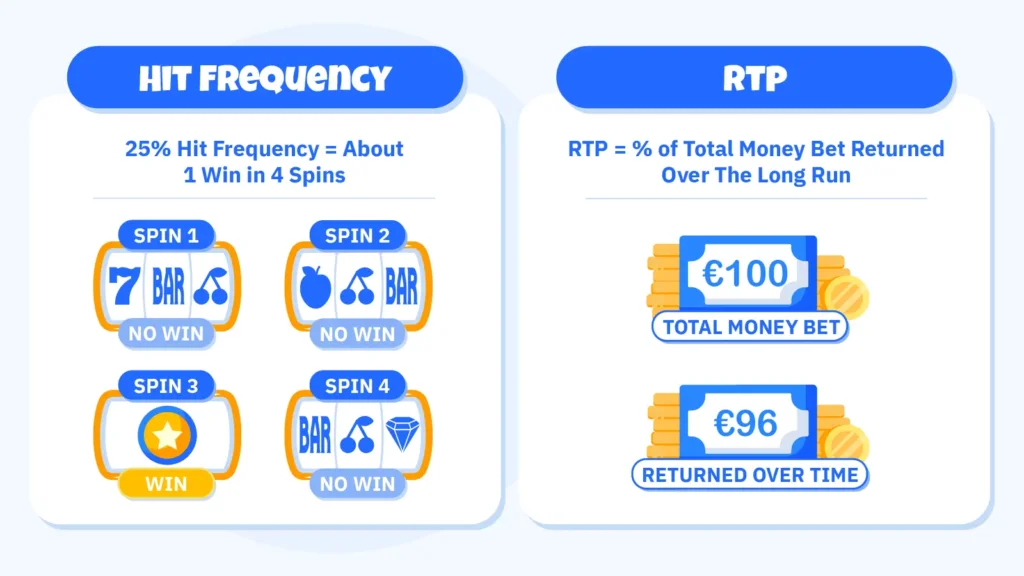
Hit frequency is the percentage of spins in which the slot machine pays out any kind of win, no matter how small. If a slot machine has a hit frequency of 25%, it means that, on average, about one in four spins results in a win, even if the amount won is less than the bet.
Hit frequency is the percentage of spins in which the slot machine pays out a win, regardless of how small or large it is. If you play a game with a hit frequency of 25%, that means one out of every four spins will result in a win.
On the other hand, RTP is the percentage of the total money you bet that a slot returns to you. However, this applies only to long sessions, not if you’re playing for just 2 minutes.
Keep in mind that the two are completely separate. You can play a game with a high RTP but a low hit frequency and vice versa. So neither of these metrics tells you that a game is better. The difference lies solely in how the winnings are distributed.
It’s important to remember that hit frequency counts any win as a hit, even if you win less than your bet. That’s why you often might feel like you haven’t won anything, but you actually have.
Why It Matters More Than RTP Short-Term
RTP is a long-term average, meaning it’s calculated after you’ve played a very large number of spins on a slot. Let’s be honest with you we’re talking about millions of spins. How many players actually reach that number? Very, very few! A typical gaming session involves hundreds or maybe thousands of spins, but not enough for the RTP to have a noticeable effect.
This is where hit frequency comes in it directly influences those few hundred spins you play. If you choose a game with a low hit frequency, you may experience long stretches without any wins, even if the RTP is high. If you have a clearly defined budget for a gaming session, it’s best to consider the game’s hit frequency.
That’s why two games with the same RTP can offer completely different experiences. Unfortunately, many players don’t know this!
Verified Example: Two Games, Similar RTP, Different Feel
To understand the differences as clearly as possible, we selected two different slots and compared them. Isabell Dreghiciu, the editor of this article, created the following table:
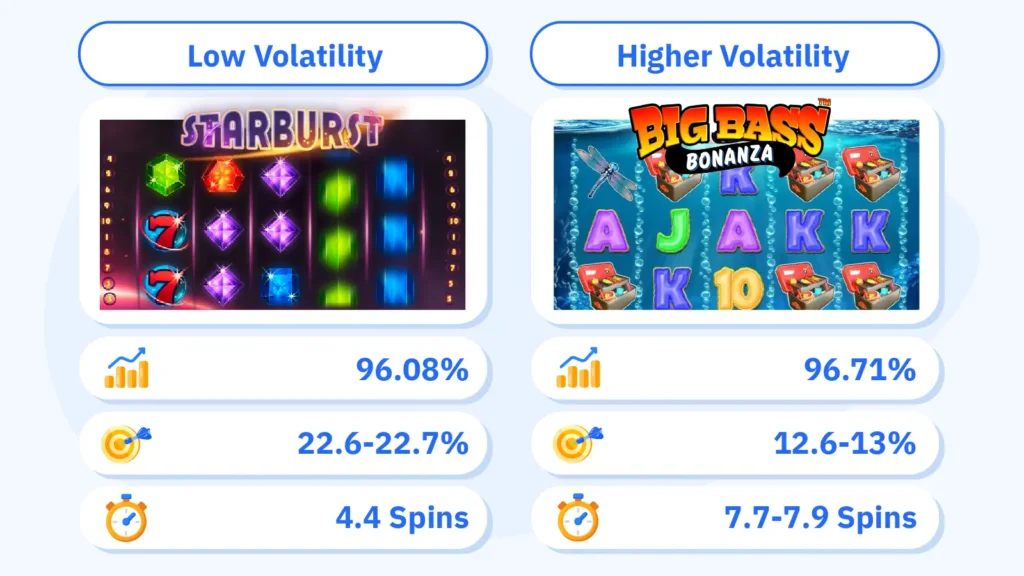
Both games have nearly the same RTP close enough to be comparable. The difference lies in the hit frequency. As you can see above, Big Bass Bonanza’s hit frequency is about half that of Starburst.
Starburst is a classic game with low volatility that pays out a win about every 4 spins. However, these are mostly small wins because it features wilds. Big Bass Bonanza has higher volatility and experiences much longer dry spells. However, it does offer free spins bonus rounds.
We obtained the RTP information directly from the game developers NetEnt and Pragmatic Play. However, neither of these developers publishes information on hit frequency. So the values you see above come from independent slot monitoring services. Nevertheless, we want you to understand that the data is not certified by the developers.
Dead Spin Analysis
Hit frequency is easier for you to understand if we show you how to see it directly during a session. Let’s see how many spins without a win you might have before a win appears.
It’s a simple calculation. For a hit frequency of p, the average number of spins without a win before a hit is (1-p)/p.
Let’s apply the formula to the two games we presented above:
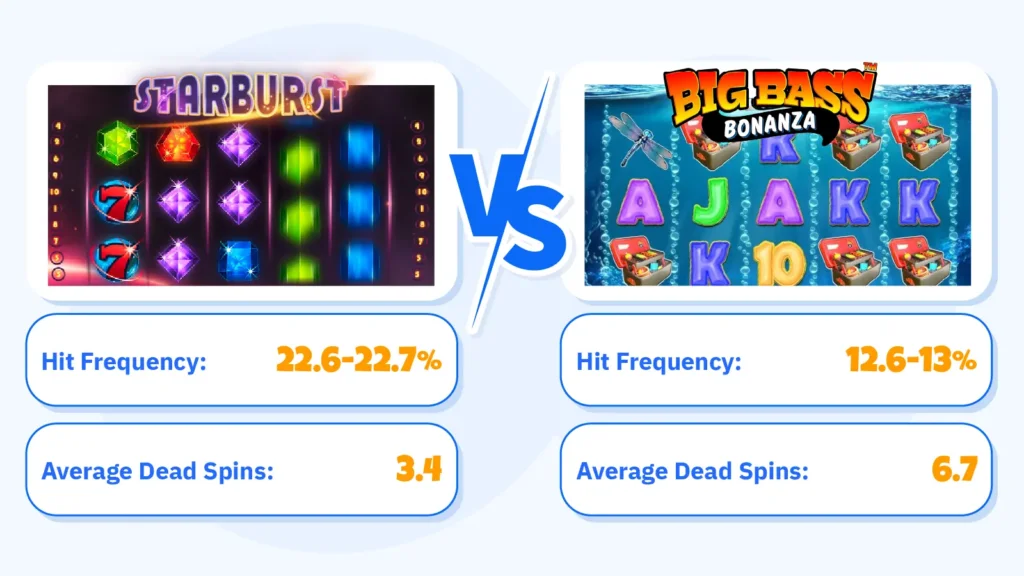
- On Starburst, that means 3.4 spins without a win until the next hit.
- On Big Bass Bonanza that means 6.7 spins before a hit.
Please also keep in mind that these values are calculated based on millions of spins. An individual session will look different especialy if it’s short.
How Dead Spins Kill Bankrolls (Psychological and Mathematical)
If we look at it from a mathematical perspective, things are simple. Let’s say you bet the same amount on every spin, and many of those spins don’t pay out anything. Your balance steadily decreases. The lower the hit frequency, the more often this will happen, and you’ll lose a lot of money before you hit a win.
Unfortunately, there’s a chance that the funds you’ve set aside for the session will run out before you get a chance to win anything.
This is where an important psychological factor comes into play. If you have a long streak of spins without a win, it doesn’t just mean you’ve lost money it can also affect the way you play. Many players are tempted at that moment to increase their bet in the hope of recouping their losses. In reality, that’s exactly when discipline must kick in!
You need to understand that losing spins don’t occur evenly. In games with a low hit frequency, they generally occur in clusters. There may be many losing streaks, but the game’s statistics remain perfectly normal. Keep in mind that hit frequency counts any spin that pays out money as a win, even if it’s less than your bet. It shows you how often wins occur, not how much you receive!
Games Ranked by Hit Frequency (Verified Data Only)
We’ve included here only the games for which we found information on win frequency directly from multiple independent sources. Unfortunately, we couldn’t find this information for other slots, so we didn’t want to just make assumptions.
Let’s take a moment to look at the games in the Dead or Alive series, because they contradict a common assumption among gamers. Dead or Alive has the highest hit frequency of all four games analyzed.
Dead or Alive stands out from other slots due to its extremely high volatility. A significant portion of the RTP is concentrated in the bonus rounds, as well as in the sticky wilds feature. This means that base wins are small.
To put it simply, the issue isn’t how often wins occur, but how much they’re worth when they do.
How to Choose a Slot That Fits Your Playing Style

When choosing a game, you shouldn’t just think about how often you win. We recommend that you first consider your gaming budget and how much patience you have.
If you prefer short sessions and have a limited budget, we recommend choosing games with a higher win frequency. This way, you’ll have small, frequent wins that will keep your balance moving.
If you enjoy long sessions and have a large budget, it’s best to choose a game with a low win frequency and high volatility.
To meet the wagering requirement, the best thing you can do is choose games with a high hit frequency.
We’ll let you in on a secret. If this is your first time trying a new slot, why not spend a few minutes in demo mode? That way, you’ll see how often wins occur.
The Bottom Line for Players
As I mentioned in the paragraphs above, an RTP tells you how much a slot pays out over the long term. That means you’d have to play millions of spins. On the other hand, the hit frequency tells you what your current gaming session will be like!
Choosing a game with a high RTP doesn’t guarantee a smooth gaming experience. Unfortunately, there can be long stretches where you don’t win anything, and your budget can disappear quickly. For this reason, we recommend that when choosing a slot, you look beyond the RTP value and also check the other important information we’ve discussed in this guide.
How We Verified This
All the RTP values you’ll find in this guide were taken directly from the game developers’ official websites. The hit frequency values were verified and compared with independent sources. As you may have noticed throughout the guide we’ve clearly indicated which of these values are officially published by the developers and which come from other sources.
We chose to remove the initial values for non-winning spins for Dead or Alive when they did not match the verified data. So we used Big Bass Bonanza as an example. This way, we avoided presenting information that might not be accurate. For games where we could not find a hit frequency value we omitted them entirely rather than making estimates.
Responsible Gaming
Neither the RTP nor the hit frequency will guarante you a win in any given session. The best thing you can do is set a budget for your gaming session. If you feel that gambling is causing you harm, you can contact ConnexOntario.
This article is intended solely for informational and educational purposes. It does not constitute financial advice. Keep in mind that RTP and hit frequency values may vary depending on the casino or jurisdiction.
Meet Our Experts

Author
Isabell Dreghiciu
Author
Isabell Dreghiciu, an Author at CasinoAlpha since 2021, personally tests every bonus with real C$ deposits and withdrawals to uncover hidden terms, explains provincial gambling laws and tax implications on Canadian winnings using plain language, and continuously updates content to reflect regulatory changes.
Recommended Articles

Responsible Gambling Laws: What Casinos Must Provide by Province
Responsible gaming tools aren’t the same everywhere in Canada. What is a casino required to provide? The answer depends on where you live! We’ve put together a guide with all the information you need to know! Here’s what to look out for:
By Isabell Dreghiciu

All About Alberta's Regulated Online Casino Market
Welcome to our newest legal guide, where you will find out all about the new Alberta-regulated online casino market we’ve all been waiting for.
By Adela Mariuta

Interac's 2026 Gambling Transaction Changes: New Limits and What They Mean for Players
This article provides predictive analysis about potential Interac and Canadian banking policy changes affecting online gambling transactions as of January 2026. This is not financial advice. Bank policies vary by institution and change frequently. Predictions are analytical opinions based on current trends.
By Anca Iamandi
Ontario Licensed Casinos vs Offshore Sites
Here’s your newest CasinoAlpha.ca’s detailed legal guide to Ontario’s regulated iGaming marke where we analyse 49 licensed operators, AGCO player protections, $261M provincial revenue impact, and how Ontario’s model compares to other Canadian provinces and offshore casinos.
By Adela Mariuta
Federal Online Gambling Regulation Is Coming to Canada: Criminal Code Review Analysis
The online gambling industry in Canada is undergoing significant changes, and the differences between the rules applied in each province are becoming increasingly apparent. While some provinces have adopted modern and competitive models, others continue to operate under completely different systems. Could Canada eventually adopt a single federal framework to regulate the gambling industry?
By Isabell Dreghiciu
Most Read
1.