Here’s everything Canadian players need to know about offshore casinos: what “legal” actually means, how to identify safe vs dangerous operators, which licenses matter, and when offshore is better (or worse) than provincially regulated options.
Offshore Casinos in Canada: Legal Status, Grey Areas, and More
By Adela Mariuta

Summary
- Are Offshore Casinos Legal in Canada? (Yes – Here’s What That Actually Means)
- What Is an “Offshore Casino”? Definition and Types
- The Legal Framework: Why Offshore Casinos Are Legal in Canada
- Grey Area Explained: What It Means in Practice
- Which Offshore Casinos Are Safe for Canadians?
- Offshore vs Provincially Regulated: When to Choose Which
- How to Safely Gamble at Offshore Casinos
- What To Do If Offshore Casino Won’t Pay
- Common Offshore Casino Myths Debunked
- The Future of Offshore Casinos in Canada
- Sources
Are Offshore Casinos Legal in Canada? (Yes – Here’s What That Actually Means)
Yes, offshore casinos are safe to visit and play at if you’re a Canadian player. Keep in mind that provincial or federal law will not prohibit you from playing at internationally licensed casinos. However, it’s essential to understand that these casinos operate in the “gray area”, which means that you, as a customer, can play at these casinos, but they’re not provincially regulated in Canada. Still, we’re not talking about Ontario, because many gray area casinos needs a local licence.
Critical distinction most sources get wrong:
What you need to understand:
- If you’re in Canada, it’s legal to play at offshore casinos.
- Offshore casinos with international licences (MGA, UKGC) are 100% legal and safe to play at
- You will never be prosecuted for gambling at offshore casinos
- Offshore casinos are not provincially regulated; the only exception is with iGaming Ontario.
- Provincial gaming commissions will not help you in case of an offshore casino dispute
Disclaimer: This article is informative about offshore online casinos and Canadian gambling law as of January 2026. This article is not a legal consultation. Offshore gambling is an international region with different laws. For professional advice, consult an attorney.
What Is an “Offshore Casino”? Definition and Types

In the following chapter, you will learn what an ” offshore casino ” is with simple examples and definitions:
Primary Definition
An offshore casino, also labelled as ‘international operator’ or ‘non-provincial casino’ = An online gambling site that:
- Operates outside Canada’s jurisdiction
- Comes with an international legit licence like UKGC, Curacao, MGA, etc.
- These casinos accept Canadian players, and you will not face criminal charges if you do it.
- Processes payments through international banking systems – see a complete comparison of the available Canadian payment methods you can choose in 2026.
Examples of offshore casinos serving Canadians:
- Bet365 (MGA-licensed, Gibraltar-based)
- 888 Casino (Gibraltar-licensed)
- LeoVegas (MGA-licensed)
- Bodog (Antigua-licensed)
- Casino Rewards network casinos (Kahnawake-licensed)
Offshore Casino Licensing Tiers
Not all offshore casinos are equal. Licensing authority matters, too. Let’s see why and how:
The Legal Framework: Why Offshore Casinos Are Legal in Canada
Continue to find out more about the legal framework or why you can visit and participate in offshore casinos in Canada. We were curious, too, but we did find the answer so you don’t have to spend time searching for it:
Federal Law: Criminal Code Section 207
What the law says: So, Section 207 via the Criminal Code in Canada tells you exactly who can operate gambling in canada, not who can play. [1]
Key provision: “It is lawful for the government of a province… to conduct and manage a lottery scheme in that province” [1].
What this means:
- Provinces have control over gambling operations
- Every unlicensed casino in Canada is illegal
- You cannot advertise unlicensed Casinos in Canada
- There’s no law in Canada that restricts you for playing at licensed casinos offshore
- NO law gives provinces authority to prosecute players for offshore gambling
Why Provinces Don’t (Can’t) Block Offshore Casinos
These provinces let you play at offshore casinos because:
Technical impossibility
- You can bypass website lock via VPNs
- There are many offshore licensed sites and it’s impossible to ban them all
- New domains everyday
Legal grey area
- Offshore casinos are not Canadian businesses, which means no jurisdiction
- If you play at offshore casinos, you don’t do any illegal actions
- Offshore casinos with licences like MGA are legitimate
Political will
- Blocking websites is controversial because of the internet freedom
- They focus on making players visit licensed options
- Resource-intensive enforcement for minimal player protection benefit
Ontario exception: The Ontario exception is that this province created iGaming Ontario licensing and they started to attract offshore casinos to take this licence. For example, Bet365 and Pokerstars already did it, while others don’t.
Grey Area Explained: What It Means in Practice
Let’s see what ‘grey area’ means in simple terms:
The Term “Grey Area” Defined
Grey area means a legal situation when:
- The activity of “grey area” casinos is not sanctioned in an official way
- The government does tolerate the activity, but they do not promote it or something.
- If you play at “grey area” casinos, you’re not facing any legal consequences, so don’t worry.
Applied to offshore casinos:
Grey Area vs Fully Regulated: Key Differences
Which Offshore Casinos Are Safe for Canadians?
Let’s see this checklist to know when you’re safe when playing at Offshore casinos

How to Identify Legitimate Offshore Casinos
Step 1: Verify International License
Check the casino footer for licence information:
- The number of licenses
- You should see the regulatory body name
- The logo of the regulatory body should be visible and you must be able to click it
Verify the licence is active:
- You must visit the website of the licensing authority
- Go and search the casino name via the database
- If the licence number match, it’s ok
Tier 1 Licensing Authorities (Safest):
- MGA: https://www.mga.org.mt/licensees/
- UKGC: https://www.gamblingcommission.gov.uk/public-register
- Gibraltar Regulatory Authority: https://www.gibraltarlaws.gov.gi/gambling
Tier 2 Licensing Authorities (Reputable):
- Kahnawake Gaming Commission: https://www.gamingcommission.ca/
- Curaçao eGaming (main license): https://www.curacao-egaming.com/
Step 2: Check for Red Flags
Avoid offshore casinos if:
- If you can’t verify the licence because there are fake licence claims, avoid
- If you see “licensed in Costa Rica”, avoid because Costa Rica don’t give licences; it’s just a tax paradise for corporations
- If you ask the support for licence and they don’t provide info, leave that place
- If you don’t see support or contact info such as email, live chat, phone line, or FAQs, this is a red flag.
- If you want to withdraw and they start demanding unreasonable documents such as passport + utility bill or credit card photos and a selfie, this is a data theft risk you should immediately avoid
- If you see bad reviews on other sites given by players, they’re true.
- Absurd bonuses such as 1000% up to €10k
- If you see poor website quality
Step 3: Verify Payment Methods
Legitimate offshore casinos accept:
- Interac e-Transfer
- Visa/Mastercard because they don’t work with fake casinos
- E-wallets; the most important one is PayPal.
- Cryptocurrency
Red flags:
- Only accepts wire transfer or Western Union (scam indicator)
- Requires cryptocurrency only + no other options (high risk)
- Payment processor names you’ve never heard of (sketchy third parties)
Step 4: Test Customer Support
Before you deposit, you must test the following:
- Live chat response time should be in 2-5 minutes.
- Email response after 1 day
- The agents must be professionally prepared to answer questions related to licensing, withdrawals, promo terms, etc.
- Professionalism and English fluency
Red flags:
- If there’s no live chat, this is a red flag.
- If the agents are rude
- If they can’t answer basic questions about the licence or withdrawal process
Recommended Offshore Casinos for Canadians (2026)
These are our recommendations based on licensing, reputation, and Canadian player comments:
Tier 1 (MGA/UKGC/Gibraltar Licensed):
- Bet365: a casino licensed by MGA with excellent reputation full Interac support
- 888 Casino: Gibraltar-licensed, established 1997. This is a popular casino in the UK and other European countries.
- LeoVegas: A mobile casino licensed by the UKGC and MGA. 100% trustworthy.
- Casumo: MGA-licensed with strong player protection.
Tier 2 (Kahnawake Licensed – Canadian Connection): Casino Rewards Network (12 casinos) – Kahnawake-licensed, Canadian-focused since 1999, Microgaming exclusivity
- Jackpot City
- Spin Casino
- Ruby Fortune
- Yukon Gold
- Zodiac Casino
- Bodog – Antigua-licensed (previously Kahnawake), Canadian market specialist
Offshore vs Provincially Regulated: When to Choose Which
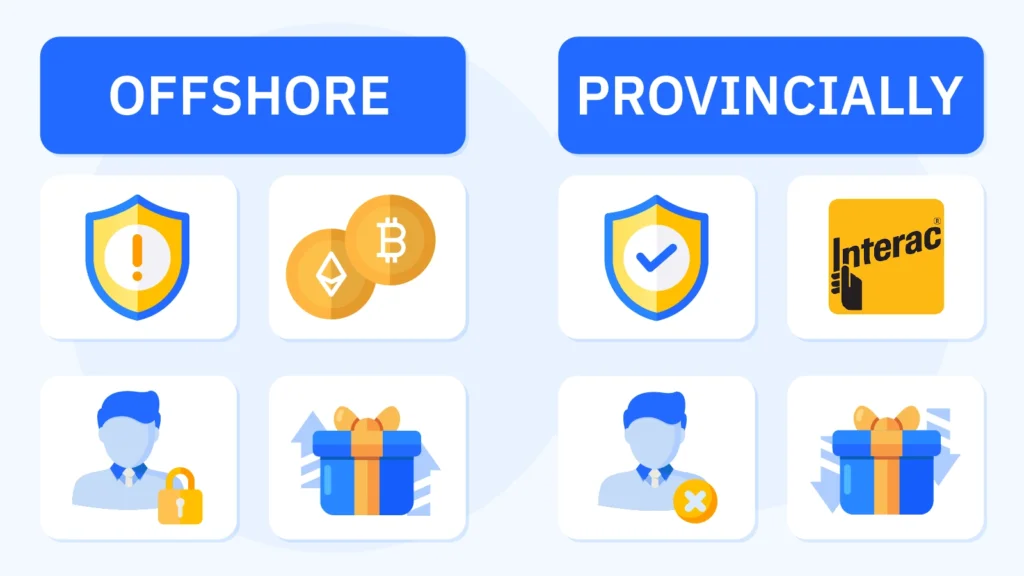
Choose Provincially Regulated (iGaming Ontario, PlayAlberta, Espacejeux) If:
- You appreciate local protection over game selection. See all about the newest Alberta regulated market.
- You want easy dispute resolution via AGCO/AGLC/provincial body
- If you want universal self-exclusion. If you apply to this, you will be excluded from all Canadian casinos, online and land-based.
- You want Interac acceptance
- If you like low-value bonuses because regulatory costs reduce bonus budgets
- If your aim is to support the provincial economy since revenue stays in the province
Best for: this is best for player who seek safety
Choose Offshore (International Licensed) If:
- You look for high-value promotions
- You want higher gaming collections; for example, some providers don’t license in Canada like Microgaming
- You have an account with VIP status at offshore casino
- You want cryptocurrency payment options; keep in mind that provincially regulated sites rarely lets you use crypto to deposit and withdraw
- You’re comfortable with international dispute resolution (MGA/UKGC have robust processes, but they lower than provincial)
- You play at multiple casinos (offshore offers hundreds of choices vs limited provincial options)
Best for: Experienced players, bonus hunters, VIP players, crypto users, players outside Ontario/Alberta (no provincial regulation available)
Hybrid Approach (Most Common)
Reality: Most Canadian players use both:
- They choose provincial casinos for provincial safety and improved player dispute resolution
- They pick offshore casinos for better bonuses, larger slots collections, crypto, etc.
Example player strategy:
- Main account: Your main account should have iGaming Ontario licence (local protection, Interac)
- Secondary accounts: You can make 2-3 offshore MGA-licensed casino accounts for better bonuses, variety, etc.
- Self-exclusion if needed: Focus on provincial system
How to Safely Gamble at Offshore Casinos
Here’s is where we will teach you how to play safe at offshore casinos in 2026:
Before You Deposit
Necessary Checklist:
- You need to verify the licence
- It’s essential to read the T&Cs to look for hidden terms, misleading rules, etc.
- If you can, go and check the customer support by asking technical or legal questions on payments, etc.
- Verify the payment system as a whole; look for Interac, Visa, Mastercard or PayPal.
- Research casino reputation on the internet, especially what real players had to say from their experience.
- Check the withdrawal limits (daily/weekly/monthly caps)
- Read and understand the bonus terms, such as wagering requirements, game restrictions, payout limit
When You Deposit
Best practices:
- Make small deposits like €1, €5 or €10. Do not go higher!
- Screenshot everything like terms, bonus page and deposit confirmation
- Use Interac e-Transfer
- Avoid credit cards deposits
- Save all emails from the casino
When You Withdraw
To ensure smooth withdrawal:
- It’s a must to complete the KYC by sending the copy of ID, address proof, etc.
- If you have an active bonus, make sure that you finished the wagering.
- Withdraw via the same method as you used to deposit. Use Visa to withdraw if you deposited with Visa, and so on.
- Respect withdrawal limits to avoid issues
- Be patient because at offshore casinos you can wait even 72 hours for a cashout.
- If you encounter payout delays, use customer service for assistance
What To Do If Offshore Casino Won’t Pay
So, if the offshore casino doesn’t pay you, you must contact the casino first and send withdrawal details, screenshots, verification proof, etc. You need to stay in a professional state approach and request resolution within 48 hours, calmly. If you don’t have a positive outcome after 7-14 days, you need to go to the licensing authority, such as the MGA or UKGC because these have the strongest enforcement, so they can force the casino to pay you.
Still, if you’re refused or simply the regulatory body fails to force the casino to pay you, there’s eCOGRA’s free dispute resolution tool you can count on.
Also, keep in mind that taking legal action is very expensive, and if your payment is below €10k, don’t do it. If UKGC, MGA or eCogra can’t help you, you won’t get payed, especially if you’re a canadian citizen
Dispute Resolution Timeline & Success Rates
Key Contact Points:
- MGA complaints: mga.org.mt/support/online-gaming-support
- UKGC complaints: gamblingcommission.gov.uk/public-and-players/raising-a-complaint
- Kahnawake complaints: [email protected]
- eCOGRA ADR: ecogra.org/alternative-dispute-resolution
- IBAS: ibas-uk.com (sports betting disputes)
Common Offshore Casino Myths Debunked
Myth 1: “All offshore casinos are scams”
Reality: No, offshore casinos with UKGC or MGA approvals are 100% safe and not scams. They’re based on a strict player protection and regulatory oversight.
Myth 2: “You’ll get arrested for playing offshore.”
Reality: No, if you read the law, you’ll see that only casino operators can face legal actions, not you as a player. Play wherever you want, but do it responsibly; that’s all.
Myth 3: “Offshore casinos rig games”
Reality: This is absurd because offshore casinos with UKGC or MGA use professional RNG which is certified by independent labs such as iTech, eCogra, etc. At these casinos, games are fair.
Myth 4: “Offshore casinos never pay out big wins.”
Reality: MGA/UKGC licensed casinos will pay the same amount you have got via gameplay, so don’t worry if you get €1 million from a progressive jackpot. Licensing authorities enforce this. Horror stories usually involve:
- Unlicensed casinos, or “Costa Rica” licensed sites
- If you violated the bond’s terms
- If you made multiple-account fraud
Myth 5: “Provincial casinos are always safer than offshore”
Reality: Provincial casinos are not “safer” than offshore; they simply have a more strict and direct player resolution protocol, and the waiting time is less compared to offshore UKGC casinos, where you must wait and the law isn’t on your side.
The Future of Offshore Casinos in Canada
Will More Provinces Regulate Like Ontario/Alberta?
From what we saw, yes, provinces such as British Columbia, Saskatchewan or Quebec will follow the Ontario/Alberta approach by 2027-2029.
What happens to offshore casinos then:
- Some offshore operators will get provincial licences.
- Many will remain offshore-only
- Players will have variety by choosing to play at a provincially licensed casino or at an offshore one with the best bonuses.
Ontario precedent: After iGaming Ontario launched, offshore casinos didn’t disappear. Players use both.
Will Offshore Casinos Be Blocked?
No, offshore casinos will stop working because:
- Is technically difficult since VPNs exist and the possibility to change domain.
- Internet freedom
- Legally grey
- Proven ineffective because the other countries that tried to block them saw a failure in this approach
Sources
[1] Criminal Code of Canada, R.S.C. 1985, c. C-46, Section 207, Government of Canada https://laws-lois.justice.gc.ca/eng/acts/C-46/section-207.html
[2] Malta Gaming Authority, Licensee Database https://www.mga.org.mt/licensees/
[3] UK Gambling Commission, Public Register https://www.gamblingcommission.gov.uk/public-register
[4] Kahnawake Gaming Commission, Official Website https://www.gamingcommission.ca/
[5] eCOGRA, Alternative Dispute Resolution https://ecogra.org/alternative-dispute-resolution
Meet Our Experts

Author
Adela Mariuta
Author & Editor
Adela Mariuta is a Senior Gambling Specialist at CasinoAlpha since 2019. Her work focuses on what casinos usually hide: ethical gambling practices, self-exclusion tools, and responsible gaming features. She has written 400+ casino reviews, bonus codes, guides, and blogs that prioritize player safety.

Recommended Articles

Casino Red Flags: 15 Warning Signs Before Depositing
In our newest guide for Canadian players, we will show you 15 red flags that you must know to identify fraudulent Canadian online casinos in %an%. In our 10+ years of experience, we have seen many red flags. Still, we conducted another analysis by reviewing 140+ of the best online casinos to understand the latest red-flag trends better. We also reviewed 500+ player disputes, most involving casinos that don’t pay. Continue reading this helpful article to learn about the red flags and start identifying them yourself to safeguard your funds.
By Adela Mariuta

Your Complete Guide to Casino Bonus Types in Canada
In almost every Canadian online casino you will see different type of bonuses, each of them having its personal structure and practical value. For example, the Up to C$500 welcome bonus is very different from 100 free spins on deposit or 10% cashback. Our newest %an% guide will serve you as a tutorial to smartly identify and recognize each type of bonus and what’s the best one for you. After testing more tna 46 casinos and checking more than 87 bonuses, this is what you need to know.
By Adela Mariuta

Which Canadian Banks Block Casino Deposits?
Let’s say your deposit just got declined, even if you have funds in your account, and the casino is also legit. This isn’t a technical error; it’s a situation when your bank is blocking gambling transactions. Canadian banks block gambling payments but won’t admit it. For example, some banks block 67% of casino deposits, while others don’t block at all. We tested 45+ Canadian casinos via the popular banks to see which ones will block transactions and why.
By Adela Mariuta

Payment Method Comparison for Canadian Players
Did you know that if you choose the wrong payment methods, it will cost you hundreds of dollars in fees, you will encounter withdrawal delays, and you will miss many promotions, especially if you’re a Skrill or Neteller user? Our comparison guide will show you every option, such as Interac e-Transfer, credit/debit cards, crypto and e-wallets, and we will focus on the real costs, processing times and strategies to choose the right payment method to avoid paying more than you should.
By Adela Mariuta

How to Complete Casino Wagering Requirements
You claimed a C$100 casino bonus, and now you’re facing a C$3,500 wagering requirement. If you’re regularly playing at online casinos in Canada, you may have come across bonuses with different wagering levels, as the industry standard is around 30x-50x for most promotions.
By Adela Mariuta
Most Read
1.