#1 The Short Answer is that Recreational Casino Winnings are Tax Free
The good news for Canadian players is that they don’t have to pay taxes on their casino winnings. You don’t have to tell the Canada Revenue Agency (CRA) about your recreational gambling winnings, even if you win C$500 on slots or C$50,000 at blackjack.
The Federal Income Tax Act says that recreational gambling winnings are not taxable income, so you don’t have to pay taxes on them. People see the money you win from recreational gambling as a windfall, not as earned income. This is different from money you make from a job, investments, or a business. That’s why these winnings are tax-free for people who play for fun.
Applies to All Canadians, All Provinces
The tax-free rule is the same in all of Canada’s provinces. This federal rule is not affected by any provincial gambling income taxes. This federal tax rule stays the same no matter where you play in Canada, whether it’s in British Columbia, Alberta, Atlantic Canada, or any other province.
All Casino Types Are Covered
The tax exclusion rule applies regardless of where you choose to play:
- Provincial Lottery Sites:
PlayNow (BC), PlayAlberta, and other sites run by provincial governments
- International Licensed Casinos:
Operators who have a licence from the Malta Gaming Authority or Curacao
- Land-based Casinos: All of Canada’s casino locations
It doesn’t matter if you play at licensed online casinos or the best online casinos in Canada; your winnings will not be taxed.
No CRA Reporting Required
You won’t have to report any money you win from gambling for fun on your taxes. You don’t get a T4 slip for these winnings, and you don’t have to report them when you file your taxes each year. The CRA does not see these amounts as taxable income.
How Canada Differs from The United States
In Canada, gambling winnings are not taxed, but in the US, they are. American players have to tell the IRS about all of their gambling winnings, but Canadian recreational players don’t have to pay taxes on their casino winnings, which is a big plus for players in Canada.
The Important Term: Recreational Players
This tax-free treatment is only for recreational gamblers, who make up 99% of all casino players. But if you make a living from gambling or do it as a business, the rules are different.
Helpful Insight:
According to the Canadian Income Tax Act, money made from recreational gambling is not taxable income. The main difference is between professional and recreational activities.
#2 What Recreational Gambler Means – You’re Almost Certainly One
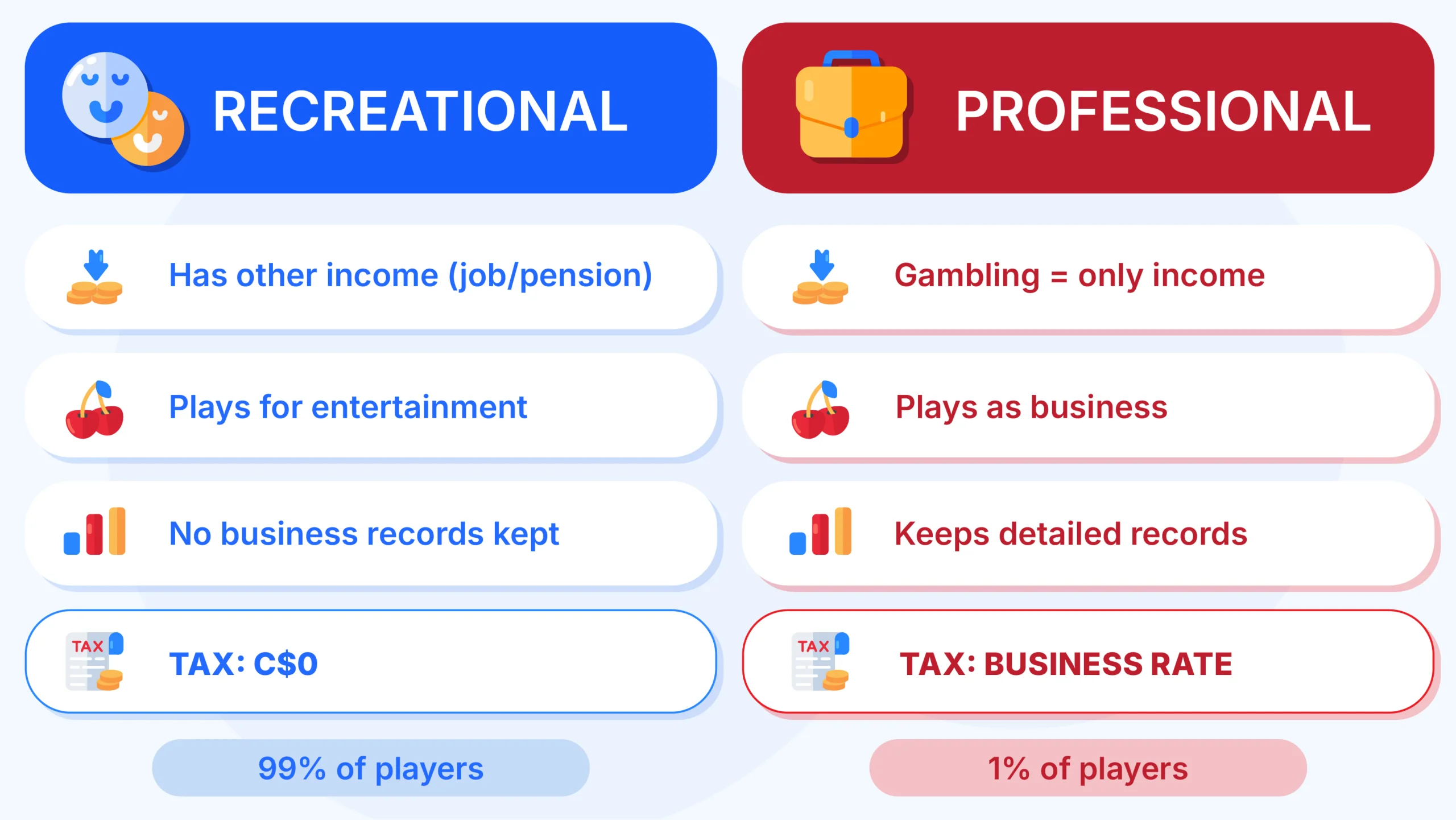
The Canada Revenue Agency defines recreational gambling as an activity that is done for entertainment purposes, hobby or leisure. When you treat it as a systematic business operation or your primary source of income, then it’s no longer a recreational activity.
Only 99%+ of all Canadian casino players
fall into the recreational category. Professional gambler status is extremely rare, and requires specific business like characteristics that just don’t apply to typical players.
What Are the Recreational Gambling Characteristics
All recreational gamblers share a few characteristics that distinguish them from professional gamblers. You’re gambling recreationally if you play mainly for enjoyment and entertainment purposes rather than this being your sole source of financial support. This applies even if you play weekly or monthly at licensed casinos.
Having a primary income source is the first indicator of recreational status. If you have income from employment, pensions, investments or business activities that are separate from gambling, you show proof that gambling is not your profession. The gambling activities are supplementary, they are not sustaining your lifestyle.
Recreational players also have a different conduct than professional gamblers. They don’t keep thorough records like a business operation, don’t advertise gambling services and also don’t coach others for fees. Basically, they don’t structure their activities with formal business planning.
Frequency and Amounts Don’t Change Your Status Automatically
You can play daily, even multiple times per day, and you will still be deemed to be a casual wagerer under gambling income tax rules. The CRA focuses on the purpose and nature of your activity, not how often you play.
The same concept applies for winning amounts. Even if you win C$1,000 or C$100,000 in a single session, it won’t make you a professional. Recreational players can have large wins and still keep their recreational status.
View Your Own Status
Is gambling your only way to make money? Most of the time, the answer is no. Many players have jobs, pensions, or other sources of income that pay for their daily costs.
Do you use the money you win from gambling to pay for your rent, mortgage, groceries, or other necessary bills? Most of the players don’t see gambling as a way to pay the bills; they see it as an unexpected bonus.
Do you treat gambling like a business by keeping loss statements, using a business name, or filing HST/GST returns? People who play for fun don’t use these strategies.
Do you offer gambling services, sell betting systems, or coach people for money? These are the things that make someone look like a professional, but most players just like to gamble for fun.
If you said “no” to most of these questions, you are a recreational gambler. This means that you don’t have to pay taxes on your casino winnings, no matter how often you play or how much you win.
Quality Check for Reassurance: Data from the Canadian gambling industry shows that 99.7% of online casino players are just doing it for fun. It’s very rare to be a professional gambler, and the CRA has to prove it.
#3 When the Gambling Income IS Taxable – the Case for Rare Professional Gambler
Professional gambler tax obligations exist for the rare players who operate gambling as a business rather than a hobby. Professional gamblers are required to report their winnings as taxable business income to CRA.
CRA Indicators for Professional Gambler Status
- Primary source of income:
if gambling is the only source of income to pay your bills, groceries, mortgage payments, with no employment or other income, CRA can examine whether gambling has become your profession
- Systematic and organized approach:
if you keep detailed records of loss and profit, tracking expenses for tax purposes, studying strategies as professional occupation, and approach gambling with business like format and planning
- Intent to make profit:
Professional gamblers see gambling as their career and the main aim is to generate income, not for entertainment purposes. This is verified from the behavior pattern that prioritizes consistent profit rather than enjoyment
- Sustained period: If you make gambling income over multiple years, not just from a single lucky year. It’s received as a professional activity rather than a temporary windfall.
Who Can Qualify as a Professional Gambler According to the Law
- Full-time poker players who travel to tournaments and receive their main income over significant periods of time may be considered professional gamblers according to the legal stipulations.
- Advantage players who use mathematical systems to gain edges can also be deemed to be professional gamblers.
- Sports bettors who use systematic mathematical methods designed to generate constant earnings can also qualify as professional wagerers.
- Online casino players are almost never qualified as professionals, due to the house edge mechanics in slots, roulette, and most casino games, which prevents profit in the long run.
Tax Obligations for Professionals
If you are classified as a professional gambler, you need to report the gambling income as business income on Form T2125 – Statement of Business Activities. The professional status allows you to deduct business expenses like travel costs, equipment and education against the gambling income.
Important to know:
the burden of proof falls under CRA. The agency must prove that your gambling is a business activity, you don’t need to prove recreational status.
Professional Classification Warning! If CRA ever classifies you as a professional gambler, but it’s very rare, you’d have to pay taxes on unreported income plus interest and potentially even penalties. But, for 99%+ of online casino players, this will not be the case.
#4 Rest of Canada Reality: International Licensed Casinos & Tax Treatment
Since most Canadians play at international licensed casinos, a common question arises: Are the winnings from Malta Gaming Authority, or Curacao licenses casinos taxes under different regulations than provincial sites? The clear answer is NO, the federal tax law applies regardless of casino license jurisdiction.
The Federal Income Tax Act applies the gambling tax law Canada for all provinces, your province of residence and the casino’s licensing jurisdiction don’t change anything.
British Columbia: Provincial vs International Options
British Columbia has PlayNow.com as the official BCLC – British Columbia Lottery Corporation platform. Winnings from PlayNow are not taxable. Still, many BC residents choose international licensed casinos in search for more game variety, better promotions and alternative banking methods.
British Columbia residents can see their BC casino selection with confidence that tax treatment doesn’t differ based on the casino choice.
Alberta: Limited Provincial Offerings Increase International Play
Alberta provides PlayAlberta as the AGLC – Alberta Gaming, Liquor and Cannabis Commission as its official platform, but the selection of games and offers it’s still limited compared to international casinos. As a result, many Albertans search for licensed casino options.
Winnings from PlayAlberta receive the same tax rules for income, zero fees.
Residents from Alberta can check Alberta casino sites knowing that casino tax Canada regulations don’t penalize if you choose international options rather than provincial platforms.
Saskatchewan, Manitoba & Atlantic Canada
These provinces don’t have online casino platforms run by the provincial government, making international licensed casinos the main, often the only, viable choice for online gambling. Residents from these provinces rely heavily on licensed operators under Curacao or Malta authorities. Recreational gambling activities from international casinos are not taxable, no matter the province you are from.
Key Takeaways for All Provinces
Your province of residence doesn’t change how the federal tax treatment is applied. The casino’s license jurisdiction Malta, Curacao, or provincial lottery corporation don’t matter for tax purposes. The Federal Income Tax Act applies to all gambling winnings across Canada.
Even if you play at provincial lottery sites or international licensed casinos, all recreational gambling winnings remain completely tax free, with no CRA reporting needed.
#5 Large Casino Winnings: What Happens if You Win C$50,000+
Hitting a major jackpot remains tax-free for recreational players, even if you win C$10,000 or C$500,000. The Federal Income Tax Act doesn’t charge winnings made from recreational gambling activities. But, large casino winnings Canada scenarios do involve several banking considerations that every Canadian player should understand before withdrawing their winnings.

Bank Scrutiny: Anti-Money Laundering Compliance
If you deposit C$10,000+ into your account, you should expect questions, not as an accusation, it’s standard Anti-Money Laundering (AML) compliance that all Canadian financial institutions need to follow. Banks must verify the source of large deposit amounts to prevent criminal proceeds from entering the banking system.
Your bank might or will ask you to prove where your funds came from. This is a normal question that everyone who makes a significant deposit, from casino winners to people selling cars or getting inheritances, has to answer. If you have the right paperwork, you’re all set.
Documentation to Have Ready
The verification process is quick if you are ready, legally speaking. When you withdraw money with Interac e-Transfer or another Canadian banking alternative, you need to have these papers ready.
- Casino account statements: these are essential because they have your deposit history, withdrawal history, and balance charges that clearly show that you are gambling legally.
- You should also have emails from the casino
confirming the cashout, which include transaction IDs, the amount you withdrew, and dates indicating the source of the funds.
- You will also need casino licence verification, which means that you need to screenshot the licensing level behind the casino you’ve played at. The casino licence verification is needed because they need to know if you played at a regulated site or not.
To show that you play for fun, the bank might also ask for more information, like game history logs that show different bet sizes and session lengths that are focused on entertainment.
FINTRAC Reporting: Threshold at C$10,000+
When someone makes a transaction of C$10,000 or more, banks automatically send a report to FINTRAC (Financial Transactions and Reports Analysis Centre of Canada). This is a required compliance, not a report to the CRA. The only thing that FINTRAC casino reporting looks for is signs of money laundering and terrorist financing.
When you take out C$50,000 from playing at licensed casinos, your bank sends FINTRAC a Large Transaction Report. This happens on its own, no matter where it comes from. Legitimate players with the right paperwork won’t have any problems. FINTRAC is only interested in money that comes from crime, not money that comes from legal gambling.
CRA Inquiry: Not Usual But Possible
There are rare cases where large deposits can trigger CRA inquiry separate from bank verifications. If contacted, explain that these are recreational gambling winnings, that are not taxable income under the Federal Income Tax Act. Provide the statements from the casino that prove recreational play patterns. The outcome of these inquiries are almost always positive, since winnings are not taxable.
Example of a Real Situation:
A player from BC wins C$75,000 on a progressive jackpot at a casino in Curacao that is licensed. He uses Interac e Transfers to take out C$3,000 in several transactions over the course of two weeks, which is within the casino’s withdrawal limits.
The bank wants to make sure you have a way to make money. The player shows their Curacao licence and account statements. The bank looks over the papers and then releases all the money within 24 hours. There is no need for the player to contact the CRA, and the only thing they have to do is give them the information in five minutes.
#6 Government Benefits Impact: EI, CPP, OAS & Child Benefits
This section offers relevant clarifications for Canadians receiving Employment Insurance, Canada Pension Plan, Old Age Security, Guaranteed Income Supplement or Canada Child Benefit.

Employment Insurance – EI
If you win money at gambling, you can still get Employment Insurance, but it doesn’t count as “income while on claim.” Casino winnings are not considered employment income or self-employment income by Service Canada. If you win C$5,000 or C$50,000 at a casino while getting EI benefits, the EI payments will not change.
Important: You must be ready to work and actively look for jobs. Gambling shouldn’t stop you from getting a good job, but it won’t hurt you to gamble for fun every now and then.
Canada Pension Plan – CPP
Your CPP benefits won’t change if you win money at the casino. Casino winnings won’t change your CPP retirement, disability, or survivor benefits.
Old Age Security – OAS
Your gambling winnings don’t count as income for OAS purposes, so they don’t change your OAS benefits. Your OAS eligibility and payment amount stay the same no matter how much you win at casinos.
Guaranteed Income Supplement – GIS
If you win C$20,000 at a casino, GIS calculations don’t count that as income, so your payments won’t go down based on income thresholds.
But having a lot of money in the bank is important: GIS does asset tests every year. If you win money at a casino and your total savings go over C$50,000, it could affect your GIS eligibility. The thresholds are different for each province and for each marital status.
Canada Child Benefit – CCB
When figuring out family net income for CBB purposes, winnings from gambling are not included. Even if you win a lot of money, the CBB payments stay the same. Service Canada figures out your CCB based on line 23600 of your tax return, which is your net income. This does not include any money you won from gambling for fun.
Provincial Income Assistance
Most provincial income assistance programs don’t count casino winnings as income that they have to report. These rules are a little different in each province, though. If you get help from the province and win a lot of money, make sure to read the rules about windfalls and asset limits in your own programme.
Important Benefit: Service Canada does not keep track of or record your gambling activities. If you win money at the casino and it raises your bank balance above the asset limit for the Guaranteed Income Supplement (GIS), then your benefits will change. Winnings are not considered income for any federal benefit calculations.
#7 International Licensed Casinos: Tax Treatment for Canadian Players
Canadians mostly play at international licensed casinos because they offer a wider range of games, better deals, and more ways to pay. But a lot of people want to know if winnings from casinos that are licensed by the Curacao eGaming, Malta Gaming Authority, or UK Gambling Commission are taxed differently than winnings from provincial sites.
No, the answer is no. The tax treatment for international casino winnings in Canada is the same as for provincial casino winnings. Recreational gamblers don’t have to pay any taxes, no matter where the casino is licensed.
CRA Perspective: Location Doesn’t Matter
When figuring out how much tax you owe, the Canada Revenue Agency doesn’t care about which casino licensing jurisdiction you’re in. They want to know what kind of gambler you are, whether you are a professional or just for fun. It doesn’t matter where you got your winnings licence from, whether it’s Curacao, Malta, British Columbia, or anywhere else.
The way you are taxed depends only on what you do. You don’t have to pay taxes on recreational gambling, whether you do it at a government-run provincial platform or at an international licensed casino.
Casino License Jurisdictions Explained
Works as a well-known licensing authority with years of experience regulating online gambling. If players choose Curacao sites, they don’t have to pay any Canadian taxes on their casino winnings as long as they are playing for fun.
- Malta Gaming Authority (MGA)
Has strict rules from the European Union and careful oversight of player protection. They own casinos that have strict rules about fairness, safety, and responsible gambling.Canadian recreational players at Malta casinos don’t have to pay any taxes. You don’t have to pay taxes on any of your winnings.
- Kahnawake Gaming Commission
This licence is held by many international online casinos and is located on Canadian First Nation land, close to Montreal. Even though it’s in a different place, the tax rules are still the same: no tax for recreational players.
PlayNow (British Columbia) and PlayAlberta (Alberta) are government-run platforms that offer the same tax-free winnings as international options for people who want to gamble for fun.
Tax Treatment: Identical Everywhere
The same federal tax law applies everywhere. You don’t have to pay taxes on money you win from recreational gambling, and the type of licence you have doesn’t change your tax obligations or categories. No matter where you look for licensed casino verifications or review the BC casino scene, the way taxes are handled is the same everywhere.
Legal Status Classification
There is no law in Canada that stops people from playing at licensed international casino sites. This is because provincial laws only apply to operators, not players. Players in Canada can legally use platforms from international casinos that have a licence. The tax implications stay the same: there are none for recreational gambling.
#8 Record Keeping for Casino Winnings
According to the CRA, you are not required to keep gambling records, since there is no reporting obligation for tax. But keeping basic records is a good way to protect yourself and also encourages responsible gambling.
4 Reasons to Track your Gambling Activity
This is rare, but CRA may occasionally make inquiries about large bank deposits as part of routine identification for income. If you have casino records you can prove instantly your recreational player status by showing infrequent large wins, instead of systematic business income patterns. Documentation proves all patterns of recreational activity by showing: mixed bet sizes, irregular winning sessions, and the entertainment focused play.
- Bank Compliance Simplification
As part of routine Anti-Money Laundering compliance, banks will routinely ask about the source of large deposits (C$10,000+). If you have the casino account statements and withdrawal confirmations, you can easily pass this verification, instead of being stuck waiting for casino information.
- Responsible Gambling Awareness
Written records make you aware of your budget, do you spend more than intended? You can spot early signs of problem gambling before any money problems arise by looking at real numbers. The CRA gambling guideline doesn’t say you have to do this, but it’s very helpful for keeping track of your casino activity.
Audit Period Retention/What to Track:
- Date of the transaction, name of the casino, and where the licence is held
- The amount of the deposit and the method of payment
- The amounts withdrawn and the method of payment used
- Net results, wins and losses per session
- You can choose to include the types of games played.
Tips: Keep records in password-protected files and back them up in cloud services like Google Drive and Dropbox so you can get to them easily.
#9 FINTRAC Reporting and Money Laundering Compliance
The Financial Transactions and Reports Analysis Centre of Canada (FINTRAC) is the country’s financial intelligence agency. Its job is to find people who are laundering money or funding terrorism. If you know how FINTRAC casino reporting works, you’ll be able to spot routine compliance steps right away.
The C$10,000 Reporting Threshold
If you make a single transaction or a series of transactions that total C$10,000 or more within 24 hours, FINTRAC will automatically send you a Large Cash Transaction Report. All Canadian casinos and institutions must follow this compliance reporting procedure.
How Reporting Works:
- On deposits: when you deposit more than C$10,000, the casino triggers an automatic FINTRAC report, as a compliance procedure
- On withdrawals: when you make a withdrawal of C$10,000+ to your bank account with Interac e-Transfer or wire transfer, your bank files a FINTRAC report. They might ask about fund sources as standard for the AML verification step.
- Critical fact: FINTRAC reports are not sent to CRA; these are separate authorities that have different mandates. FINTRAC monitors financial crimes; CRA handles taxation.
What FINTRAC Monitors
FINTRAC is responsible for looking for signs of money laundering, like making large deposits and small withdrawals, or structuring many transactions just below C$10,000 to avoid reporting. They also monitor activities related to terrorist financing, which are not associated with legitimate entities.
Legitimate Player Impact
Every year, Fintrac gets millions of routine reports, and regular casino play doesn’t cause any problems. The backend systems independently manage the reporting process, and they won’t notify you upon completion. These compliance reports prevent the CRA from conducting audits or suspecting any irregularities.
Red Flags to Avoid
To stay in compliance, you should not do the following:
- Avoid creating multiple accounts at the same casino.
- Don’t set up multiple C$99,999 deposits to navigate around the C$10,000 limits. This isn’t allowed.
- To deposit and then withdraw with minimal play. This is money laundering.
- The act of using someone else’s account or card to make a payment on their behalf is considered a red flag.
Legitimate Player Advice
When you sign up for a casino, only use banking methods that have your name on them. Play normally, don’t take your money out right away, and keep casino statements that show you are really gambling.
FINTRAC Policy:
Canadian casino players don’t have to worry. Normal play patterns don’t trigger any investigations. FINTRAC is only looking for signs of financial terrorism or money laundering. They don’t keep track of taxes on winnings.
The possibility of a CRA inquiry is less than 1% for recreational players. Still, it’s essential to understand the process in case it will happen if CRA casino winnings questions ever are made.
What triggers CRA Attention
- If you have large deposits that don’t match the income you reported on your tax returns, this could lead to a verification inquiry.
- If your T4 shows C$45,000 in employment income but your account gets C$75,000 in deposits, the CRA system can flag this difference for routine verification.
- The CRA may also ask questions about sudden changes in wealth, like buying a new car or a house or living a lifestyle that doesn’t match the income you reported.
Context Clarification: This isn’t an accusation; it’s just a question about your income. The CRA’s gambling audit process is meant to find out where the money comes from, not to punish people who are just having fun.
How to Respond in 4 Steps
Step 1: Don’t Panic: If you receive a CRA casino inquiry letter, you shouldn’t think that you have done something wrong. CRA verifies that deposits match legitimate non-taxable sources, and it’s a routine verification done only on a small number of players.
Step 2: Provide Detailed Documentation
- Make casino account statements that show deposits, cashouts, and patterns in game history.
- Include emails confirming withdrawals with transaction IDs, amounts, and dates as well.
- Include the T4 slips from your job records that show your main source of income is from work, a pension, or a separate business, and not gambling.
- Show that wins don’t happen very often, which proves the activity is for fun.
- Include a check of your casino licence to make sure you used a real MGA, Curacao, or other licensed site.
Step 3: Respond Fast: Reply in the time provided by them, most common in 30 days from the letter date. You need to attach documentation that proves your recreational player status and that you did legal gambling activities.
Respond clearly: “These deposits represent recreational casino winnings and are not taxable income under the Federal Income Tax Act.”
Step 4: Take into Consideration Asking for Professional Help: You can easily handle simple cases where you can show that you are a recreational gambler by sending in the right paperwork. But complicated cases with a lot of money, multiple sources of income, and uncertainty about whether the person is a professional or a recreational user may benefit from talking to a CPA. However, most cases are resolved without the help of an accountant.
Likely Outcome:
CRA reviews your documents and confirms recreational player status, and no taxes are owed, resulting in the inquiry being closed. The majority of recreational gamblers have a quick and favourable resolution.
#11 Cryptocurrency Casino Winnings and Canadian Tax
Bitcoin and cryptocurrency casinos are popular among Canadian gamblers, but are cryptocurrency casino winnings tax obligations any different from the rest? The clear answer is NO. The winnings from cryptocurrency casinos remain tax-free.
Simple Crypto Example: You win 1 BTC worth C$60,000 at win time, as a player with recreational status, you don’t pay taxes. The currency form doesn’t change the recreational status under bitcoin casino tax Canada rules.
Capital Gains Complexity
It gets complicated if you hold cryptocurrency. Let’s say you keep 1 BTC and value rises to C$80,000 resulting in C$20,000 capital gain. CRA taxes 50% of capital gains, resulting in C$10,000 that is taxable income.
This is different from gambling, the C$60,000 from the casino remains tax free, but the C$20,000 appreciation is the taxable cryptocurrency investment gain.
Recommendation: Convert crypto winnings to C$ currency as soon as you can, to avoid the capital gains complexity. If you want to invest in Bitcoin, it’s better to purchase it separately.
CRA Perspective
CRA sees cryptocurrency as a commodity and gambling principles remain the same. Recreational gambling activities are tax free, no matter the currency. Crypto gambling CRA position follows tax-free recreational treatment consistency.
Tips: Keep track of your exchange rates at win time for C$ equivalent documentation. Keep records of every conversion transaction because crypto requires more detailed tracking due to conversion exchange.
Legal Disclaimer
This article tackles general information about Canadian gambling tax laws based on current CRA guidelines, it’s not a personalized legal or tax advice.
Tax situations are different, for specific advice and recommendations, consult with a qualified CPA or lawyer.
CasinoAlpha CA is not responsible for actions based on this information, the law changes, always verify the current regulations with CRA or a tax professional.
Sources: